
North Korea leader’s sister hails Seoul’s pledge to prevent drone incursions, vows stronger border vigilance: KCNA
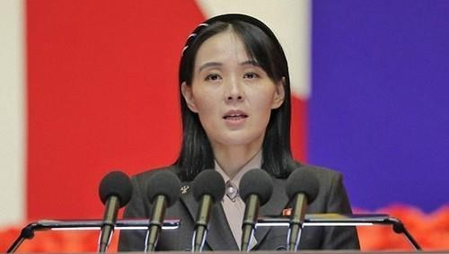
Seoul, Feb 19 (IANS) The powerful sister of North Korean leader Kim Jong-un said on Thursday she 'highly appreciates' South Korea's pledge to prevent a recurrence of drone incursions into the North, vowing to step up the country's vigilance along the border with the South.
Kim Yo-jong, a party vice department director, issued the statement via the Korean Central News Agency (KCNA) a day after Unification Minister Chung Dong-young expressed 'regret' over drone incursions into the North and announced a series of measures aimed at preventing a recurrence.
"I highly appreciate Chung Dong-young, minister of unification of the ROK, officially acknowledged the ROK-born drone's provocative intrusion into the airspace of our country, expressing regret once again and willingness to prevent a recurrence," Kim said in the statement.
ROK stands for the Republic of Korea, South Korea's official name.
At a press conference the previous day, Chung acknowledged that, based on the results of an investigation, drones were sent to the North by South Korean individuals four times between last September and February, including two occasions confirmed by the North.
Chung said Seoul will review and seek to reinstate the suspended 2018 military pact with North Korea, aimed at halting hostilities along the inter-Korean border and between their militaries, including a no-fly zone, as part of measures to prevent a repeat of drone incursions into the North.
In January, Pyongyang accused Seoul of sending drones equipped with surveillance equipment in September and on January 4, prompting the South Korean government to launch an official investigation.
Kim warned South Korea will face 'terrible consequences' if such a 'violation of the sovereignty' reoccurs, "no matter whom the mastermind is and by what means it is carried out. This is not a threat but a strong warning."
She claimed that guaranteeing the prevention of repeated violation of North Korea's sovereignty is "entirely for the ROK's existence."
She also warned the border with the "enemy should be firmly guarded," adding, "Our military leadership will take a step for heightening vigilance in all sectors along the southern border with the ROK."
At a year-end party meeting in December 2023, the North's leader Kim Jong-un declared inter-Korean relations as those between "two states hostile to each other" and has since pursued hostile policies toward Seoul, Yonhap news agency reported.
An official at the South Korean unification ministry said the ministry 'takes note' of North Korea's "prompt" response to Chung's statement, reiterating Seoul's determination to 'responsibly' pursue the prevention measures announced the previous day.
--IANS
jk/
Murder-for-hire case: US court accepts guilty plea of Nikhil Gupta; sentencing on May 29
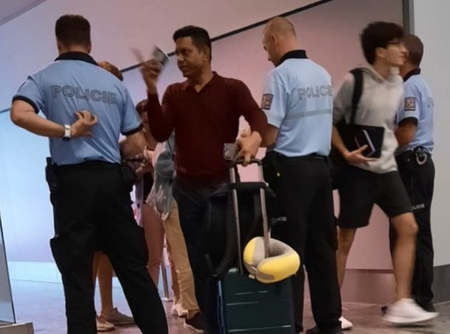
Washington, Feb 19 (IANS) Nikhil Gupta now formally stands convicted in a US federal court after a Manhattan judge accepted his guilty plea in a murder-for-hire conspiracy targeting a Sikh separatist leader in New York -- a case that carries a maximum exposure of 40 years in prison.
On February 17, US District Judge Victor Marrero issued an order accepting Gupta’s guilty plea after reviewing the transcript of his allocution before Magistrate Judge Sarah Netburn.
Gupta, 54, had stood in court last week and admitted under oath that “in the spring of 2023, I agreed with another person to have another individual murder a person in the United States,” and that he “had delivered $15,000 in cash via cellular phone to another individual in the United States”.
During questioning, he acknowledged that he knew the intended victim was in New York -- “In Queens especially” -- and that the payment recipient was in Manhattan.
He pleaded guilty to conspiracy to commit murder-for-hire and conspiracy to commit money laundering. The government formally requested that Judge Marrero accept the plea in a filing submitted the same day.
With the district court’s order now entered, Gupta’s conviction is official, and the case moves squarely into the sentencing phase.
Under federal law, Gupta faces up to 10 years each for conspiracy to commit murder-for-hire and for murder-for-hire, and up to 20 years for conspiracy to commit money laundering, for a total statutory maximum of 40 years.
However, federal sentencing is guided by advisory Sentencing Guidelines rather than statutory maximums alone. In a Pimentel letter filed prior to the plea, prosecutors calculated Gupta’s advisory sentencing range at 235 to 293 months in prison.
During the plea hearing, the court made clear that the guidelines are advisory and that the final sentence will be determined solely by Judge Marrero after reviewing a Presentence Investigation Report.
Sentencing has been scheduled for May 29 at 10 a.m.
Gupta confirmed in court that he is a citizen of India and understood that his guilty plea would likely result in removal from the United States. The government’s sentencing submission states that removal is presumptively mandatory for non-citizens convicted of such offences.
--IANS
lkj/dpb
US military buildup raises Iran strike concerns: Report

Washington, Feb 19 (IANS) The rapid buildup of US forces in the Middle East has progressed to the point that President Donald Trump has the option to launch military action against Iran as soon as this weekend, a newspaper reported, citing administration and Pentagon officials.
According to a report in The New York Times on Wednesday (local time), the military posture now allows Trump to strike Iran’s nuclear program, ballistic missiles and launch sites. However, the President “has given no indication that he has made a decision about how to proceed.”
The buildup has continued despite indirect talks between Washington and Tehran in Geneva on Tuesday. Iran’s Foreign Minister said there was agreement on a “set of guiding principles.” US officials said the two sides made progress but acknowledged that significant gaps remain.
Trump has repeatedly demanded that Iran give up its nuclear program, including agreeing not to enrich uranium. He has warned that Iran must meet his terms or face severe consequences.
White House press secretary Karoline Leavitt said the President still prefers negotiations. “The President has always been very clear, though, with respect to Iran or any country around the world, diplomacy is always his first option, and Iran would be very wise to make a deal with President Trump and with this administration,” she said.
“He’s always thinking about what’s in the best interest of the United States of America, of our military, of the American people, and that’s how he makes decisions with respect to military action,” she added.
The New York Times reported that the military buildup includes more than 50 additional fighter jets, dozens of refuelling tankers, and two aircraft carrier strike groups. The USS Gerald R. Ford was approaching Gibraltar as it headed to join the USS Abraham Lincoln in the region.
US officials said the deployment also includes Patriot missile defence systems and Terminal High Altitude Area Defense (THAAD) systems, designed to intercept Iranian ballistic missiles.
Additional F-35, F-22 and F-16 fighter jets have moved from the United States to Europe and onward to the Middle East. Refuelling aircraft necessary for sustained air operations have also been repositioned, the daily reported.
One military official told the newspaper that the US could now defend its troops, allies and assets from Iranian retaliation, at least during a short campaign. But the official cautioned that it remains unclear whether the military is prepared for a prolonged and wider war.
Israeli forces are also preparing for possible joint action. According to Israeli defence officials cited by the newspaper, planning envisions delivering a severe blow over several days to force Iran into concessions at the negotiating table.
Trump struck three Iranian nuclear sites last June during a 12-day conflict. At the time, he declared Iran’s nuclear program had been “obliterated.” He is now weighing whether to resume military action.
Senior national security officials have told the President that any operation aimed at changing Iranian leadership is not guaranteed to succeed, the report said.
--IANS
lkj/sd/
US accuses China of yield-producing nuclear test, warns of ‘intolerable disadvantage’
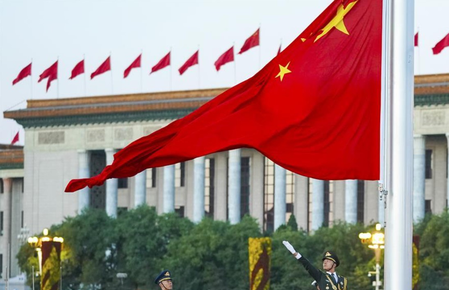
Washington, Feb 19 (IANS) The United States has accused China of conducting a “yield-producing nuclear test” in 2020 and warned that Washington will no longer remain at an “intolerable disadvantage” as President Donald Trump pushes for a new multilateral arms control agreement.
Assistant Secretary of State for Arms Control and Non-Proliferation Christopher Yeaw told a Washington audience on Wednesday (local time) that the US government is “aware that China conducted one such yield-producing nuclear test on June 22, 2020,” near the Lop Nur test site.
“We are aware of yield-producing nuclear explosive testing in China,” Yeaw said at the Hudson Institute. “China has used decoupling, a method to decrease the effectiveness of seismic monitoring to hide its activities from the world.”
He cited seismic data showing a “2.75 magnitude” reading at “09:18 Zulu, Greenwich Mean Time,” detected at a Kazakhstan monitoring station. “There is very little possibility, I would say, that it is anything but an explosion. A singular explosion,” he said.
Yeaw added that the exact yield could not be determined because of decoupling techniques. “What the yield was is impossible to tell,” he said. “That it was super critical, that it was yield producing, is pretty obvious from the seismic graphs.”
China has not publicly acknowledged such a test. Yeaw said Beijing has relied on “opacity, silence, obfuscation, and deflection.”
The remarks come days after the expiration of the New Strategic Arms Reduction Treaty, or New START. Yeaw called the treaty flawed because it “constrained the United States while allowing China to remain completely unconstrained.”
“Only two blocks out of six were captured by the treaty,” he said, referring to US and Russian intercontinental warheads. “That’s a problem. That’s a big problem.”
He described China’s nuclear buildup as “geometric” and said it was expanding “by leaps and bounds.” Quoting a former US commander, he said that the growth was “breathtaking and maybe even beyond breathtaking.”
Yeaw stressed that Article VI of the Nuclear Non-proliferation Treaty (NPT) obligates all nuclear-weapon states to pursue disarmament talks. “I don’t see anywhere in Article VI a special caveat or assignment to the United States and Russia for special responsibility in this matter,” he said.
President Trump, he said, wants “a better agreement” and is offering China an opportunity to join “multilateral strategic stability talks.” “America first arms control cannot and does not mean America only arms control,” he said.
On nuclear testing, Yeaw cited Trump’s pledge to return to testing on an “equal basis.” He clarified that this did not mean a return to large atmospheric tests. “Equal basis doesn’t mean we’re going back to Ivy Mike-style atmospheric testing,” he said.
He quoted former US Ambassador Robinson, who warned that if adversaries test at yields that cannot be detected while Washington maintains strict limits, the United States would face “an intolerable disadvantage.”
Asked whether Washington had raised the issue with Beijing and Moscow, Yeaw said, “They have received cables from us, yes.” He added that he hoped for “productive discussions” in Geneva and Vienna.
Yeaw also linked arms control to extended deterrence. “In extending deterrence to our allies… the United States is doing more for non-proliferation than frankly, almost any other tool,” he said.
New START, signed in 2010, capped deployed US and Russian strategic nuclear warheads and delivery systems. It expired after a five-year extension, amid worsening US-Russia ties over Ukraine and broader strategic tensions.
The NPT Review Conference is scheduled for April. Washington is expected to press all nuclear-weapon states, including China, to engage in what Yeaw called “good-faith negotiations toward disarmament,” as global concerns grow over renewed nuclear competition among major powers.
--IANS
lkj/sd/
India-US trade deal unlocks big gains: Expert (IANS Interview)
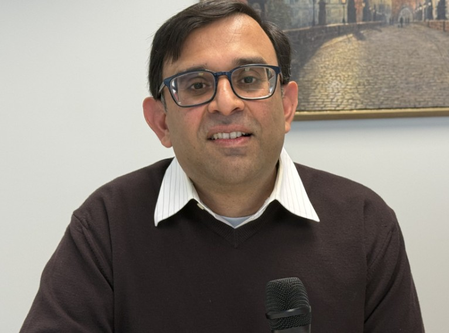
Washington, Feb 19 (IANS) The newly announced India-US trade framework is a “positive development” that could unlock significant export gains for both countries, deepen supply chain integration, and inject fresh momentum into the broader strategic partnership, a former US Commerce Department official said.
Atman Trivedi, Partner at DGA-Albright Stonebridge Group, who was Senior Director for Policy in Global Markets at the US Commerce Department and played a central role in creating the US-India Strategic and Commercial Dialogue, said the agreement opens new space for businesses on both sides.
“It’s a positive development. The trade deals should unlock significant export gains for both countries, help small and medium-sized entrepreneurs in both markets,” Trivedi told IANS in an interview.
He said the framework opens key sectors on both sides. “For the US side, it opens up key Indian areas, all industrial goods, and a number of other sectors as well. For India, it presents the opportunity to make good on the Prime Minister’s manufacturing goals, help make an India where US exports should increase.”
He added: “We’ll see more Indian products coming into the US, which is already India’s largest export market. That should be a boost for making in India for the world.”
For the US, the deal lowers long-standing tariff barriers in the Indian market. “Historically, the average applied tariff rates have been high in India. Those reduced barriers should make it easier for US businesses of all varieties to sell into India’s market, the largest in the world, of course, by population,” he said.
From India’s perspective, Trivedi described it as “a tremendous opportunity.” He pointed to expanded market access “for textiles, for critical items like gems and jewellery, for leather.” He said it was “a big opportunity from an Indian perspective to sell more into what is already India’s largest global market for India’s products.”
On trade-offs, he said India made “a significant give” by reducing tariffs, in some cases “going to zero on industrial goods.”
The US, he said, agreed “to go from 50 per cent tariffs very high down to 18 per cent.”
That shift gives India a competitive edge. “Countries like Vietnam, Malaysia, Indonesia, Bangladesh, and Pakistan all face higher tariffs on their exports to the US than India does. So that’s a significant advantage going forward,” he said.
He argued that opening India’s market would help integrate it more deeply into global supply chains and “reduce its dependencies on other countries that have a more adversarial relationship with India.”
The agreement also sets ambitious purchase targets, including India’s commitment to buy goods and services worth $500 billion. Trivedi said energy and defence would be central.
“I think India will purchase more energy, more defence acquisitions, given our countries have a common strategic view of the Indo-Pacific region,” Trivedi said.
He also flagged “civilian aircraft… things like Boeing planes” and industrial segments.
But he cautioned that the target is steep. As of 2024, India imported over $ 87 billion in US goods. And so to get to 500 billion in five years, that’s going to require a significant effort.”
“Whether we can get to 500 billion in 5 years remains to be seen,” he said.
Beyond tariffs, Trivedi said non-tariff barriers remain a concern for US firms in India, including “compulsory licensing requirements or conformity assessment rules, standards challenges… localisation requirements.”
On the Indian side, the friction lies more in “services, mobility, and issues of workers having skilled workers having greater access to the US economy.”
On H-1B visas, he noted the political sensitivity. “Even legal immigration and skilled immigration have become an issue. I don’t know whether we’ll see that tackled in the bilateral trade discussions. But it’s an issue… in the broader relationship. Certainly.”
Asked why negotiations took so long, Trivedi cited longstanding trade differences and geopolitical disruptions, including the May conflict between India and Pakistan, which he said “took us off track.”
Looking ahead, he expects renewed momentum. “I expect to see more momentum in the relationship. I think this is a positive step,” he said.
He predicted spillover into “technology cooperation,” “defence cooperation,” and “energy cooperation,” and said there was “opportunity to accelerate on, on areas that had slowed down because these trade differences consumed so much of the agenda.”
The United States and India have steadily expanded their economic and strategic engagement over the past two decades, with bilateral trade reaching record levels in recent years. Trade has often been a friction point, even as defence and technology ties deepened.
Both governments have described each other as key partners in the Indo-Pacific. The latest trade framework is being viewed as an effort to align economic cooperation more closely with their strategic convergence.
--IANS
lkj/sd/
Trump praises Indian American Harmeet Dhillon at White House event
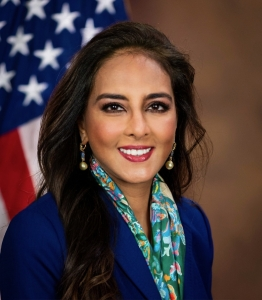
Washington, Feb 19 (IANS) US President Donald Trump marked Black History Month at the White House, using the occasion to highlight his record on criminal justice reform, the economy, and public safety -- and to praise Indian American leader Harmeet Kaur Dhillon from the stage.
“This is a nice, full room,” Trump said as he opened the reception on Wednesday (local time), calling the centennial observance of Black History Month “a big deal, 100th. That’s sort of special.”
The President began by paying tribute to the late civil rights leader Jesse Jackson. “He was a piece of work, but he was a good man,” Trump said. “I just want to pay my highest respects to Reverend Jesse Jackson.”
As he moved through a long list of guests and officials, Trump turned to legal battles involving Harvard and other institutions and said, “Harmeet is on their trail, right?” -- a reference to Harmeet Dhillon, who serves as US Assistant Attorney General for the Civil Rights Division.
Dhillon, an Indian-American lawyer born in 1969, was appointed to the role in 2025. She previously served as vice chair of the California Republican Party and as the Republican National Committeewoman for California. Her elevation to a top Justice Department civil rights post has made her one of the most senior Indian Americans in the Trump administration.
Trump used the event to reiterate what he described as key accomplishments for Black Americans. “I signed historic criminal justice reform into law,” he said, referring to the First Step Act enacted during his first term. “Just so you know, for 30 years, more than any other group of people, have been trying to get criminal reform, and they couldn’t do it.”
He also pointed to long-term funding for historically Black colleges and universities. “Black Americans single-handedly secured record-long-term funding for, I told you, the historically black colleges and universities,” Trump said. “I created nearly 9,000 opportunity zones with our great secretary.”
On the economy, Trump argued that the United States was outperforming the rest of the world. “We’re the hottest country right now anywhere in the world,” he said. “The stock market has hit 53 all-time record highs since the election.”
He added, “More Americans are working today than at any time in American history,” and said wages were rising faster than inflation.
The reception also featured remarks from Alice Marie Johnson, whose life sentence for a nonviolent drug offence was commuted during Trump’s first term.
“Only in America could there be a story like my story,” she said. “This president right here, President Donald Trump, brought me from the prison pit to the White House.”
Johnson added, “Don’t let anyone tell you that this president right here, Donald Trump, has not -- is not for Black America.”
Trump said, “We celebrate Black History Month. We honour the memory of those who came before us by continuing their legacy and fighting for an America that’s -- really an America that’s safe and strong and prosperous.”
For Indian audiences, Dhillon’s mention at a major White House event underscores the growing presence of Indian Americans in influential positions across US administrations, including in sensitive portfolios such as civil rights enforcement.
Black History Month is observed every February in the United States to recognise the contributions of African Americans to American history.
--IANS
lkj/sd/
US Senator moves to end China visa waiver
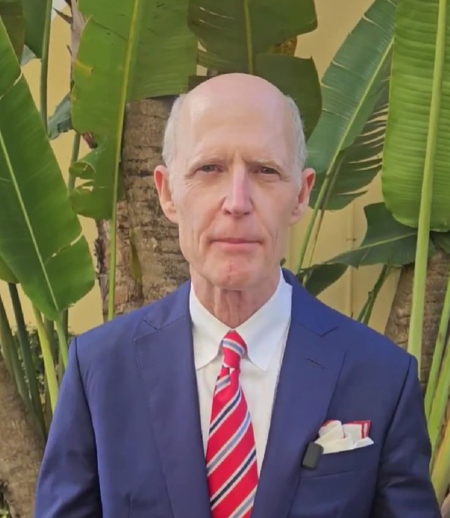
Washington, Feb 19 (IANS) US Senator Rick Scott has introduced legislation to bar Chinese nationals from entering any part of the United States without a valid visa, targeting a visa-waiver program that allows travel to American Pacific territories.
Scott said his One Nation, One Visa Policy Act would prohibit “Communist Chinese nationals from entering the United States without a valid visa and barring them from participating in any visa-free travel program, including the Guam–Commonwealth of the Northern Mariana Islands Visa Waiver Program.”
The move follows what Scott described as “horrific reports” of exploitation of an Obama-era program that allows visa-free access to the Commonwealth of the Northern Mariana Islands (CNMI).
“Communist China has a track record for exploiting America’s weaknesses to advance its interests and undermine our national security, and the horrific reports of how they have exploited an Obama-era visa program are a prime example,” Scott said.
“This program provided Chinese nationals a visa-free fast-track to US territories, allowing them to establish a backdoor breeding ground to infiltrate our nation,” he added.
Scott said his bill “makes it crystal clear that no part of the United States, including our territories, will be abused by Communist China.”
“It’s time to shut Communist China’s back door into our nation by eliminating this reckless program and ensuring the full vetting of any Chinese national who wishes to come to our nation,” he said.
In a January 15 letter to Homeland Security Secretary Kristi Noem and Interior Secretary Doug Burgum, Scott and fellow Senators Jim Banks and Markwayne Mullin urged the administration to end what they called a “lingering Obama- and Biden-era policy” allowing Chinese nationals “to obtain fast-track American citizenship.”
“This is a clear and significant short- and long-term national security risk,” the senators wrote.
The letter cited a “Wall Street Journal investigation” that “highlights a related national security concern: Chinese nationals are increasingly using the US surrogacy system to obtain American citizenship for their children, often outside traditional immigration vetting processes”.
It noted that in 2009, “former President Obama created a categorical parole program that enabled Chinese nationals to visit the Commonwealth of the Northern Mariana Islands (CNMI) without a tourist visa and the vetting that entails”.
The Guam-CNMI Visa Waiver Program “allows holders of a Hong Kong passport visa-free access to the CNMI for up to 45 days at a time,” while a 2024 Biden administration program “also allows Chinese nationals visa-free access to the CNMI for 14 days,” the senators wrote.
According to the letter, “birth tourism in Saipan has exploded,” with births by visiting Chinese mothers rising from “fewer than 10 annually in 2009 to nearly 600 by 2018”.
The senators also alleged that some Chinese nationals had used visa-free travel to attempt unlawful entry into other parts of the United States, citing federal prosecutions related to smuggling operations between Saipan and Guam.
The CNMI is a US territory in the western Pacific. Under current rules, certain foreign nationals can enter under special visa-waiver arrangements unique to the territory.
The Guam-CNMI Visa Waiver Program was created in 2009 to promote tourism and economic activity in the islands. US territories fall under federal immigration law but may have limited, territory-specific travel provisions approved by the Department of Homeland Security.
--IANS
lkj/sd/
Lula’s India visit will elevate ties to deeper economic, strategic partnership: Expert (IANS Interview)
Washington, Feb 19 (IANS) Brazilian President Luiz Inacio Lula da Silva's visit to India for the ongoing AI Impact Summit, followed by a full-fledged state visit, signals a deliberate attempt by the two largest democracies of the Global South to elevate ties beyond multilateral coordination and into a deeper economic and strategic partnership, a senior US-based economist working on India-Brazil ties has said.
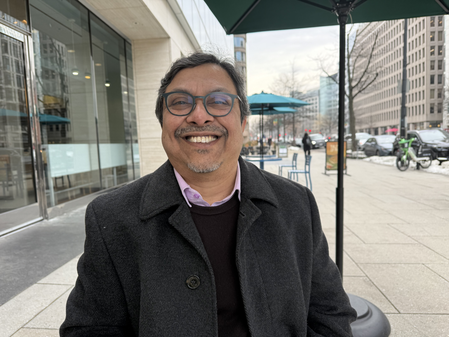
"This Brazil visit is very significant," said Dr Anit Mukherjee, Senior Fellow at ORF America, who is working on the India-Brazil relationship, told IANS on Wednesday (local time).
He noted that Prime Minister Narendra Modi had travelled to Rio de Janeiro last year for the BRICS summit, followed by a state visit.
Lula is accompanied by "14 other ministers of his cabinet, nearly half his cabinet and 150 business leaders", Mukherjee said. That, he added, "is a signal that the Brazil-India relationship is not just about coordination and G20 or BRICS, but will move towards a more strengthened partnership in trade, in investment, in manufacturing, in services, and also in other spheres."
Mukherjee said the relationship was not always robust. "I think the relationship between Brazil and India historically has not been very strong," he said.
But he traced a turning point to the early 2000s. "When President Lula came to power in 2001, he had the vision of bringing together the three large developing countries, Brazil, India, and South Africa," he said. That effort led to IBSA and later BRICS, laying "a strong foundation of trust in their relationship mostly through high-level exchanges."
He argued that the two countries now have a broader economic agenda. "Brazil and India are the two largest democracies of the global south. They are growing economies. They have a large young population. They also have quite a lot of technical capacity," he said.
He pointed to Brazil as "an agricultural powerhouse" and highlighted Embraer as "the third largest civilian plane manufacturer in the world". On the Indian side, "Bajaj and Mahindra, two large Indian conglomerates… have opened factories in Brazil manufacturing motorcycles and tractors", he said. Indian IT firms "like TCS and Infosys… have a relationship with the Brazilian market."
"Digital public infrastructure is another emerging area. India has the Unified Payments Interface, which is the world's largest instant payment system. Brazil has a very similar system built on digital public infrastructure called PIX," Mukherjee said. Together, he said, the systems "are going to do about 1 billion transactions per day, which is nearly similar to what MasterCard and Visa do per day."
On people-to-people ties, he said the Indian community in Brazil is "about 4,000 non-resident Indians who live there," but "it is growing". He also pointed to cultural links. "Yoga is very big in Brazil. So is Ayurveda," he said.
India and Brazil are key members of BRICS and the G20, often coordinating positions on development finance, trade reform, and Global South priorities. Both have pushed for reform of multilateral institutions and a greater voice for emerging economies in global governance.
Trade between the two countries has expanded steadily over the past decade, spanning agriculture, energy, pharmaceuticals, automobiles, and information technology, even as both seek to diversify supply chains and deepen South-South cooperation amid shifting geopolitical alignments.
--IANS
lkj/sd/
Trump warns UK not to give up Diego Garcia
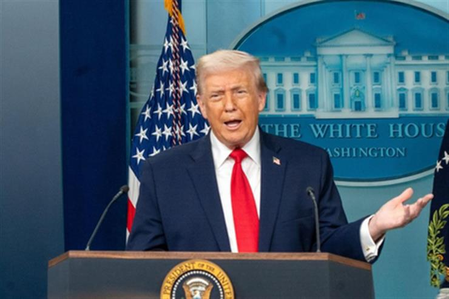
Washington, Feb 19 (IANS) US President Donald Trump has publicly urged British Prime Minister Keir Starmer not to proceed with what he described as a “100-Year Lease” arrangement with Mauritius involving Diego Garcia, the strategic Indian Ocean island that hosts a key joint US–UK military base.
In a Truth Social post, Trump said, “Leases are no good when it comes to Countries,” and warned that Starmer was “making a big mistake by entering a 100 Year Lease with whoever it is that is ‘claiming’ Right, Title, and Interest to Diego Garcia.”
“Our relationship with the United Kingdom is a strong and powerful one, and it has been for many years,” Trump wrote. But he added that the British leader was “losing control of this important island by claims of entities never known of before. In our opinion, they are fictitious in nature.”
Linking the island directly to regional security, Trump said: “Should Iran decide not to make a Deal, it may be necessary for the United States to use Diego Garcia, and the Airfield located in Fairford, in order to eradicate a potential attack by a highly unstable and dangerous Regime -- An attack that would potentially be made on the United Kingdom, as well as other friendly Countries.”
He cautioned that “Prime Minister Starmer should not lose control, for any reason, of Diego Garcia, by entering a tenuous, at best, 100 Year Lease,” and added: “This land should not be taken away from the UK and, if it is allowed to be, it will be a blight on our Great Ally.” He ended with a blunt appeal: “DO NOT GIVE AWAY DIEGO GARCIA!”
The remarks come a day after the State Department confirmed that the United States and Mauritius will hold bilateral discussions in Port Louis from February 23–25. The talks will be led by the Bureau of Political-Military Affairs, with participation from across the US interagency.
The department said the discussions “underscore the continued importance of the Chagos archipelago and the joint US–UK base on Diego Garcia to our national security.” It said the meetings would focus on “bilateral security cooperation and effective implementation of security arrangements for the base to ensure its long-term, secure operation.”
The United States also stated that it “supports the decision of the United Kingdom to proceed with its agreement with Mauritius concerning the Chagos archipelago.”
It reiterated its desire “to conclude a bilateral agreement with the United Kingdom to guarantee continued use of basing and other facilities in the Chagos archipelago to advance US national security, as well as security and stability across the Indian Ocean.”
At her daily press briefing, White House Press Secretary Karoline Leavitt was asked whether Trump’s post suggested a change in US policy after the State Department indicated support for the UK’s move.
“The post should be taken as the policy of the Trump administration,” Leavitt said. “It’s coming straight from the horse’s mouth. When you see it on Truth Social, you know it’s directly from President Trump. That’s the beauty of this president in his transparency and -- and relaying this administration’s policies to all of you and to the rest of the world.”
The Chagos archipelago, including Diego Garcia, has been the subject of a long-running sovereignty dispute between the United Kingdom and Mauritius. Diego Garcia hosts a major joint military facility that has supported US operations in the Middle East and across the Indo-Pacific.
Its location in the central Indian Ocean gives it strategic value for power projection, maritime security, and regional deterrence -- issues closely tracked in New Delhi as India deepens its engagement in the Indo-Pacific and monitors shifts in US–UK–Mauritius arrangements affecting the region.
--IANS
lkj/sd/
From Lucknow to NASA: A space odyssey
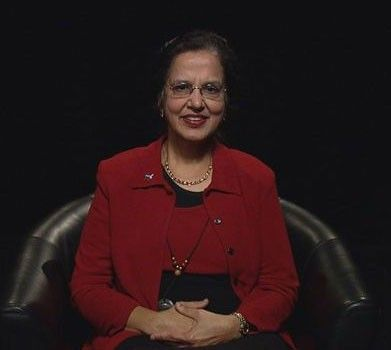
Washington, Feb 19 (IANS) A seven-year-old girl in Lucknow stood in her backyard at dawn in October 1957, watching Sputnik streak across the sky. Nearly seven decades later, that child would help steer some of NASA’s most complex space telescopes, from Hubble to James Webb.
“The story starts in October 1957, when I was 7 years old, and my grandmother ordered the entire family, including my 3-year-old sister, all the servants and their families, to collect at dawn in the backyard of the home and watch Sputnik pass by the clear night skies of Lucknow,” Hashima Hasan wrote in a personal account released by NASA on Wednesday.
“That morning, as I saw Sputnik and the dark, starry sky, I dreamt the impossible dream that one day I would be a space scientist.”
Hasan went on to win a scholarship to the University of Oxford, earning a doctorate in theoretical nuclear physics in 1976. “The path to a traditional academic career for a female scientist was fraught with challenges, exacerbated by social pressures,” she said. After post-doctoral work and a faculty position across three continents, she moved to the United States in 1985 with her husband and two infant sons.
At the Space Telescope Science Institute in Baltimore, she accepted a research position to write software to simulate the optics of NASA’s newest telescope, the Hubble Space Telescope. Under Dr Christopher Burrows, she wrote the Telescope Image Modelling (TIM) software.
“Little did we know that after the launch of Hubble, TIM would be instrumental in our analysis of the first images, the identification and characterisation of the spherical aberration, monitoring the focus of the telescope, and image simulations to enable scientists to analyse their aberrated data,” she wrote.
Hasan was appointed as the Optical Telescope Assembly scientist. She said she had “the dubious distinction of being the first and only OTA scientist whose task was to keep the Hubble ‘in focus’ until a fix could be designed.” Every three months, adjustments were needed to maintain the telescope’s best focus.
“I am proud to be a part of the NASA team that turned adversity to victory. The story of Hubble is a tribute to NASA’s ‘can-do’ attitude,” she said, praising the astronauts who serviced Hubble five times.
In 1994, she joined NASA Headquarters as a visiting senior scientist under Dr Edward Weiler. By 1999, she became a civil servant and was appointed program scientist for Hubble, overseeing key instruments and participating in servicing missions SM3A and SM3B.
Her involvement with the James Webb Space Telescope began in 1995, when it was known as the Next Generation Space Telescope. She later served as NGST program scientist from 1999 to 2001 and JWST program scientist from 2011 to 2015. She led early technology development and complex negotiations with the European Space Agency and the Canadian Space Agency over the Mid-InfraRed Instrument.
“We were conducting a review of proposals for MIRI management on the fateful day, Sept. 11, 2001. Again, we did not let adversity stop us, and today MIRI and all the other science instruments are installed on JWST,” she wrote.
She called JWST “another example of ‘Explore as One,’ where scientists, engineers, private industry and non-US space agencies have come together.”
“I would like all readers to follow their dreams as I have and not to get discouraged, as we continue exploring the Universe. The sky belongs to all of us,” Hasan said.
Hasan has served as NASA program scientist for multiple missions and as deputy program scientist for JWST.
--IANS
lkj/sd/