
Buddhist monks end 2,300-mile peace walk in Washington
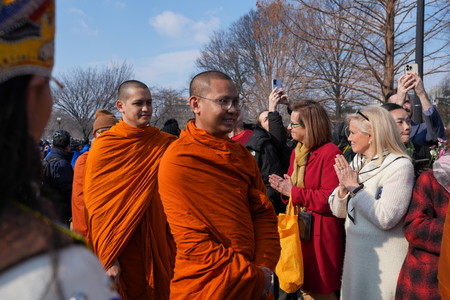
Washington, Feb 12 (IANS) Nineteen Buddhist monks completed a 2,300-mile Walk for Peace to Washington, drawing lawmakers, faith leaders, and thousands of supporters as they delivered a message of compassion in the heart of the American Capital.
Congressional Asian Pacific American Caucus (CAPAC) Chair Grace Meng led 22 House and Senate Democrats in welcoming the monks at the Peace Monument west of the US Capitol on Wednesday (local time).
“It is a great honour to welcome the Venerable Monks who have walked thousands of miles across the United States to spread a message of peace that our nation desperately needs,” said Meng.
“Their journey inspired millions of people from different faiths and backgrounds to live each day with greater compassion, understanding, and respect for others. It is a movement we must sustain,” she said.
The monks began their 108-day journey on October 26, 2025, from the Huong Dao Vipassana Bhavana Centre in Fort Worth, Texas. Wearing saffron and maroon robes, they walked through winter storms and along icy sidewalks, accompanied by a rescue dog named Aloka.
Over 100 days, their simple message -- peace, loving kindness and compassion -- resonated widely. Thousands lined Washington’s streets as the monks walked single-file into the city. Nearly 3,500 people packed American University’s Bender Arena for their first public stop, observing silence as a sign of respect.
At the Washington National Cathedral, more than 100 Buddhist monks and nuns joined them for an interfaith gathering hosted in part by Washington Episcopal Bishop Mariann Budde.
“It is overwhelming for us,” said the Venerable Bhikkhu Pannakara, the group’s leader. “This is the moment I will remember for the rest of my life. And I hope you do the same.”
The trek was not without peril. In November, outside Houston, their escort vehicle was struck by a truck. Two monks were injured, and Venerable Maha Dam Phommasan lost his leg in the accident. He rejoined the group near Washington, entering the university arena in a wheelchair.
“There are so many things happening in the world,” said Jackson Vaughn, who travelled beside the monks after they passed through his hometown. “To see people gathering peacefully and setting an example, I think, is a wonderful thing.”
Long Si Dong, a spokesperson for the temple, stressed that the walk was not political.
“It's a spiritual offering, an invitation to live peace through everyday actions, mindful steps and open hearts,” he said. “We believe when peace is cultivated within, it naturally ripples outward into society.”
On Wednesday, the monks walked through Capitol Hill and held a closing ceremony at the Lincoln Memorial before returning to Texas by bus. From downtown Fort Worth, they will walk six final miles back to the temple where their journey began.
Peace walks are a long-standing tradition in Theravada Buddhism. Vipassana meditation, which the monks practice and teach, traces its roots to ancient India and emphasises mindfulness of breath and the connection between mind and body.
In recent years, interfaith gatherings and public peace processions have gained visibility in the United States amid political polarisation and social tensions, drawing diverse communities seeking shared civic and spiritual space.
--IANS
lkj/sd/
Trump, Netanyahu hold talks on Iran, ‘progress’ in Gaza
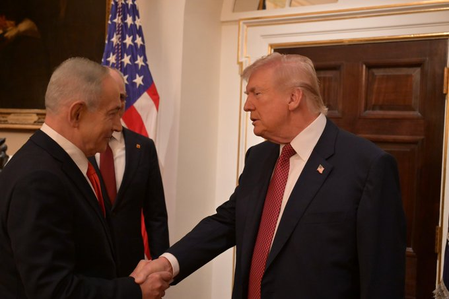
Washington, Feb 12 (IANS) US President Donald Trump said he had a “very good meeting” with Israeli Prime Minister Benjamin Netanyahu at the White House, as both leaders focused on negotiations with Iran and the situation in Gaza.
“I have just finished meeting with Prime Minister Netanyahu, of Israel, and various of his Representatives. It was a very good meeting, the tremendous relationship between our two countries continues,” Trump said on Wednesday (local time)
The Oval Office meeting marked Netanyahu’s fifth visit to the White House since Trump began his second term.
Trump said no final decisions had been taken, but stressed that diplomacy with Tehran should continue.
“There was nothing definitive reached other than I insisted that negotiations with Iran continue to see whether or not a Deal can be consummated. If it can, I let the Prime Minister know that it will be a preference. If it cannot, we will just have to see what the outcome will be.”
Referring to past tensions, Trump added, “Last time, Iran decided that they were better off not making a Deal, and they were hit with Midnight Hammer -- That did not work well for them. Hopefully, this time they will be more reasonable and responsible.”
He also said the two leaders discussed Gaza and broader regional developments. “Additionally, we discussed the tremendous progress being made in Gaza and the Region in general. There is truly PEACE in the Middle East.”
Netanyahu had indicated before departing Israel that Iran would top the agenda. “On this trip, we will discuss a series of issues: Gaza, the region, but first and foremost, the negotiations with Iran.”
He said he would outline Israel’s position to the US President. “I will present to the President our outlook regarding the principles of these negotiations -- the essential principles, which, in my opinion, are important not only to Israel, but to everyone around the world who wants peace and security in the Middle East.”
In a prior statement, his office said: “The Prime Minister believes any negotiations must include limitations on ballistic missiles and a halting of the support for the Iranian axis.”
The visit comes after US officials held indirect talks with Iranian negotiators in Oman last week aimed at reaching a nuclear agreement. Trump told Israel’s Channel 12: “The Iranians really want to make a deal. Either we make a deal, or we have to do something very tough like last time.”
According to US officials, additional negotiations are expected this week. Tehran has said it will not negotiate beyond its nuclear activities and will not relinquish its right to enrich uranium.
The meeting also comes ahead of the first session of the newly formed Board of Peace, scheduled for February 19, which is intended to oversee a reconstruction plan for Gaza.
The Trump administration brokered a ceasefire that took effect on October 10, 2025, under a 20-point peace plan agreed on by Israel and Hamas.
Netanyahu, 76, has served multiple terms as Israel’s prime minister and leads a coalition government. He has long maintained that any agreement with Iran must address not only its nuclear programme but also its regional activities, a position that has shaped Israeli policy across successive US administrations.
--IANS
lkj/sd/
Bangladesh national election unlikely to alter political landscape: Report
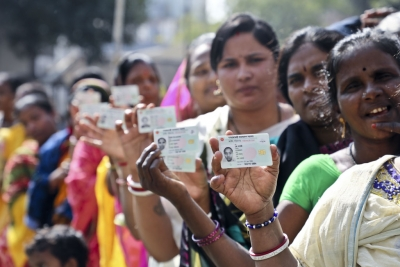
London, Feb 11 (IANS) Bangladesh’s national election on Thursday is unlikely to bring any significant change, with the Bangladesh Nationalist Party (BNP) possibly assuming power, the Jamaat-e-Islami gaining ground, and a few students entering parliament.
While power may shift in the South Asian nation, the entrenched bargain — "cheap labour, hollow institutions, money siphoned abroad, dissent managed" — will endure, a report said on Wednesday.
“From afar, Bangladesh’s upcoming election appears as an old morality play, staging Sensible Centrism against Unhinged Islamism — the dependable binary that reappears time and again along the crescent from Morocco to Malaysia. Some 128 million voters are expected to trudge to polling stations tomorrow, two in five of whom have never experienced anything resembling a free and fair vote. Some 150 parties have registered, with the predictable result that ballot papers are long enough to double as picnic rugs,” British media outlet UnHerd highlighted.
“Yet in Bangladesh itself, the prevailing mood is not anticipation but ennui, as voters contemplate a Hobson’s choice dressed up as pluralism. This is democracy as pageant: grand, noisy, faintly impressive — and entirely beside the point. Nothing, in truth, is at stake,” it stated.
According to the report, the likely winner is the centre-right Bangladesh Nationalist Party (BNP), comfortably polling above 50 per cent and now led by Tarique Rahman, who returned to Bangladesh in December last year after 17 years of self-imposed exile.
“His admirers both at home and abroad cast him as a chastened liberal: a steady pair of hands, sobered by history and burnished by absence. His voters, who will back him faute de mieux, remember rather more. During the BNP’s spells in office in the Nineties and 2000s, power rested with his mother, Khaleda Zia — the formidable widow of the soldier-president Ziaur Rahman, assassinated in a failed putsch in 1981. She broke the glass ceiling as Bangladesh’s first female Prime Minister and broke records soon after, presiding over a country that managed the rare feat of being ranked the world’s most corrupt for four consecutive years by Transparency International,” it detailed
"Rahman himself was later described in leaked diplomatic cables as a walking emblem of kleptocracy. Memory, however, is a luxury in Bangladeshi politics,” it further stated.
The report highlighted that the main challenger is the Jamaat-e-Islami, the once-banned Islamist party now enjoying a brisk revival under the leadership of Shafiqur Rahman, a “solemn scold, skull-capped and maned”. With a disciplined grassroots machine and an electorate “weary of secular strongmen”, the party polls at around 30 per cent.
“The Jamaat insists it has reformed — no theocracy, no Taliban theatrics — yet urban liberals rightly remain unconvinced. It is surely no coincidence that the party of the mullahs has not fielded a single female candidate, while also flirting with limiting women’s working hours. Then there is the amateurism: hardly surprising for a party that has never run anything larger than a student union,” it noted
--IANS
scor/uk
US no longer interested in containing China in Southeast Asia: Report
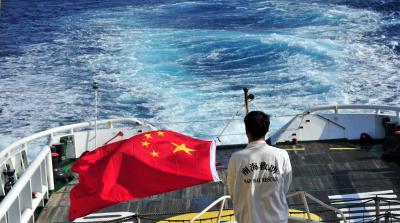
Washington, Feb 11 (IANS) The National Security Strategy (NSS) of US President Donald Trump's administration serves as a wake-up call for Southeast Asia, signalling that the US may no longer act as a counterbalance to China’s assertiveness in the region. The era of US security guarantees for parts in the region may also end sooner than anticipated, a report said on Wednesday.
According to a report in Eurasia Review, the emerging environment shifts towards a more uncertain, competitive, and fragmented order, requiring Southeast Asian countries to reinvigorate ASEAN-led regional institutions and broaden their strategic partnerships with regional powers.
“As the Philippines takes over as the 2026 ASEAN Chair, it is clear that the South China Sea dispute and maritime security issue will form the very core of the Philippine agenda for ASEAN 2026. The best case scenario for the Philippines would be a revised and fortified code of conduct on South China Sea, the chances of which have gone weaker latterly, particularly keeping in view the Trump administration’s long-awaited 2025 National Security Strategy (NSS), released in December 2025, which mark a fundamental shift from liberal internationalist values to a more transactional, interest-based, America-first ‘chaos’ in US foreign policy,” the report detailed.
“Apparently, the US no longer seems interested in containing China and is open to accepting 'the outsized influence of larger, richer, and stronger nations' as 'a timeless truth of international relations'. In other words, China and Russia are no longer its competitors or threats to the Rules-based international order, and both Beijing and Moscow can have their own spheres of influence. Trump’s Venezuela adventure and statements about taking Greenland from Denmark have only encouraged China and Russia to establish their own versions of the Donroe doctrines in their respective spheres of influence," it added.
The report emphasised that as Washington sharpens its focus on its immediate hemisphere, Southeast Asian nations could face strategic uncertainty, particularly as many countries in the region have long depended on the US as a counterbalance to China’s growing presence and as a partner in maintaining regional stability. However, the shift in American focus, it said, reflected in the NSS may prompt Southeast Asia’s political and economic elites to reassess their approach amid the evolving great-power dynamics.
“While a document, be it NSS, cannot truly guide Trump’s often impulsive and flippant foreign policy, Southeast Asia has already been less than a second fiddle for Trump. In the absence of a clearly defined US strategy for Southeast Asia, the region must adapt. The challenge for the Association of Southeast Asian Nations (ASEAN) countries will be to strengthen their own institutions, such as the ASEAN Regional Forum (ARF), ADMM+, and EAS, while deepening intra-regional trust and cooperation vis-a-vis China,” the report noted.
--IANS
scor/as
Bangladesh: Jamaat’s promises on women empowerment mask enduring regressive attitude
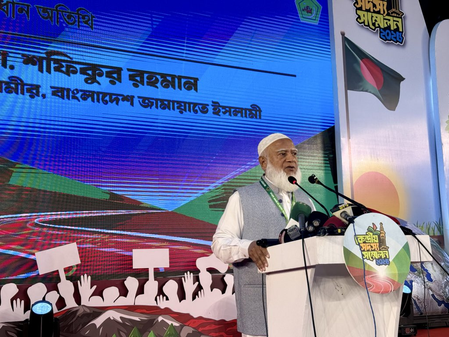
Male, Feb 11 (IANS) Bangladesh’s radical Islamist party Jamaat-e-Islami’s recent statements and manifesto expose a striking contradiction, projecting an image of inclusivity and protection for women, while its longstanding regressive attitudes towards them remain unchanged. The promises of representation and safety by Jamaat are weakened by the exclusion of women from leadership roles, the absence of female candidates, and the continued rhetoric that confines women to the domestic sphere, a report said on Wednesday.
According to a report in Maldives Insight, Jamaat’s ambiguous stance on Shariah laws further suggests that its vision for women remains regressive, grounded in segregation and subordination rather than empowerment.
For women in Bangladesh, it said, Jamaat’s narrative offers not liberation but a continuation of restrictions, framed in the language of dignity and protection.
“The question of women’s empowerment within Islamist movements has always been fraught with contradictions, and Bangladesh’s Jamaat-e-Islami offers a striking case study. On the surface, the party’s recent election manifesto appears to embrace inclusivity, pledging representation for women, ethnic minorities, and religious minorities in government. Yet, when examined against the party’s longstanding rhetoric and practices, these promises reveal themselves as cosmetic gestures rather than genuine commitments to gender equality,” the report detailed.
“In campaign speeches, Jamaat Ameer Shafiqur Rahman has repeatedly emphasised women’s 'security and dignity' as a top priority. He has assured that women will be safe 'in homes, on the roads, in workplaces, and everywhere'. The manifesto echoes this sentiment, promising safe working environments, reduced working hours during maternity, and measures such as dedicated bus services, CCTV cameras, and emergency helplines,” it added.
The report highlighted that the pledges made by Jamaat, however, emphasised protection over empowerment, reinforcing the notion that women are vulnerable beings who must be safeguarded rather than active participants in public life.
“Despite these promises, Jamaat-e-Islami has not fielded a single female candidate in the upcoming elections. This glaring omission undermines the manifesto’s claim of ensuring women’s representation in the cabinet. The party’s leadership has also made clear that women cannot hold the highest positions of authority,” it mentioned.
Jamaat’s stance towards women, the report said, lacked meaningful evolution from its founding ideology.
“The party continues to enjoin women to fulfill domestic obligations, while its promises of inclusion remain symbolic at best. The absence of female candidates, the ban on women in top leadership, and the persistence of rhetoric equating women’s public participation with immorality all point to a deep-seated resistance to genuine empowerment,” it noted.
“The manifesto’s pledges of safety and dignity, while superficially appealing, mask a vision of society where women are segregated, subordinated, and denied equal leadership. The party’s ambiguity on Shariah further underscores its reluctance to openly admit its regressive agenda, preferring instead to cloak it in the language of protection and morality,” it stressed.
--IANS
scor/as
New Zealand strengthens strategic partnership with India through key defence appointment
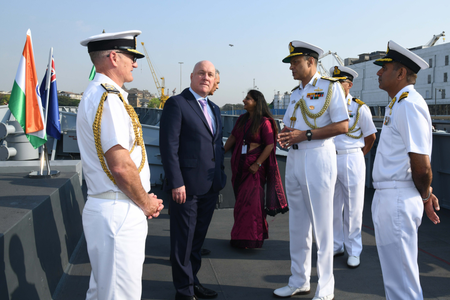
Wellington, Feb 11 (IANS) The recent appointment of New Zealand’s First Resident Defence Advisor to India underscores the growing bilateral partnership between the two nations.
A Royal New Zealand Navy (RNZN) Commodore Andy Dowling, appointed to the New Zealand High Commission in New Delhi for a three-year posting in late January 2026, highlights India’s expanding focus on defence cooperation and other strategic ties under the Act East Policy, a report in the military magazine ‘Indo-Pacific Defense Forum,’ stated on Wednesday.
“We’re seeing the Act East with the Indian Navy in particular. They’re deploying out of the Indian Ocean, exercising with other countries and visiting New Zealand and Australia. They’re getting out and about and that’s only going to increase in the coming years,” the magazine quoted Dowling as saying.
According to the report, Dowling's appointment as New Zealand’s first full-time Defence Advisor to India will allow Wellington to understand the system better "to identify and explore opportunities" for both nations to work together.
Dowling highlighted similarities between the two navies, particularly in air operations and refuelling at sea.
“They have P-8 aircraft like us, they operate the MH-60 helicopter which we’re getting and they have the C-130J Hercules,” he said. “Their hydrographer training is similar; they operate a sea training group very like our Maritime Training Group. So, they have structures and capabilities that we recognise,” he stated
The report stated that Dowling’s appointment followed a month after Prime Minister Narendra Modi and New Zealand Prime Minister Christopher Luxon unveiled a major Free Trade Agreement and emphasised development in defence cooperation.
“In the first half of 2025, as part of the United States-led multinational Combined Maritime Forces, the RNZN led a counternarcotics task force in the Western Indian Ocean, with the Indian Navy second in command. The Indian Navy frigate INS Tarkash seized more than 2,500 kilogrammes of hashish and heroin during the mission,” it stated.
The RNZN frigate HMNZS Te Kaha, the report said, made a port call in Mumbai during its task force deployment. The visit coincided with Luxon’s visit to India, which included discussions with PM Modi, including the signing of a defence cooperation agreement.
“I reiterated New Zealand’s strong commitment to working with India to address shared concerns over our respective interests and contributions to ensure a strong, stable and prosperous region,” Luxon said.
PM Modi also emphasised that both nations would deepen collaboration in areas such as counterterrorism.
“We both support a free, open, secure and prosperous Indo-Pacific. We believe in policies of development, not expansionism,” he said.
--IANS
scor/as
Bangladesh: BNP and Jamaat trade religious slurs ahead of election
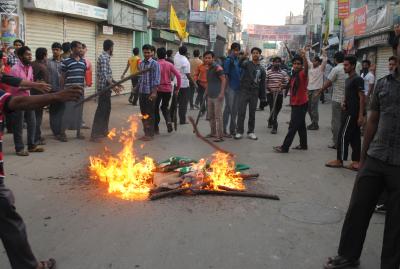
Dhaka, Feb 11 (IANS) With Bangladesh heading for polls on Thursday, election rules strictly prohibit exploiting religious sentiments for gaining electoral advantage, yet the parties and candidates from across the political spectrum ran paid ads and unpaid social media content portraying the rival camps as “bad Muslims,” local media reported on Wednesday.
An analysis of 50 sponsored ads between December 23, 2025, and February 6, 2026 reveals that both Bangladesh Nationalist Party (BNP) and Jamaat-e-Islami candidates traded slurs, each labelling the other a “munafeq” - an Islamic term for someone who outwardly professes faith but is in fact a nonbeliever.
Bangladesh’s leading newspaper, The Daily Star, reported 55 similar religiously provocative posts from 33 social media pages, groups and profiles, 30 of which appear to support the BNP and the Jamaat.
BNP supporters and anti-Jamaat activists promoted the claim that Jamaat leaders are offering "tickets to Jannah (paradise)" in exchange for votes.
On the other hand, Jamaat and its 11-party alliance partners are accusing their opponents of being "seasonal Muslims" adopting Islamic attire, donning beards and skullcaps during election season, to "deceive voters".
Reports suggest that on January 28, the official page of Sharif Uddin, the BNP-nominated candidate for Rajshahi-1 and former defence advisor to former BNP chairperson Khaleda Zia, ran a political ad on social media describing Jamaat’s tactics as deceptive.
“Asking for votes in the name of religion or promising tickets to Jannah is clear hypocrisy (Munafiqi); Allah has commanded us to stay away from such deception,” The Daily Star quoted Sharif as saying.
Just days later, on February 3, the social media page “Kazipur Daripalla Supporters”, which appeared to support Jammat Sirajganj-1 candidate Maolana Shahinur Alam, ran an ad in which Alam called those individuals who accused Jamaat of "selling Jannah tickets” as “seasonal muslims”.
“Bangladeshi politics has undergone a rightward turn. There is a demand-side factor. This shift has pushed Jamaat further to the right in order to cater to voters. In the absence of any strong left or centre-left alternative, the BNP had a chance to move left. But it did the opposite. To capture right-wing votes, it mobilised religiosity to counter Jamaat,” said Asif Shahan, who teaches Development Studies at the University of Dhaka.
Bangladesh’s elections are unfolding amid escalating political conflict, with critics warning that a shift in power could fuel Islamist extremism.
--IANS
scor/as
Pakistan has structurally inadequate whistleblower protection framework: Report
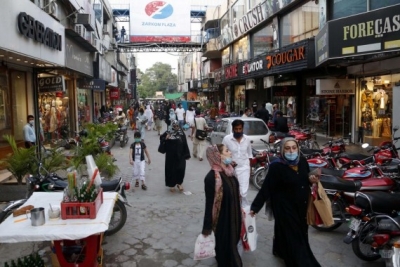
Islamabad, Feb 11 (IANS) Pakistan presents an interesting scenario, where whistleblower protections are inadequate, weak and only symbolic, thus showcasing longstanding failures in political accountability, contractual implementation and regulatory independence, a report has stated.
According to the 2024 Corruption Perceptions Index, Pakistan is ranked at the 135th spot among 180 nations, placed amongst the world’s most corruption-vulnerable states.
An opinion piece in The News International highlighted that transparency and accountability are important for any civilised and functioning society. These are not merely slogans made during political speeches, it stated, but concrete pillars that fosters trust between the state and its people. Thus, a culture of whistleblowing is essential for upholding transparency and accountability and the absence of these fundamentals will spread corruption and facilitate the culture that rewards silence and punishes truth-telling.
"Pakistan has a structurally inadequate whistleblower protection framework. While the Whistleblower Protection and Vigilance Commission Act 2019 exists, it lacks enforcement and operational power. Without guaranteed anonymity, a proper enforcement mechanism, and protection from retaliation, there can be no progress. This can be addressed by aligning the current legal framework for whistleblowers with the United Nations Convention against Corruption (UNCAC)," Sakib Berjees, political economist and public policy commentator, wrote in The News International.
While anti-corruption laws do exist in Pakistan, the government lacks the courage to implement them.
"Pakistan is at a crossroads, where decades of ineffective accountability have weakened institutions, eroded public trust, and driven both talent and capital flight. Pakistani professionals are not leaving because they have cast off Pakistan, but are leaving because Pakistan has rejected merit. Whistleblower protection is not an answer to the problems we are facing as a nation, but it is the substance upon which all serious reform rests," wrote Berjees.
"Nations that commit to institutionalising accountability attract investment, talent and command legitimacy. Those who reject these notions and continue to live in a state of denial may survive temporarily, but ultimately cannot endure and will face the consequences. If we protect our whistleblowers, then we will protect our future, but if we punish them, then surely, we will disqualify ourselves from modernity," he further mentioned in The News International.
--IANS
akl/as
Pakistan presents Balochistan as global investment opportunity, treats it as permanent security threat internally: Report
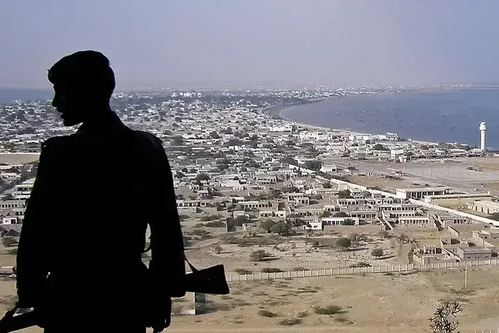
Quetta, Feb 11 (IANS) The coordinated attacks conducted recently by the Baloch Liberation Army (BLA) have once again exposed the fragility of Pakistan's Balochistan province, a report has highlighted.
"Islamabad’s insistence on framing Balochistan solely as a security problem is proving increasingly short-sighted. Peaceful forms of dissent — from marches by families of the disappeared to student protests — have been met with arrests, media blackouts, and intimidation. As long as the State refuses to acknowledge that the insurgency is driven by genuine political and social demands — control over resources, political autonomy, respect for identity, and accountability for human rights violations — it strengthens the argument that armed struggle is the only remaining option. In doing so, Pakistan risks transforming a political conflict into a permanent state of exception," a report in EU Reporter stated.
In recent years, Pakistan has replaced governance with military management, presenting the political crisis as a security issue. The downplaying of military casualties, continuous allegations of enforced disappearances and criminalisation of Baloch people is not collateral damage but part of a deliberate plan of control. By refusing to acknowledge the political and social roots of the insurgency, Pakistan deepens alienation and legitimises rupture in the eyes of people of Balochistan.
"If this trajectory continues, Balochistan risks following a familiar historical path: from an 'internal security issue' to a violent separation — a new Bangladesh, this time produced by Islamabad’s own choices, writes Dimitra Staikou.
The report details that this instability persists despite Balochistan’s immense mineral wealth and its strategic importance to both Chinese and American investment ambitions.
Instead of holding meaningful political dialogue with local residents, Pakistan has doubled down on repression and external blame and claimed that unrest is foreign-sponsored sabotage, resulting in Balochistan being presented as an investment frontier and governed as an enemy zone internally.
According to the EU Reporter, security operations, extensive deployment of forces and accusations of extrajudicial killings and enforced disappearances have established a cycle of violence in Balochistan. Each operation presented as "restoring order" reinforces perceptions of occupation and promotes recruitment into armed separatist groups like the BLA.
"This longstanding conflict has now acquired a critical economic and geopolitical dimension. Balochistan lies at the heart of China’s investments in Pakistan through the China–Pakistan Economic Corridor (CPEC) and is also central to Islamabad’s recent attempts to attract US capital into the mining sector. The province’s vast reserves of copper, gold, coal, and gas have become central to Pakistan’s economic recovery narrative. Yet the state struggles to guarantee even basic security for heavily guarded infrastructure projects. Persistent attacks signal that militarisation has failed to create sustainable stability," the EU Reporter stated.
Pakistan presents Balochistan as a "land of opportunity" while considering it as a permanent security threat internally at the same time. Balochistan controls Pakistan’s access to the Arabian Sea, borders Iran and Afghanistan and is the land corridor that connects China with the Indian Ocean. Balochistan is the geostrategic core of CPEC for China. This geopolitical value of Balochistan results in Pakistan promising stability and development internationally while treating the region domestically with repression, casualty minimisation, and collective suspicion towards local residents, the report mentioned.
--IANS
akl/as
UNECA chief urges Africa to mobilise financing, deepen integration amid global economic transition
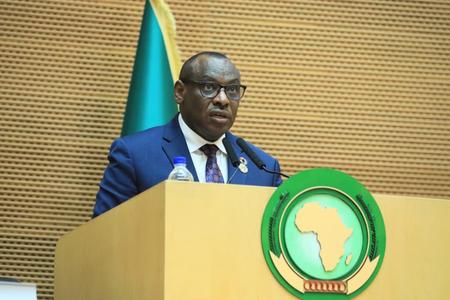
Addis Ababa, Feb 11 (IANS) United Nations Economic Commission for Africa (UNECA) Executive Secretary Claver Gatete on Wednesday called on African countries to mobilise and manage development financing more effectively and deepen continental market integration to withstand global economic uncertainties.
Speaking at the opening session of the 48th Ordinary Session of the Executive Council of the African Union (AU) at the AU headquarters in Addis Ababa, the capital of Ethiopia, Gatete said African foreign ministers are meeting at "a time of profound economic transition," characterised by a slowing global growth and intensifying trade tensions, while supply chains are being re-organised, Xinhua News Agency reported.
"We are witnessing a transition to a world economy organized around industrial strategy, geopolitical competition and control of key resources. In short, the rules of development are changing," Gatete said.
Noting that capital has become more expensive and development assistance is declining, the UNECA chief said these economic challenges are further exacerbated by a worsening security situation and persistent climate change.
Gatete warned that developing countries' reliance on external partners, characterised by the export of raw commodities, import of manufactured goods, and finance through concessional flows, is no longer viable.
"The implication for Africa is clear -- our development can no longer depend primarily on external conditions. It must increasingly be organized around our own continental economic system," Gatete said.
To effectively navigate a complex global economic context, Gatete called African countries to harness and add value to the continent's natural resources.
The UNECA chief proposed five priority actions for the continent's collective attention, namely mobilizing and managing development finance more effectively, investing in integrated productive infrastructure, accelerating value addition through regional value chains under the African Continental Free Trade Area Agreement, deepening continental market integration, and harnessing technology and data as economic infrastructure.
The executive council meeting, attended by foreign ministers from AU members under the framework of the 39th AU Summit, is being held under the AU's 2026 theme: "Assuring Sustainable Water Availability and Safe Sanitation Systems to Achieve the Goals of Agenda 2063."
--IANS
akl/as