
Trump attacks Nobel Peace Prize decision
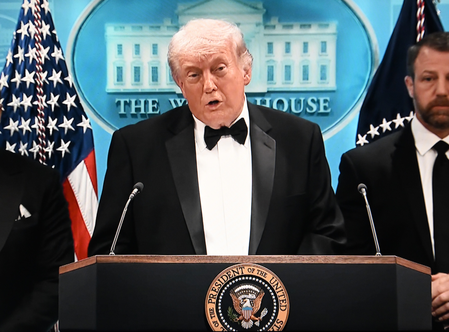
Washington, Oct 10 (IANS) US President Donald Trump has sharply criticised the Nobel Peace Prize committee for overlooking his claims of having ended eight international conflicts, calling the decision an embarrassment and a disservice to the United States.
Addressing a Republican election rally in Syracuse, New York, on Friday, Trump said his administration had achieved an unprecedented record in resolving international disputes and argued that the United States deserved recognition for those efforts.
"The United States of America, represented by me as your President, should have received the Nobel Peace Prize, but didn't," Trump told supporters.
He described the decision as "an indelible stain" and accused the Norwegian Nobel Committee of allowing political considerations to influence its selection.
Trump said he had helped resolve eight conflicts and was working towards agreements involving Russia, Ukraine and Iran.
"I settled eight wars," he declared, arguing that each of the conflicts he claimed to have resolved could have justified a separate peace prize.
Beyond South Asia, Trump listed disputes involving Kosovo and Serbia, the Democratic Republic of the Congo and Rwanda, Armenia and Azerbaijan, Egypt and Ethiopia, and Israel and Hamas among the conflicts he claimed to have resolved.
He also credited himself with preventing Iran from acquiring nuclear weapons and averting wider regional warfare.
Trump said his administration was now moving towards resolving the Russia-Ukraine conflict and the confrontation with Iran.
"Russia, Ukraine we're going to get that all done, too and that's happening quickly," he said.
He also issued a warning to Tehran, saying that Iran would have to meet American demands or face further consequences.
The President criticised the Nobel committee's decision to recognise another recipient, saying he was unfamiliar with the person selected for the 2026 award.
He accused the committee of failing to acknowledge what he described as extraordinary American diplomatic achievements.
Trump also expressed frustration with the United Nations, claiming that the organisation had played no meaningful role in the conflicts he said his administration had resolved.
"In all of the wars that I have settled, I never spoke to the United Nations they were of no help to me," he said.
The President argued that the award should have recognised the United States rather than an individual, saying his administration's peace efforts were undertaken on behalf of the American people.
His criticism came during a campaign rally supporting Republican candidates ahead of the November 3 congressional elections, where he also highlighted his administration's economic, immigration and national security policies.
The Nobel Peace Prize is awarded by the Norwegian Nobel Committee, an independent five-member body appointed by Norway's parliament. The prize recognises individuals and organisations considered to have made significant contributions to peace, international cooperation and conflict resolution.
--IANS
lkj/rs
India demands Pakistan end human rights violations in PoK, suppressing people’s revolt
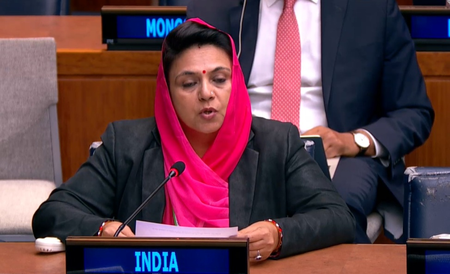
United Nations, Oct 10 (IANS) India has demanded that Pakistan stop the military's human rights violations in the part of Kashmir it illegally occupies, where the people have risen in revolt against it.
“In the last few months, the Pakistani armed forces and their proxies have killed dozens of innocent civilians who were agitating for their basic rights and freedoms and basic necessities”, BJP MP Mahima Kumari Mewar said here on Friday.
“We call upon Pakistan to stop the grave and ongoing human rights violations in the areas illegally occupied by it, where the population is in open revolt against Pakistan, its military occupation, repression, brutality, and illegal exploitation of resources”, she said at the General Assembly's Fourth Committee that deals with decolonisation.
She delivered the tough message, exercising the right of reply to Pakistan's Acting Permanent Representative Usman Jadoon's attempt to draw Kashmir into the debate.
“A country like Pakistan, with an established record of military dictatorship, sham elections, incarceration of popular elected leaders, religious extremism, and sponsoring terrorism as an instrument of state policy, should, in future, refrain from preaching homilies of this sort at this platform”, Mewar said.
“Jammu and Kashmir is and always remains an integral and inalienable part of India”, she declared.
More than 90 people have been killed by Islamabad's security forces, which brutally put down Kashmiris' protests that began against Pakistan sending outsiders there to manipulate the elections.
The people's anger over the exploitation of its natural resources, the worsening living conditions, and the rising prices boiled over and a civil society coalition, Jammu Kashmir Joint Awami Action Committee (JAAC), has led the broader protests.
Mewar represents Rajasthan's Rajsamand constituency in the Lok Sabha and is among the MPs in India's delegation to the General Assembly.
Earlier, delivering India's statement at the committee, she reaffirmed that India would work tirelessly to achieve the goal of decolonisation.
“The fight against colonisation has been arduous” and although more than 80 countries have been able to break free of the shackles of colonialism, the decolonisation “process, however, remains unfinished”, she said.
Seventeen non-self-governing territories remain on the agenda of the Fourth Committee, and a pragmatic approach will lead to their decolonisation and the fulfilment of the legitimate wishes of the people there, she said.
The UN's list of the non-self-governing territories includes the Falkland Islands or Malvinas, which are claimed by Argentina, over which there were heated exchanges between Britain, which holds them, and Argentina and its supporters.
--IANS
al/rs
US sanctions on ICC draw criticism from UN, member states
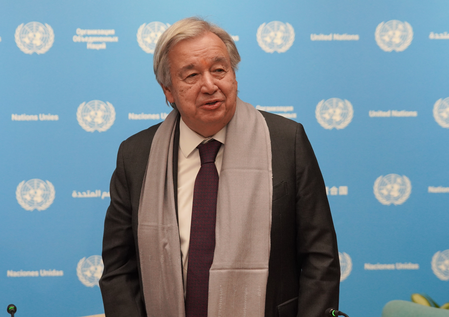
United Nations/Ottawa, Oct 10 (IANS) UN Secretary-General Antonio Guterres and foreign ministers of eight countries on Friday criticised the US announcement of sanctions against the International Criminal Court (ICC) as an institution.
"The secretary-general is deeply alarmed by the expected impact of today's sanctions on the International Criminal Court as a whole, and in particular, its continued ability to perform its important mandates, including in relation to the situations referred to it by the Security Council and states parties to the Rome Statute," said Stephane Dujarric, the spokesman for Guterres.
"Today's decision marks a serious blow to our collective pursuit of international criminal justice, of which the ICC is a key pillar. Accountability for international crimes and delivery of justice to victims are central to our global commitment to peace, security, human rights and fundamental freedoms," said the spokesman.
He said the secretary-general reiterated his unwavering support for the independence of the ICC and its officials, adding that Guterres called on all states to uphold their commitments under international law and to support efforts aimed at ensuring accountability for the most serious crimes of concern to the international community.
Also on Friday, foreign ministers of eight countries, Canada, Denmark, Germany, France, Italy, Japan, the Netherlands and the United Kingdom, issued a joint statement, expressing regret over and strong opposition to the US announcement of sanctions against the ICC.
"We, the undersigned States Parties to the Rome Statute of the ICC, reaffirm our continued and unwavering support for the independence, impartiality, and integrity of the ICC," said the statement.
The eight nations pledged to engage in constructive and inclusive dialogue with non-States Parties as they prepare for the Assembly of States Parties in December 2026.
Earlier Friday, US Secretary of State Marco Rubio announced sanctions against the ICC, saying the measures would ban transactions with the court, cut off its resources and cripple its ability to operate.
--IANS
int/rs
Vance warns of tariffs over US job losses
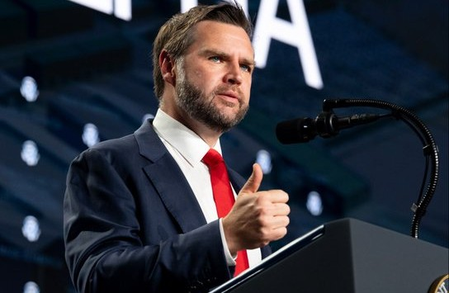
Washington, Oct 10 (IANS) US Vice President JD Vance has warned that companies shifting American jobs overseas or replacing US workers with legal immigrants could face steep tariffs, outlining the Trump administration's approach to protecting domestic employment and encouraging manufacturing investment.
Addressing a Republican midterm election rally in Lima, Ohio, Vance said the administration would reward companies that manufacture goods in the United States and employ American citizens, while penalising businesses that move production and jobs abroad.
"If you're making things in America and you're employing American citizens to do it, great. We're gonna give you a big fat tax cut and we're gonna reward you for building and expanding production," Vance said.
"But if you're sending American jobs overseas, if you're trying to ship your factory to a foreign corporation or you're trying to replace American workers with a legal immigrant later, you know what you're gonna get? A big fat tariff," he told supporters.
The remarks are significant because Vance explicitly referred to legal immigrants while describing the administration's efforts to protect American workers.
The Vice President did not identify any new tariff measure specifically targeting employers of legal immigrants or explain how such a penalty would be implemented.
His comments nevertheless highlighted the administration's emphasis on giving preference to American citizens in employment and encouraging companies to expand production within the United States.
Vance framed the administration's policies as an effort to reverse decades of industrial decline and prevent American manufacturing jobs from moving overseas.
Drawing on his upbringing in Middletown, Ohio, he recalled watching factories close and families struggle after workers lost their jobs.
"I know what it does to families when mom or dad loses their job," he said.
The Vice President argued that government policy should encourage companies to invest in domestic production rather than move jobs to foreign countries.
"We are gonna fight for our people," he said.
Vance also claimed that the administration's economic policies had attracted trillions of dollars in investment and generated new manufacturing employment.
He cited planned investments by automobile, aerospace and pharmaceutical companies in Ohio as examples of businesses expanding American manufacturing operations.
Among them, he referred to a $400 million investment by Stellantis in automobile manufacturing, an $850 million aerospace project and a $2.2 billion pharmaceutical manufacturing investment.
The Vice President also criticised Democrats over immigration and employment policies, accusing the previous Biden administration of allowing illegal immigration to undermine wages and job opportunities for American workers.
His remarks formed part of a broader campaign speech supporting Republican candidates, including Indian-American entrepreneur Vivek Ramaswamy, who is running for Ohio governor, and Senator Jon Husted.
--IANS
lkj/rs
Vance backs Ramaswamy in Ohio governor race
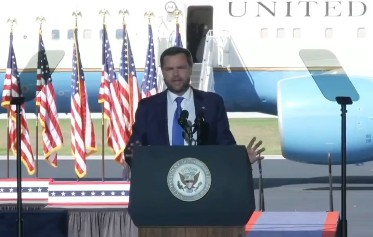
Washington, Oct 10 (IANS) US Vice President JD Vance has thrown his weight behind Indian-American entrepreneur Vivek Ramaswamy's campaign for Ohio governor, portraying him as a businessman capable of creating jobs, lowering energy costs and providing property tax relief as Republicans step up their campaign ahead of the November 3 midterm elections.
Addressing a Republican rally in Lima, Ohio, Vance praised Ramaswamy's business background and said his experience would help revive manufacturing, attract investment and improve economic opportunities in the state.
"Vivek is an entrepreneur. He's a guy who hasn't just received a paycheck he signed a paycheck to," Vance told supporters, drawing a contrast between the Republican candidate and career politicians.
The Vice President, who previously represented Ohio in the US Senate, said Ramaswamy understood the challenges facing businesses and working families.
"What Vivek is gonna do is he's gonna to attract jobs and he's gonna unleash the incredible potential of this state," Vance said.
He said Ramaswamy would focus on reducing living costs, particularly energy expenses, and creating conditions for businesses to expand their operations in Ohio.
Vance also highlighted Ramaswamy's proposal to provide property tax relief to homeowners, presenting it as a central element of the Republican candidate's economic agenda.
"He's gonna get historic property tax relief for every single citizen who owns a house in this state," he said.
The Vice President described Ramaswamy as someone capable of translating policy proposals into action.
"Vivek is not like so many politicians, a person who just talks about things," Vance said, adding that the candidate had demonstrated an ability to execute his ideas.
Ramaswamy, a biotechnology entrepreneur and former Republican presidential candidate, is seeking the governorship against Democrat Amy Acton.
Vance sharply criticised Acton over her role in Ohio's response to the COVID-19 pandemic, accusing her of supporting restrictions that disrupted schools, religious gatherings and family activities.
His criticism was part of a broader attack on Democrats, whom he accused of pursuing policies that increased costs and weakened American manufacturing.
The Vice President also campaigned for Republican Senator Jon Husted, who is seeking election to the Senate seat previously held by Vance.
He credited Husted with supporting the Trump administration's tax and economic policies, including measures affecting overtime income, tips and Social Security benefits.
Vance argued that Republican leadership was essential to maintaining what he described as an economic revival in Ohio.
He pointed to manufacturing investments involving automobile, aerospace and pharmaceutical companies, claiming that administration policies were encouraging businesses to expand domestic production.
"We've created 72,000 manufacturing jobs just in 2026 alone," Vance said.
The employment figure was presented as an administration claim and was not independently verified in the speech.
Vance also defended President Donald Trump's tariff policies, arguing that companies investing in American manufacturing should receive tax incentives while businesses moving jobs overseas should face financial penalties.
"But if you're sending American jobs overseas, if you're trying to ship your factory to a foreign corporation or you're trying to replace American workers with a legal immigrant later, you know what you're gonna get? A big fat tariff," he said.
The Vice President's remarks reflected the administration's emphasis on domestic manufacturing, immigration restrictions and economic nationalism as Republicans campaign to retain political control in Washington.
Vance also attacked former Democratic Senator Sherrod Brown, who is challenging Husted, accusing him of supporting policies that harmed American workers and encouraged illegal immigration.
He urged Republican supporters to turn out in large numbers on November 3, describing the elections as critical to continuing the Trump administration's economic agenda.
--IANS
lkj/rs
Kamala Harris’s husband opposes another White House bid: Report
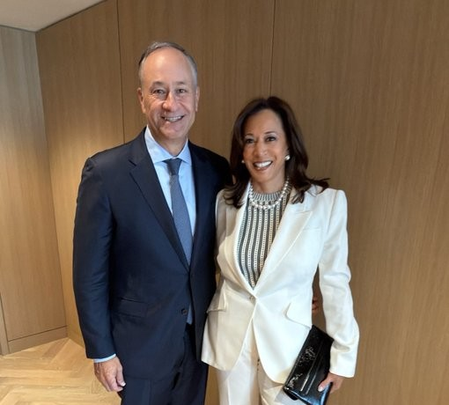
Washington, Oct 10 (IANS) Former US Vice President Kamala Harris is considering another presidential run in 2028, but her husband, Doug Emhoff, has privately expressed reservations about the prospect, while some Democratic donors have warned that another campaign would face significant challenges, according to a media report.
The Wall Street Journal reported on Friday that Emhoff has told people privately he would prefer Harris not to seek the presidency again, although those close to him expect he would support her if she decides to enter the race.
The report, citing people familiar with the conversations, said Harris has been taking steps that could lay the groundwork for another White House campaign, including meeting major donors, hiring political staff and travelling to battleground states to campaign for Democratic candidates ahead of the November midterm elections.
Harris, the daughter of an Indian mother and Jamaican father, has publicly maintained that she has not decided whether to make another attempt to become America's first woman president.
"I have not decided if I’m going to run again," Harris said at an NAACP event in Michigan last month, according to the newspaper.
"I do sincerely believe ’28 won’t matter if we don’t get through ’26," she added, emphasising the importance of the upcoming congressional elections.
A spokesman for Harris declined to comment on the Journal's report.
Harris was the Democratic presidential nominee in 2024 and lost to Republican Donald Trump.
According to the newspaper, some Democratic donors have privately questioned whether Harris should seek the nomination again, while several party figures believe Democrats should consider a fresh candidate in 2028.
The report said Emhoff's concerns come after years of supporting Harris through demanding political campaigns and intense public scrutiny.
In her memoir, "107 Days," Harris described the personal toll of the 2024 campaign on their marriage, including the pressure created by political attacks and public criticism.
Since leaving Washington, Emhoff has resumed practising law in Los Angeles, while the couple have purchased a home in Malibu.
Despite uncertainty surrounding her presidential ambitions, Harris has remained politically active.
The Journal reported that she has participated in several private fundraisers in California, including events supporting Wisconsin gubernatorial candidate David Crowley and Nevada gubernatorial candidate Aaron Ford.
She also joined a Democratic National Committee mobilisation call involving more than 2,000 volunteers, encouraging campaign workers to reach voters in competitive states.
Harris is expected to campaign in Nevada and Georgia, including on behalf of Democratic Senator Jon Ossoff, who is seeking re-election.
She has also strengthened her political operation, working with advisers including former ambassador Candace Bond and communications director Eduardo Negrón.
The report said Harris has maintained ties with Democratic strategist Brian Fallon, who worked on her 2024 presidential campaign.
Her political activities come as several prominent Democrats weigh potential presidential bids.
California Governor Gavin Newsom, another possible contender, has said he would not run if Harris entered the race, according to the newspaper.
Harris continues to have support among important Democratic constituencies, particularly Black women, and has been campaigning to mobilise voters in competitive states.
Democratic strategist Donna Brazile, who remains in contact with Harris, told the Journal that the former vice president was concentrating on helping Democratic candidates in the November elections.
Harris served as vice president from 2021 to 2025 under Biden, becoming the first woman, first Black American and first person of South Asian descent to hold the office. Before that, she represented California in the US Senate and served as the state's attorney general.
--IANS
lkj/rs
‘We will not bow to nuclear blackmail’: India warns Pakistan, vows strong response to terrorism
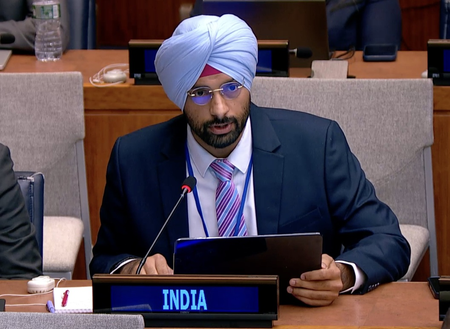
United Nations, Oct 10 (IANS) India has warned Pakistan that it will not be deterred by Islamabad using nuclear weapon risks to attempt to evade the repercussions for its terrorism, and will respond to terror attacks.
“India will not bow to nuclear blackmail”, Anmol Sher Bedi, the senior adviser in India's Permanent Mission to the UN Conference on Disarmament in Geneva, said on Friday.
He served notice on Pakistan that “any terrorist attack against India will receive a fitting response” and it will “make no distinction between those who sponsor terrorism and those who mastermind it”.
Operation Sindoor last year against terrorist bases in Pakistan “followed a grave provocation” of the terrorist attack in Pahalgam by Pakistan-based terrorists who killed 26 civilians, he said.
“India acted in self-defence”, he said, and “these actions were measured, targeted, and designed to be non-escalatory”.
“Nuclear weapons must not be treated as routine instruments of statecraft” and “a posture that relies on nuclear overhang to limit the consequences of subconventional activity raises the risk of escalation and not the prospect of restraint”, he said at the meeting in New York of the General Assembly's First Committee, which deals with disarmament issues.
He was responding to Tahir Andrabi, Pakistan's permanent representative to the UN in Geneva, who spoke at the New York meeting.
Bedi gave the committee the reassurance that India's nuclear capabilities are not directed at anyone and stressed they “are defensive in nature”.
“They are shaped by our own security environment”, he said.
India, unlike Pakistan, has declared a policy of no-first-strike, meaning it will not be the first to use nuclear weapons against any country.
Bedi, who responded strongly to Pakistan, is from Amritsar and ranked second in the 2016 public service exam. He holds a computer science degree from BITS Pilani and has studied Mandarin in China.
He exposed the facts behind Pakistan's call for nuclear cooperation, citing the nuclear bazaar run by Abdul Qadeer Khan, who headed its nuclear programme, that provided nuclear bomb know-how to other countries and traded nuclear material for missile technology with North Korea.
Bedi warned countries to look out for their own safety when they cooperate with Islamabad on nuclear and military technology.
“On proliferation, India refers to the history of the AQ Khan network, which contributed to the Security Council Resolution 1540 almost two decades back”, he said.
“This is relevant in the context of demands for unquestioned nuclear cooperation and transfer of advanced weapons and military capabilities”, he said.
“We urge all states and all responsible suppliers to exercise the highest degree of vigilance, not because of India, but for their own security”, he said.
Security Council Resolution 1540, adopted in 2004, is a binding measure that prohibits all countries from transferring weapons of mass destruction to terrorists, euphemistically referred to as “non-state actors”, or enabling them to obtain them.
It also set up a body, known as the 1540 Committee, to monitor compliance with the resolution.
What destabilises the region, Bedi said, is Pakistan using cycles of crises fueled by terrorism.
“In India's experience, crises in the region have tended to follow a recurring pattern: first, provocation; second, denial of responsibility; and third, appeals for restraint once a response has been made”, he said.
“That is how instability becomes useful, and that is how the cycle keeps on repeating”, he said.
Bedi pointed out that this is enabled by Pakistan's system of governance where the real power is wielded by the military.
“Those in power are neither elected by people nor accountable to them, their decisions carry no risk and impose no cost for those who take them”, he said. “That is how crisis becomes an instrument of power”.
Where the real power lies in Islamabad behind the facade of a civilian government was made clear during Secretary-General Antonio Guterres' recent visit to Pakistan, when he took the unusual step of meeting the military chief Asim Munir, while formal talks with military leaders are not in his usual itinerary.
Bedi said that India put the Indus Water Treaty in abeyance because it was signed on the understanding of trust and cooperation, and Pakistan undermined them.
As for Andrabi raising the Kashmir issue, Pakistan does so regardless of the topic on the meeting agenda, Bedi said, “Jammu and Kashmir is an integral and inalienable part of India. We call for India's illegally occupied territories to be vacated and returned back”.
--IANS
al/rs
US lawmakers urge FBI director Kash Patel to cancel Russia trip
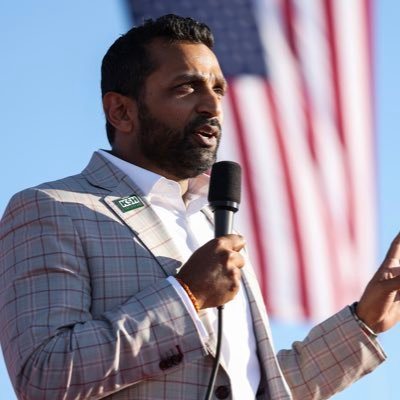
Washington, Oct 10 (IANS) Two senior Democratic lawmakers have urged Indian-origin FBI Director Kash Patel to cancel a reported visit to Russia, warning that the trip could expose sensitive American intelligence to espionage and raise serious national security risks at a time of heightened tensions between Washington and Moscow.
Representatives Jim Himes, the top Democrat on the House Intelligence Committee, and Jamie Raskin, the ranking Democrat on the House Judiciary Committee, raised their concerns in a letter to Patel, made public on Friday.
The lawmakers questioned why the head of America's premier federal investigative agency would travel to Russia while Washington has imposed sweeping sanctions on Moscow over its war against Ukraine.
"In the interest of national security, we ask you to reconsider. Call off this trip," the lawmakers wrote.
According to their letter, Patel is reportedly planning a two-day visit to Moscow and St. Petersburg, where he is expected to be hosted by Russia's Federal Security Service (FSB), the successor to the Soviet-era KGB.
The lawmakers warned that the FSB has a history of surveillance, cyber espionage and intelligence operations targeting American officials, diplomats and other US personnel.
They also expressed concern over reports that Patel has been pursuing closer cooperation between the FBI and Russian and Chinese law enforcement agencies, including personnel exchanges and intelligence sharing.
Such arrangements, they argued, could provide foreign intelligence services opportunities to penetrate American institutions and obtain sensitive information.
The lawmakers questioned whether expanding cooperation with Moscow and Beijing was consistent with the administration's broader national security priorities.
Their letter cited reports that Chinese officials had been granted unusual access to American intelligence personnel, diplomatic officials, government facilities and contractors.
The allegations concerning the scope of that access were based on previous media reports and were not independently established in the congressional statement.
They cited continuing concerns about Russian cyber operations, election interference and alleged intelligence assistance to Iran in attacks involving American forces in the Middle East.
The letter also referred to a reported Russian intelligence-linked plot to assassinate a prominent dissident in Washington.
They said Patel had challenged US intelligence assessments of Russian interference in American elections in the documentary.
The lawmakers did not provide evidence that Patel had compromised classified information, and the letter did not establish that any security breach had occurred.
If Patel proceeds with the visit, Himes and Raskin have demanded a closed-door congressional briefing by 5 p.m. on October 12.
They want details of the FBI's cooperation with Russia, China, Iran and North Korea, including any objections raised internally by intelligence or law enforcement officials.
The requested briefing would also examine who proposed the Russia visit, its purpose, Patel's itinerary, planned meetings and the identities of those accompanying him.
The lawmakers specifically sought information about measures to protect against Russian espionage, including secure communications and other counterintelligence safeguards.
The October 5 letter was released publicly on October 9.
Patel, who is of Indian origin, heads the FBI, which is responsible for federal criminal investigations, domestic counterintelligence and counterterrorism operations. The bureau also maintains international law enforcement relationships to address transnational crime and security threats.
--IANS
lkj/rs
Trump thanks Putin for Russian oil deal
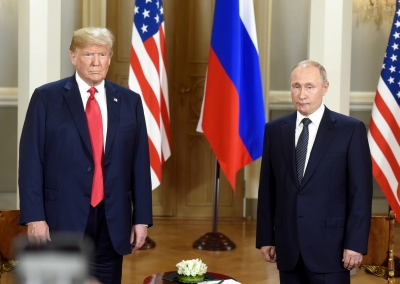
Washington, Oct 10 (IANS) US President Donald Trump thanked Russian President Vladimir Putin for a major oil deal involving diesel supplies to the United States, defended the agreement amid criticism from Ukrainian President Volodymyr Zelensky and kept open the possibility of further military action against Iran.
Speaking to reporters at the White House before leaving for a political rally in Syracuse, New York, Trump described the Russian energy agreement as significant for American supplies and global oil markets.
“By the way, I think you heard about the oil deal with Russia. That is a big deal. That is massive amounts of oil coming into our country. And I want to thank President Putin to be honest with you,” Trump said.
“We have massive amounts of oil being coming into our country and it's diesel, which is what we want. So thank you,” he added.
The President's remarks came as a reporter cited criticism from Zelensky, who was described as having called Trump weak over the agreement.
Trump defended the need for energy supplies and emphasised the importance of diesel.
He also claimed that the agreement was contributing to lower energy prices.
“Look, we need it. Oil prices are already dropping like a rock, so we're very happy to get it,” Trump said.
Turning to Iran, Trump declined to rule out additional American military action when asked why such action was being linked to the upcoming midterm elections rather than undertaken immediately.
Trump portrayed Iran as a country facing severe military and economic difficulties.
“The military is defeated. They have no Navy. They have no Air Force,” he said, while also claiming that Iran was experiencing inflation of 300 per cent.
Asked separately about a reported attack on an airport in Riyadh, Saudi Arabia, Trump expressed disapproval.
“No good. It's not a good thing. I'm not happy,” he said.
Trump also addressed questions about the Fort Hood shooter and the possibility of livestreaming his execution.
Asked whether he wanted the execution broadcast and whether such footage could be used for extremist propaganda, Trump said he was primarily concerned that the death sentence be carried out.
“So I really don't care how he goes as long as he goes. And I think that the death penalty is a, , very worthy way of going for him,” he said.
--IANS
lkj/rs
Green Card, H-1B fuel US growth: USISPF
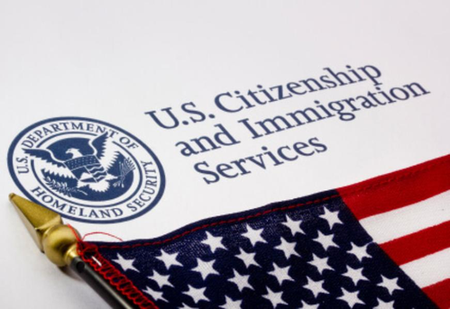
Washington, Oct 10 (IANS) The US-India Strategic Partnership Forum (USISPF) has strongly defended the Green Card and H-1B visa programmes, calling them major drivers of American economic growth and innovation, even as the Trump administration moves to tighten scrutiny of legal immigration pathways.
The influential Washington-based organisation said on Friday that the programmes have helped generate $2.1 trillion in household income and contributed hundreds of billions of dollars in taxes to the US economy.
"The Green Card and H-1B programs are among the United States' most significant economic policy success stories, strengthening America's economic growth, innovation, and global competitiveness," USISPF said in a statement.
The organisation said these immigration pathways have attracted some of the world's brightest minds, helping American companies expand, create jobs and maintain their technological leadership.
Citing an analysis of 2022 US Census Bureau data, USISPF said the legal immigration pathways had generated $2.1 trillion in combined household income.
The analysis, according to the organisation, showed that the immigrants covered had paid $382.9 billion in federal taxes and another $196.3 billion in state and local taxes. Their combined spending power stood at $1.6 trillion.
The statement came against the backdrop of recent action by the US Department of Labour concerning the Permanent Labor Certification (PERM) programme, an important route for employment-based permanent residency.
USISPF expressed support for the administration's efforts to prevent misuse of immigration programmes but cautioned against overlooking their economic benefits.
"We fully support the administration's efforts to prevent fraud and abuse in legal immigration programs," the organisation said, adding that such abuse undermines the domestic job market.
It stressed that immigration pathways must operate with integrity and serve their intended purpose.
At the same time, the organisation said efforts to eliminate waste, fraud and abuse should recognise the contribution of immigrants to American economic success.
The statement placed particular emphasis on Indian Americans, describing the community as an example of how legal immigration has strengthened the United States.
USISPF said Indian Americans account for just 1.5 per cent of the country's population but contribute six per cent of its gross domestic product.
It also described Indian Americans as highly educated and law-abiding, pointing to their role in building successful businesses and advancing American technology.
According to the organisation, Indian Americans co-founded 72 of the 648 unicorn companies in the United States in 2024.
These contributions, it said, have strengthened America's technological position while reinforcing ties between India and the United States.
USISPF also pointed to a recent White House ceremony at which President Donald Trump presented the National Medals of Science and the National Medals of Technology and Innovation to six leading innovators.
Five of the six recipients were born outside the United States, the organisation said, citing the ceremony as an example of the contribution of foreign-born talent to American scientific achievement.
"We share the administration's goal of helping the United States succeed as a global technology leader by attracting the best global technology talent while sustaining a strong domestic job market," USISPF said.
The H-1B programme allows American employers to recruit foreign professionals for specialised occupations, particularly in technology and engineering. Indian nationals have historically accounted for the largest share of H-1B beneficiaries.
The Green Card provides lawful permanent residency in the United States.
Employment-based immigration, including pathways involving H-1B workers and PERM certification, remains an important route for foreign professionals seeking to build long-term careers in America.
--IANS
int/lkj/khz