



Ottawa, May 29 (IANS) Canadian researchers have called for a more coordinated response by G7 nations to counter “systemic” Chinese foreign interference, especially as technology and tactics evolve and Chinese agents join the Canadian societies, local media reported.
Authored jointly by Marie Lamensch and Kyle Matthews, a report by the Montreal Institute for Global Security – titled ‘Guarding the G7: Countering Beijing’s Interference Operations – draws on open-source research and interviews to present case studies of Chinese interference in G7 nations: Italy, Japan, France, Canada, UK, Germany and the US.
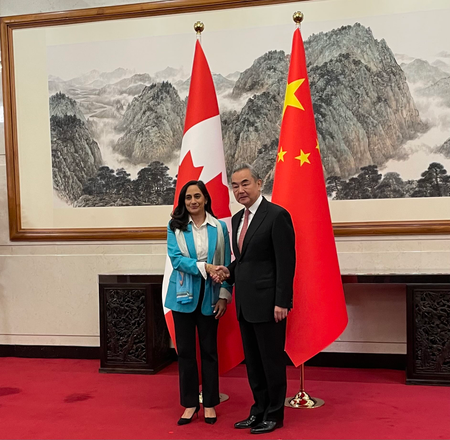
Speaking along with the report’s authors on Parliament Hill, former Canadian MP John McKay urged Canada’s Foreign Affairs Minister Anita Anand to raise the issue of foreign interference with Wang Yi during his visit to the country, Canada’s Global News reported.
“As this is an opportunity for a reset of our relationships between Canada and China, I hope that both ministers will take the opportunity to operationalise that reset so that this level of interference ceases,” he said.
John McKay appealed to journalists to ask Anand and Wang Yi on any commitments made by the Chinese government to stop foreign interference in Canada.
Anand and Wang Yi will have a meeting in Ottawa later on Friday to advance pragmatic engagement and the implementation of the updated Canada-China Strategic Partnership, including on trade and investment, global security, as well as respective bilateral issues, according to the official statement released by the Canadian government on May 22.
The Montreal Institute for Global Security report paid special attention to China’s United Front Work Department, which as per the report, coordinates a broad ecosystem of political, business, academic, media and civil society groups in democratic nations, Global News reported.
The report noted that these groups function legally and often have legitimate ties are pursuing long-term narrative influence that further China’s interests abroad.
Marie Lamensch, the Director of global affairs at the Montreal Institute for Global Security, said, “It’s a little bit like the ancient Chinese game ‘wei chi’. It takes space over a long time, it is adaptive, and the government basically takes its time.”
Lamensch said universities in G7 nations are also susceptible to partnerships with Chinese academics and schools that are being pursued for ulterior motives. The report also mentioned about instances of transnational repression, including intimidation of Chinese nationals through so-called “police stations” established in Canadian cities and other methods. The authors stressed that intelligence sharing, foreign influence registries and coordinated national strategies on managing foreign partnerships are needed for countering China’s influence activities, Global News reported.
Meanwhile, Canada-based Uyghur Rights Advocacy Project (URAP) urged Canadian Prime Minister Mark Carney and Foreign Minister Anita Anand to publicly raise the mass detention and surveillance of Uyghurs in East Turkistan, also known as the Xinjiang Uyghur Autonomous Region of China, during their meeting with the Chinese Foreign Minister.
It further urged the Canadian leaders to highlight the ongoing forced labour and supply-chain abuses and the growing pattern of transnational repression by Beijing targeting Uyghur activists and human rights defenders in Canada.
The URAP warned that Canada risks undermining its own human rights commitments by advancing memoranda of understanding and broader strategic partnership agreements with Beijing amid the persistent “genocide” and “transnational repression” against Uyghurs.
The group also raised concerns over “undisclosed” Canada–China law enforcement cooperation agreements and Royal Canadian Mounted Police (RCMP) memoranda of understanding involving information sharing, investigative assistance, and coordination with Chinese public security authorities.
Citing critics, it said that such agreements lack transparency and parliamentary scrutiny and may expose vulnerable communities to further risk.
“We cannot normalise relations with the Chinese government while Uyghurs remain imprisoned, families are separated, and survivors of repression continue to seek justice. Economic cooperation must never come at the expense of human rights,” said URAP’s Executive Director, Mehmet Tohti.
The URAP called for renewed attention to the case of Canadian citizen Huseyin Celil, a Uyghur-Canadian who has remained imprisoned in China since 2006 after being detained during a visit to Uzbekistan and later transferred to Chinese custody.
–IANS
akl/as