



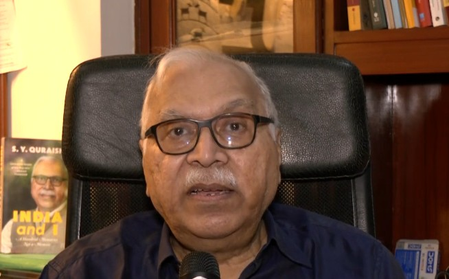
New Delhi, July 14 (IANS) Former Chief Election Commissioner S.Y. Quraishi has revealed a startling conversation with former Prime Minister Manmohan Singh in his new book “India and I: A Hundred Memories, Not a Memoir”, recounting how he had told him he would “commit suicide” after mistakenly believing the then CEC Quraishi had questioned his commitment to the poll panel during a controversy over the censure of then Union Minister Salman Khurshid for violating the Model Code of Conduct during the Uttar Pradesh Assembly elections.
In an exclusive interview with IANS, Quraishi said that the remarks of the former Prime Minister came to him as a “bombshell” and he was “totally shell-shocked”, after which he had spent 15-20 minutes calming Manmohan Singh down.
Here are the excerpts of the interview.
IANS: What would you want to say about your new book “India and I: A Hundred Memories, Not a Memoir”? What are the highlights of the book?
S.Y. Quraishi: There are many interesting anecdotes from my childhood, from my college days when I joined the academy in the Civil Service, and in elections. So, I think the political episode probably will draw more attention. It’s very difficult to pick and choose because all these episodes are part of my life.
IANS: Why did then Prime Minister Manmohan Singh say that he will “commit suicide”? Why was the issue so serious?
S.Y. Quraishi: There is a story behind it. What happened was that we were conducting UP elections, and in those elections the then Law Minister, Salman Khurshid, a very fine person otherwise, but in the heat of the moment in the election when he was campaigning for his wife, he announced that they would increase the quota of minorities from 4.5 per cent to 9 per cent. So, immediately the BJP filed a written complaint; we asked the other party to explain. We heard a battery of lawyers on both sides. Then we came to the conclusion that Khurshid had indeed violated the Model Code, so we decided to censure him.
Under the Model Code, we cannot impose any fine or anything except advise, reprimand, or censure; censure is the maximum, and there is no judicial appeal also, but it amounts to conviction. So, we did that. After that, we were told by our common friends that some Congress leaders were indulging in loose talk, highly critical of me personally and the Election Commission for arrogance and for being arbitrary, whereas what we had done was a totally transparent judicial process which we had followed.
Criticism of the Election Commission was not acceptable; personally, I would not mind. So, I met Harish Khare, who was media advisor to the Prime Minister, and mentioned that some politicians are indulging in loose talk against us, which is not acceptable, and if we make it public, they’ll run for cover. So, he said, ‘Should I tell the Prime Minister? I said it is meant for the Prime Minister, do tell him please. So, the next day the Prime Minister called me, and he was so nervous, almost in panic. He said, ‘Mr Quraishi, I want to meet you urgently’. I said, ‘Sir, tell me where’. After some discussion, we decided to meet at his residence at 7 p.m. When I reached there, he was waiting at the door; he escorted me in. When we both sat down, he said, ‘Mr. Quraishi, Harish told me what transpired between you and him yesterday, and if this is what you think about me, I’ll commit suicide’. I was not prepared for this. It came to me as a bombshell. I was totally shell-shocked and didn’t know what to say, how to react, and after that I spent 15-20 minutes to calm him.
“I told him, ‘Sir, my remarks were not directed at you. They were meant for ministers and political leaders who were engaging in irresponsible and loose talk. You have always been a strong supporter of the Election Commission, and that is a matter of record.’
Every time I met Dr Manmohan Singh at official functions, he would speak with pride about India’s democracy. He often said that one of the country’s greatest strengths and sources of global recognition was its robust electoral system and the conduct of free and fair elections.
He also told me that if I ever had any concerns, I could simply pick up the phone and speak to him directly. That reflected his sensitivity and openness. First, he had immense respect for institutions, and second, he felt strongly that baseless aspersions should never be cast on an institution that he deeply believed in and respected.
That is why he was so disturbed by such remarks. I believe this episode highlights the innate goodness of Dr Manmohan Singh — his integrity, his respect for democratic institutions, and his unwavering commitment to fairness.
IANS: Was there any pressure on you from the government during your tenure as the CEC?
S.Y. Quraishi: There is no question of pressure. The government was very scared of us, and it was our Dharma mandated by the Constitution to keep distance from the government. Constitution provides that once the Chief Election Commissioner is appointed by the government, they cannot touch him, cannot remove him or do anything or transfer or shift him. So, keeping a distance between the executive and the Election Commission was the mandate of the Constitution, and in our time we absolutely both sides honoured it completely.
IANS: Do you think there was power politics in play to manipulate the election results during your tenure?
S.Y. Quraishi: There is no question about that, absolutely out of the question. It was unthinkable. Nobody dared, and nobody did.
IANS: Did you ever interact with Rahul Gandhi during your time as CEC?
S.Y. Quraishi: No, not at all. I bumped into him a couple of times in official functions in Rashtrapati Bhavan, but I don’t know whether we even wished each other, but just saw him from a close angle.
IANS: During your tenure, Samajwadi Party chief Akhilesh Yadav’s wife Dimple Yadav was elected unopposed. Do you find it a fair election or it was a state-sponsored show?
S.Y. Quraishi: I don’t know; it’s a very old thing that you brought out. I remember that she came unopposed; there were two or three candidates initially, but they withdrew, and we tried to find out from them whether they had withdrawn voluntarily. I don’t remember the details; probably they had, so it’s all political dynamics and more than that we had no personal knowledge.
IANS: What was your observation regarding that bypoll?
S.Y. Quraishi: Regarding bypoll? No, nothing. Nothing, there are several elections which are won unopposed, so it was a bit surprising that UP is a hotbed of politics and why nobody chose to contest the election. Maybe out of respect for this new entrant, the young lady. I don’t know. We conducted the election, declared the results, and moved on, nothing more, nothing less.
IANS: Was EVM a big issue in your era also?
S.Y. Quraishi: Oh, yes, very much. In fact, it was at the peak in our time. Even before I became CEC in 2010. The BJP was the biggest critic of EVMs, and they even wrote a book, ‘Democracy at Risk’. It was written by G.V.L Narasimha Rao with a foreword by L.K. Advani, and they were questioning the dependability and trustworthiness of the EVM.
When I took over, I immediately called a meeting of all political parties, as was my norm because it’s good to discuss with them, with all the opposition parties, it was led by Chandrababu Naidu. I was initially very surprised to see him leading a delegation which is anti-technology because he was a technology icon. I told him that, and I said: “Chandrababu ji, tell me what your grievance and problem is; I will try and solve. And my challenge is that, at the end of the day, either you will convince me, or I’ll convince you to become the brand ambassador of EVMs”.
He laughed, and of course then he explained, he said: “I’m not saying that EVMs have been manipulated and they have manipulated the result or will do so in the future”. Then I said, ” Then what are you saying? He said, “All we are saying is that there is no transparency. Meaning thereby, when you press a button, it goes into a machine; whether it is going to the right candidate or not, it’s not visible to the naked eye”.
I asked what the solution is. He said: “Introduce VVPAT, Voter Verifiable Paper Audit Trail, which means there will be a printer attached, and on that printer there will be a screen on which, when you choose a candidate, it will appear on the screen. So, that is how you are able to verify: yes, this is the guy I have chosen, so you can see for yourself. And after that, a chit or a slip will get cut automatically and go into a sealed box, and then you can compare the figures in the machine and the slips which it has generated.”
Lakhs and lakhs of them were compared, and they all tallied. Therefore, with the help of VVPAT we were able to establish, re-establish the credibility of EVMs. Questions are being raised now about VVPAT, how many to be counted and all that; that’s a matter of detail, and of course we have to find a solution. If some parties and many parties in this case are questioning it, we should listen to them. Surely, just as we listened to them and found a solution. So, if you talk to them and ask them to explain what it is that they want, surely a solution will be found.
IANS: Was there any EVM manipulation during your period?
S.Y. Quraishi: No question about that. Absolutely nothing. Nothing of the sort. Even people losing by one vote accepted the results with grace.
IANS: What was the relationship between Rahul Gandhi and Manmohan Singh, to your observation during the time in the office as CEC?
S.Y. Quraishi: We have no idea because what was happening inside a political party, we had nothing to do. We dealt with them only when they came to the Election Commission as a delegation. More than that, we knew nothing about what was happening except whatever we heard in the media, so, more than that, we know nothing personally.
IANS: Was money power used for the elections during the UPA-led government?
S.Y. Quraishi: That is a serious question because when I took over in 2010 as CEC, I gave myself, in my own inaugural press conference, two challenges. One was voter apathy, particularly of a so-called educated urban people, who were never voting and were bragging about it, and second was money power.
We found a solution; the solution that we suggested and we tried to do was to create two separate divisions in the Election Commission. One was for voter education; we brought a professional from the Information and Broadcasting Ministry as its first Director General. And for money power, we created the Expenditure Monitoring Division, where we got an Income Tax Service officer who was working in CBDT and made him the DG. He created the rules and regulations and all that, which we publicised; we gave training to politicians so that they do not make mistakes. We wanted to be preventive rather than punitive.
Initially, we had great success because we started seizing money in crores and later on hundreds of crores. But, in fact, in my first book, ‘An Undocumented Wonder: The Making of the Great Indian Election’, it’s mentioned that I had identified 40 modus operandi of abuse of money power, which is what we had discovered. You know how they were using money through newspapers. You know when you open the newspaper, the cash will flow, or they will go door to door. Slip in some gold chain, and they were holding fake marriage parties and birthday parties to host the voters to dinner and all that.
We discovered all kinds of modus operandi. But I’m sure they have come up with many more. So, I would not say that we have controlled the situation as we would have wanted to.
IANS: In Section 6 of your book, you mentioned that there was a PMO posting you rejected. What was that?
S.Y. Quraishi: I was Joint Secretary in the Ministry of Youth Affairs, and in addition I was also Director General of Nehru Yuva Kendra Sangathan, which had 3 lakh youth clubs all over the country, and I was also the head of NSS, National Service Scheme, which was operational in 300 universities. So, with the result, instead of a Secretariat job, my job had become a field job. In fact, it had a double benefit. I was also a Secretariat officer, as Joint Secretary, but as DG and as Director of NSS, the whole country was my field, and I found it unique. It was the only job of its kind, and I was quite enjoying it.
When somebody told me that you are going to PMO, he thought I’ll be excited, but I was shocked. I said: “But I don’t know; nobody has told me”. So, he said, “No, all decisions have been taken. Security clearance is obtained, and this order must be coming any minute, maybe by evening or tomorrow morning”. So, I was genuinely shocked, because normally, anybody would jump at that job. But one thing is that I was enjoying my current job and I didn’t want to move to PMO, where you become totally anonymous, faceless, nameless; you are a backroom boy. It is, of course, very important; working in the PMO is a privilege otherwise.
I also had another funny notion; maybe wrong, maybe right; I don’t know; that I would not like to work in three Ministries, PMO was one and Home Ministry and Defence Ministry because there was a kind of a communal feeling around — “oh, this is a Muslim officer, therefore, let us keep an extra watch on him”, that was not acceptable to me at all. That was insulting. I used to think that I would rather be a king in Panchayati Raj Department, than be a suspect in these three Ministries. People may not agree with it, but that was my view. It was a considered long-term view. I didn’t want to go.
My neighbour was the Additional Secretary, PMO, N.K. Sinha, who was first very angry and said, “How did you know, how did you get to know? It was supposed to be an all-secret process.” I said, sir, somebody told me, but I really don’t want to go. I said that I also don’t want to go in a kind of a quota — a Muslim officer. I don’t want to come as a Muslim officer; I want to come as a brilliant officer, as a bright officer. I want to come in that capacity. He said, “We do need a Muslim officer because there are some matters in which we need their advice, like Waqf”, so I said, you can get a Director or maybe I can suggest some other names, but this is my hang-up.
But my feeling was not wrong; there was a Secretary to the Prime Minister, Narasimha Rao, K.R. Venugopal… he was my boss, and he was very fond of me. When I met him, he totally agreed with me. He said, “Yaqub, your stand is absolutely correct, because six months ago I had asked you by name, and that is when they say, no, we already have a Muslim officer; we can’t have two. So, therefore your stand is right.” So, finally I had prepared an alternative list of names which were not acceptable and the incumbent then was given an extension for two years.
IANS: You mentioned in Section 5 about how television could change India. What do you have to say about this?
S.Y. Quraishi: These are some anecdotes from my days as DG, Doordarshan. One was about the TRP scam. I found that the private channels, when they came as cable and satellite channels, were all ganged up to cheat Doordarshan of its revenues by wrong interpretation. They came out with an interpretation that only 2 per cent of people were viewing Doordarshan, which was rubbish. Because that was the time when 52 per cent of India had only terrestrial TV… Which means half the country had 100 per cent Doordarshan… So 51 per cent of India was watching Doordarshan; the other channels were being watched together for 48-49 per cent. But the revenue was coming to us only as a channel with 1.5 per cent or 2 per cent audience. So, this was absolutely an attempt to defraud the public broadcaster.
They were using people metres. So, I went into the workings of the metre; there used to be a set-top box on the TV, and how it was connected to the TV by opening the back of the television, which means you lose warranty. Who would like to volunteer? Would you like to have that TV in your house, where every time you leave the room in front of the TV, you go to the toilet, you go to the kitchen, you have to press a button, come back, you press another button, and you keep doing that the whole day. Who in their senses would do that? Except somebody who had been paid. So, this was a racket which I tried to expose and which is what I have detailed here.
IANS: Once you were pointed out as a Muslim, as you have mentioned in the book. Can you explain more about the incident?
S.Y. Quraishi: For 40 years in the civil service, I have repeatedly said that all the glory that I got was from the Hindus. And all the brickbats which I got were from Muslims, and that too from Malerkotla in Punjab. They were known to be of this nature, this temperament, and they used to… I was the Administrator of the Punjab Waqf Board for some time. They used to send all kinds of false complaints against me all the time, harassing me. So, that was the context. I had not encountered any communalism in the civil service.
I was a Divisional Commissioner of Gurgaon, which had four districts in it. Elections came, and the Chief Electoral Officer of Haryana and the Home Secretary came visiting. I took them to all four districts. We reviewed the arrangement for two days. And when they were leaving, suddenly the CEO told me: “Mr Qureshi, you haven’t gone for your observer training because you have been appointed an observer in Yamuna Nagar”. I said, sir, for two days I am with you, the whole day in four districts. You never uttered a word, and now suddenly, when you are leaving, you are saying this. He said, no, that’s (training) very important. You can’t get any exemption from that.
I thought this was a mistake because I also had an additional charge at that time of Resident Commissioner. So, the Resident Commissioner is not conducting elections; maybe that’s why they gave me this duty. Haryana was under President’s rule at that time, so I spoke to Zafar Saifullah, who was the advisor and said: “Sir, there seems to be a mistake. He said, ‘Yeah, it looks like it; you forget that observer duty and you do your work in the division”. Then in half an hour, he called me and said, “Mr Qureshi, you will have to attend that observer duty because the Chief Secretary here has taken a stand that in Gurgaon district, there is an area called Mewar where there are a lot of Muslims and therefore having a Muslim Commissioner supervising the election will not be right”.
I think that was a very, very unfair stand because a Hindu Deputy Commissioner supervising the Hindu voters, that is fine. But saying there were some Muslims in one district. I think it was only foolish, I would say, or should I say mischievous. But I didn’t like it at all. That was the only time. Otherwise, all my bosses and all my colleagues and all my friends, colleagues, they were all very secular, and I was very close and dear to them.
IANS: How was your meeting with Rashtriya Swayamsevak Sangh (RSS) Chief Mohan Bhagwat? You have mentioned the meeting in your book.
S.Y. Quraishi: Yes, that is another thing which has received a lot of media attention in the past, but since people still keep on asking me, I’ve mentioned that you know, we were some friends group of friends 4 or 5, we were not happy with what was happening, the lynching every day and the hate speech and bulldozer, so, we wanted to go and mention it to Bhagwat that enough is enough. So, we sought an appointment with him, which he immediately gave, and we went to see him, and of course he said what grievances were, and we mentioned them, and it was decided that dialogue is the best way. We should keep in touch, and we have had two or three meetings after that, and I think they have been useful.
IANS: You also mentioned that Javed Akhtar made you a hero and then a villain. Can you explain why?
S.Y. Quraishi: Well, that’s an interesting story… I am sure one of the highlights of my tenure, all six years, was the UP elections. I think the best UP elections ever were held when I was the CEC and my two colleagues, of course, were ably supporting me, so we did wonderful elections. Immediately thereafter, there was a function in Delhi Gymkhana Club where Javed Akhtar sahab was there, and there were others, and Javed Sahab said that “You know Mr Quraishi, you were the hero of UP election”. So, I said: “Javed bhai, you will give me a role in your next film”. So, he says: “Role to de dunga, lekin villain ka hoga (I will give you a role, but it will be that of a villain”. What he meant was that he will give a role, but since I may have been a hero to the people, the voters, but I was a villain for the politicians whose tricks I did not permit at all. So, that is what he was hinting at, and we just laughed it off.
IANS: You have also written about your meeting with former Bangladeshi Prime Minister Sheikh Hasina. How do you see that meeting?
S.Y. Quraishi: In 2014, I had retired already for 2 years, so I was going to Bangladesh for some lecture. But the then High Commissioner of Bangladesh in India said: “Sir, if you are meeting Sheikh Hasina, please tell her the importance of the Election Commission and its credibility”. So, that was very important and significant. So, I said, all right. So, I sought an appointment, a courtesy call with Sheikh Hasina, and she readily agreed. I went with my High Commissioner, Pankaj Saran. She came with seven of her top advisors as if it was a formal meeting and a summit. I was just a retired CEC, but India had that image and that reputation that even a retired CEC enjoys a lot of respect and credibility.
We had an over-one-hour meeting in which I explained to her why a credible election is extremely important, and she was a bit defensive, but also receptive to the idea. And this was a very nice meeting; then we met ten years later just before this recent controversial election, and then she looked a little tired, and then she complained that she suspects that foreign powers are trying to unseat her, they want a change of regime. So, which is exactly what happened.
IANS: In one section of your book, there is an instance mentioned where a Chief Minister stopped talking to you. Can you tell us more about it?
S.Y. Quraishi: The Chief Minister was Om Prakash Chautala. I was very close to him because I was very close to his father (former Deputy Prime Minister Devi Lal), whom I had worked with. But on bureaucratic intrigue, I was given a sideline post of Haryana Mineral Corporation. One day he called a meeting in Chandigarh and said that some mines with which we were operating our corporation should be given to a private man. I said: “Sir, I can’t do that because that’s the way I’m paying my salaries. You close down the corporation, but I cannot give this”. He was very unhappy because nobody had the courage to speak to a Chief Minister like that. For three-four months he did not speak to me, and suddenly one fine day, when the Principal Secretary to the CM’s post was falling vacant, and there were a whole lot of candidates – every day some new name would come – then he called me and said: “Quraishi, I want to make you my Principal Secretary.”
Here is a man who has not talked to me for three months and suddenly wants to make me the Chief Minister’s Principal Secretary, the most powerful job in the state. I was surprised. I said: “Sir, are you sure? Have you thought about it?” He said: “Mr Quraishi, we will need to give your Principal Secretary’s job without thinking.” I said, it is good to be clear about certain things, so because there are certain things I cannot do, with referred to money making frankly, so but there are certain thing in which I’m strong; I said I have bright ideas for development programmes, new ideas keep coming up and half of them I’m able to implement also, and secondly, I know the art of getting money from the Government of India because I had worked in Government of India. He said: “That is exactly what we want”.
Then he appointed me, and he said: “But keep it a secret for three weeks, because there are a whole lot of critics and hostile elements who will sabotage it”. This is a moral for the civil servants, that you should not stray from your path of honesty, and because politicians may find you inconvenient temporarily, but in the heart they respect only the honest people, which you can’t find a better case and better proof than this story tells you.
IANS: Why do you think we have to rethink teaching mathematics in schools?
S.Y. Quraishi: I have two children, and I have seen that when they were going to school, 90 per cent of their time was being spent only on one subject, mathematics; 90 per cent of our money was being spent on their tuition, and that was the case in every home. So, why should mathematics be thrust on everybody? Trigonometry, calculus — why should it be? I have asked mathematicians: have you ever used this in your life? They haven’t.
I said, instead of thrusting it on everybody, after eighth class, which is elementary mathematics, after that you make it optional. Bright people who are brilliant in maths, let them go and do their PhD. But why thrust it on everybody? In fact, wherever I mentioned in school functions, I got maximum applause, which shows that the children want this.
–IANS
sd/vd