

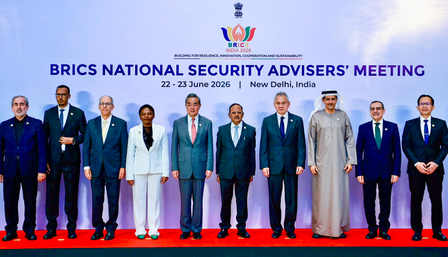
Cape Town, July 25 (IANS) The 16th BRICS Meeting of High Representatives for National Security (National Security Advisors’ Meeting) in New Delhi underscored the urgency for stronger regional and multilateral cooperation to develop collective responses to emerging challenges, a report has stated.
“There is a growing need for stronger regional and multilateral cooperation to develop collective responses to challenges such as terrorism, infectious diseases, energy insecurity, cybercrime and climate-related disasters. The urgency of such cooperation was underscored at the 16th BRICS meeting of high representatives responsible for security matters,” South African media outlet ‘The Citizen’ mentioned.
According to the report, the meeting witnessed calls from India and South Africa highlighting the need for deeper collaboration among member states to confront the shared challenges.
While addressing the meeting, India’s National Security Advisor (NSA) Ajit Doval warned about the global security environment, which was becoming increasingly volatile, with military conflicts, economic pressures, geopolitical uncertainties and rapidly evolving technologies together threatening the stability of BRICS member states.
The Citizen highlighted NSA Doval’s comments about disruptive technologies and cyberattacks transcending national borders, making conventional defence and security responses increasingly inadequate.
NSA Doval had mentioned that the meeting was taking place at “very tumultuous time” and that international institutions were struggling to respond effectively to increasingly complex challenges with multilateral cooperation itself being under strain.
The report detailed that national security was traditionally defined in terms of armed aggression and military conflict, but in the current era of globalisation with digital connectivity and rapid technologies, countries are confronting a far broader range of non-traditional security threats like cyberattacks, pandemics, terrorism and the misuse of Artificial Intelligence (AI).
“Unlike conventional military threats, these emerging challenges are often interconnected, transnational and difficult to contain. Cybercrime, for example, can finance terrorist networks operating across borders, making it both a criminal and national security concern,” The Citizen report noted.
Delegates also highlighted the protection of critical infrastructure, maritime security and key international energy routes as strategic priorities considering that global energy supplies are disrupted by tensions surrounding the conflict in the Middle East. The meeting also identified the growing threat posed by AI-driven disinformation campaigns as an area where enhanced BRICS cooperation could make a significant difference.
–IANS
ksk/as