



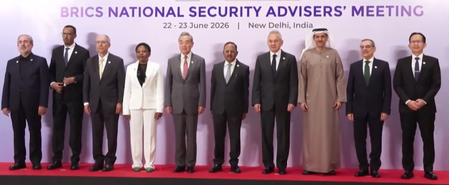
New Delhi, June 23 (IANS) National Security Advisor (NSA) Ajit Doval on Tuesday said that BRICS is far more than a grouping of nations, describing it as a collective home to nearly half of the world’s population with a “special role” in addressing global challenges at a time when the international order is facing growing instability, geopolitical tensions, and evolving security threats.
Addressing the 16th BRICS National Security Advisors’ Meeting, NSA Doval welcomed his counterparts and reaffirmed India’s commitment to strengthening cooperation among member countries. He thanked the participating nations for their continued engagement and support in advancing collaboration within the grouping.
“I thank each one of you for your presence today and your continued commitment to strengthen cooperation among BRICS countries,” NSA Doval said at the outset of his address.
Highlighting the current global situation, he observed that the world is passing through a particularly turbulent phase marked by armed conflicts, geopolitical uncertainty, economic pressures, and the emergence of disruptive technologies that are reshaping the international security landscape.
“We are meeting at a very tumultuous time. The world is beleaguered by military conflicts and complex security problems. It is facing geopolitical uncertainties, economic strain and disruptive technologies,” he said.
NSA Doval noted that the challenges confronting the international community are becoming increasingly complex and difficult to manage, while the existing institutional frameworks and conflict-resolution mechanisms are struggling to respond effectively.
“Not only are the threats compounded, but the instruments and institutional mechanisms are increasingly finding themselves inadequate to resolve or mitigate these conflicts,” he said.
Expressing concern over the weakening of multilateral cooperation, NSA Doval stated that the global system was witnessing a decline in multilateralism at a time when collective action was needed more than ever.
“Multilateralism is on the decline,” he remarked, while recalling the original vision behind the formation of BRICS.
According to the NSA, BRICS was “conceived as an informal grouping of emerging economies” with the objective of promoting a more “multipolar world order”, enhancing economic cooperation, and amplifying the voice of the Global South in international affairs.
He said the grouping was also founded on the aspiration of reforming global governance structures and improving international institutions so that they better reflect contemporary realities and the interests of developing nations.
The NSA described BRICS as a “very special coalition” of countries united by common aspirations for peace, development, economic growth, and cooperation. He expressed satisfaction at the steady expansion and growing influence of the grouping on the global stage.
“It is no ordinary grouping, but a home of 1.4 billion people that constitutes nearly 49 per cent or nearly half of the global population. Together, it also contributes 31.5 trillion dollars to the creation of global wealth. This GDP is more than 30 per cent of the global economy. It has a land mass of over 42 million square kilometres. Very importantly, it has a global spread. We are here from different continents and regions, and it is a grouping where we bring with us very diverse experiences,” NSA Doval said.
Emphasising the significance of BRICS in the present global environment, he added, “We have a special role to play in a world which appears to be in turmoil, which appears to be changing, a world in which the instruments of conflict resolution are probably getting vented.”
NSA Doval also referred to recent diplomatic developments involving the United States and Iran and welcomed the Memorandum of Understanding reportedly reached between the two countries. He said India viewed the development with cautious optimism and hoped it would contribute positively to regional and global stability.
“We have got cautious optimism, and we hope that it will work. It will help energy security. The opening of the Strait of Hormuz is a very welcome development. It will remove supply chain bottlenecks, and many of the shortages in the field of fertilisers and chemicals, among others, will be addressed. The freedom of navigation that will be available to countries in the region and beyond will probably also greatly improve our economic prosperity,” he said.
Turning to emerging security concerns, NSA Doval stressed that BRICS member states must remain alert to evolving threats that increasingly transcend national boundaries and are often difficult to counter using traditional methods.
He pointed out that non-traditional security challenges have become more sophisticated and adaptive, making conventional responses less effective.
“Non-traditional threats have transcended national borders and have developed defeat systems against conventional responses. Innovative disruptive technologies, more camouflaged variants of terrorism, cyber threats, in a world that is getting increasingly digitised, all constitute important threats for us. Today, we will be navigating some of these non-traditional security challenges in our collective deliberations here,” he said.
NSA Doval further noted that the meeting would deliberate on the outcomes of the two BRICS Joint Working Groups dealing with counter-terrorism and security in the use of information and communication technologies, both of which have gained increasing relevance amid the rapidly evolving global security environment.
“We will also discuss the outcomes of the two BRICS joint working groups on counter-terrorism and on security in the use of information and communication technologies. I look forward to your valuable interventions,” he added.
India is hosting the BRICS National Security Advisors’ Meeting, bringing together top security officials from member countries to deliberate on evolving global security challenges and strengthen cooperation on key strategic issues.
The National Security Advisors and heads of delegation from BRICS member states are participating in the meeting.
–IANS
sd/rad