



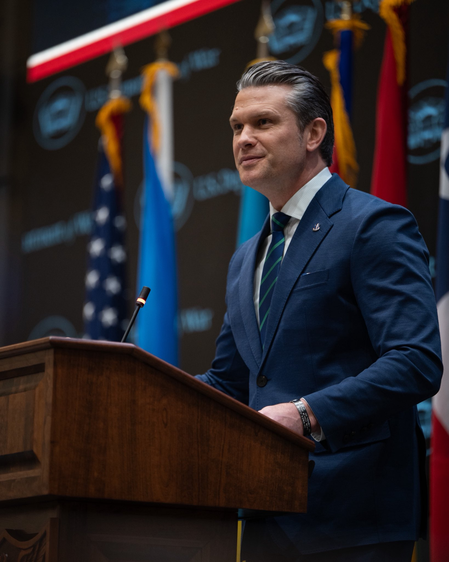
Washington, April 24 (IANS) The United States on Friday said its expanding naval blockade of Iran was tightening “by the hour”, as Defence Secretary Pete Hegseth asserted that Tehran faced a stark choice between a nuclear deal and mounting economic collapse under sustained American pressure.
“Operation Epic Fury has delivered decisive military results in just weeks,” Hegseth told reporters at the Pentagon, contrasting it with “endless wars of the past” that “dragged on for years and for decades with little to show for it.”
He said the mission remained unchanged: “Iran will not have a nuclear weapon.”
Hegseth said the US Navy was enforcing an “ironclad blockade” from the Gulf of Oman to global waters, warning that “every ship… to and from Iranian ports has been turned around” if deemed in violation.
“As of this morning, 34 total non-Iranian vessels are allowed to transit, and many have,” he said, adding that a second aircraft carrier would join the operation within days.
Chairman of the Joint Chiefs of Staff, Air Force Gen. Dan Caine, said US forces had already demonstrated willingness to use force. He described a maritime interdiction earlier this week in which a large container vessel ignored repeated warnings.
“After exhausting all other measures, CENTCOM authorised disabling fire,” Caine said, adding that US forces fired into the ship’s engine room before Marines boarded and seized control.
He said the vessel and its crew were now “safe in US custody.”
The Pentagon also confirmed multiple global interdictions of sanctioned Iranian oil shipments, including large crude tankers in the Indo-Pacific and Indian Ocean regions. “We will continue to conduct similar maritime interdiction actions,” Caine said.
Hegseth said the blockade was now “growing and going global,” asserting that “no one sails from the Strait of Hormuz… without the permission of the United States Navy.”
He accused Iran’s Revolutionary Guard Corps of behaving like “pirates” and “terrorists,” alleging attacks on commercial vessels and responsibility for regional instability.
The US has also authorised lethal action against Iranian fast boats laying naval mines. “If Iran is putting mines in the water… we will shoot to destroy — no hesitation,” Hegseth said.
He urged allies, particularly in Europe, to play a greater role in securing global shipping routes. “The time for free riding is over,” he said, adding that Europe and Asia depended more heavily on energy flows through the Strait of Hormuz.
Referring to Donald Trump, Hegseth said the President was “not anxious for a deal” but had left the door open for negotiations if Iran abandoned its nuclear ambitions “in meaningful and verifiable ways.”
“We have all the time in the world,” he quoted the President as saying.
Caine said the joint force remained “postured and prepared to commence major combat operations” if ordered, underscoring that the situation remained fluid.
The developments come amid heightened tensions in the Gulf, a critical artery for global oil supplies. The Strait of Hormuz handles a significant share of the world’s seaborne crude, making any disruption a major concern for energy markets and global trade.
–IANS
lkj/as