



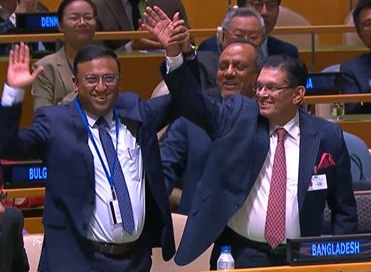
United Nations, June 2 (IANS) Bangladesh Foreign Minister Khalilur Rahman was elected the next president of the United Nations General Assembly on Tuesday, narrowly defeating Cypriot diplomat Andreas Kakouris.
Rahman will head the Assembly in September when its next session begins and succeed Annalena Baerbock.
External Affairs Minister (EAM) S Jaishankar congratulated Rahman and offered to work with him in promoting shared goals.
“Congratulations to FM (Foreign Minister) Dr Khalilur Rahman of Bangladesh on his election as President of the 81st Session of the United Nations General Assembly,” he wrote on X.
“Look forward to working closely with him to advance our shared priorities and strengthen multilateral cooperation,” he added.
Under the rotating system of the Assembly presidency, it was the turn of the Asia-Pacific group, and there were two candidates contesting it.
Rahman received 99 votes of the 190 polled in the 193-member organisation, and Kakouris 91.
Rahman, who became foreign minister in February, started as a career diplomat, doing a stint at the Bangladesh UN mission.
He also served as the national security adviser and has worked for the UN.
Rahman said the theme of his presidency will be “Restoring Trust, Managing Transformation: A United Nations that Delivers for All”.
“The eighty-first session of the Assembly (that starts in September) will open at a historic crossroads,” Rahman said after his election.
The next secretary-general will be elected during that session, although the Security Council will have the final say.
The Assembly will also face the budgetary crisis that is expected to come to a head later this year.
Other issues that the UN confronts include the Iran war and its effects on the economies of developing countries, and the conflicts around the world.
“I intend to work with Member States to prevent another lost decade” of development because of the economic crises, Rahman said.
Regarding conflicts and other issues, he asserted that his country’s UN peacekeeping experience will help him navigate the crises through multilateral cooperation.
Secretary-General Antonio Guterres said Rahman will be taking the reins of the Assembly “at a moment of deep challenge but also profound possibility for our organisation”.
“But the hard work of diplomacy, dialogue and collaboration that happens each and every day here at the General Assembly gives me renewed hope that we can transform divisions into determination to work in common purpose,” he added.
This is the second time a Bangladeshi will hold the post; former foreign minister Humayun Rasheed Chowdhury was the Assembly president during 1986-87.
The election this time brought one of the dividing lines at the UN to the fore – between the well-organised Muslim nations clustered around the Organisation for Islamic Cooperation (OIC), which lobbied for him, and the West that mostly backed Kakouris.
The US Deputy Permanent Ambassador Tammy Bruce said the Assembly will rely on his “impartial leadership to follow through” on his theme of “Restoring Trust, Managing Transformation: A United Nations that Delivers for All”.
“We hope that you seize this opportunity to improve the Assembly’s efficiency, reduce its costs, and refocus on core issues, measuring success by the quality of the results achieved — not by the volume of declarations produced,” she told him, reprising the US demands of the organisation.
–IANS
al/ksk/uk