

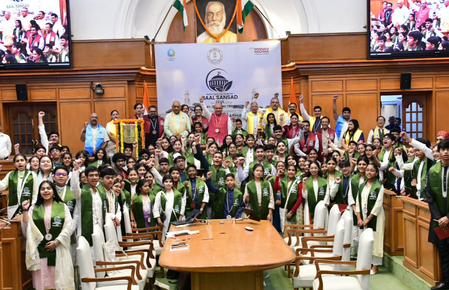
New Delhi, Oct 7 (IANS) The Delhi Assembly witnessed an unusual yet inspiring session on Wednesday as children aged between 7 and 17 years took the seats of legislators and debated pressing issues related to the environment and sustainable development.
The Rashtriya Paryavaran Baal Sansad brought together young participants from different states, who confidently raised concerns and shared ideas on pollution, water conservation, climate change, cleanliness, shrinking green spaces and responsible citizenship.
The initiative provided children with an opportunity to experience the functioning of democracy and parliamentary debate from close quarters.
Delhi Assembly Speaker Vijender Gupta praised the children for their fact-based, disciplined and peaceful discussions.
He said the Delhi Assembly is a platform for dialogue, reasoning and deliberation, and the young participants demonstrated the ability to ask questions, listen to differing viewpoints and put forward their arguments logically.
Gupta emphasised that democracy is not merely about expressing one’s own views but also about understanding disagreement and moving towards solutions through dialogue.
He said that environmental protection is directly connected with human life, stressing that preserving trees is essential for clean air, while water availability and the declining green cover remain major challenges for future generations.
“Decisions taken today will determine the kind of world future generations inherit,” Gupta said, underlining the importance of involving children in discussions on environmental challenges.
He said the decision to organise the Baal Sansad inside the Assembly chamber was aimed at giving youngsters practical exposure to democratic processes.
While books and examinations are important, he added, learning through real-life experiences is equally essential.
A girl student took the chair as the presiding officer and conducted the proceedings of the House, while other participants assumed the roles of Cabinet Ministers, ruling party members and Opposition leaders.
The young students put forward several ideas and suggestions to address the environmental challenges facing the country.
Some students also appreciated various schemes being implemented by the Central government under the leadership of Prime Minister Narendra Modi.
A participant representing the ruling benches highlighted the Pradhan Mantri Krishi Sinchayee Yojana, noting that the scheme not only helps farmers irrigate their agricultural fields but also promotes efficient use and conservation of water.
Meanwhile, a student playing the role of the Leader of the Opposition stressed the need for inclusive development.
“We are not here to oppose development, but we want development that is inclusive and benefits all sections of society,” the student said.
The programme was attended by Deputy Speaker Mohan Singh Bisht, several MLAs and other public representatives.
Participants were presented with mementoes, while winners received awards in categories, including Harit Navankur, Baal Sansad Change Maker, Best Orator, Best Parliamentarian, Baal Researcher, Best Journalist and Baal Sansad Icon.
Gupta also interacted with participants from various states and encouraged them to continue asking questions and actively contribute to nation-building.
He said the participation of an aware and responsible younger generation in environmental protection would provide a strong foundation for a cleaner, greener and sustainable future.
–IANS
brt/khz