

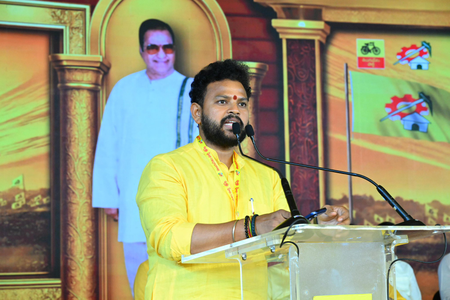
Amaravati, May 27 (IANS) Union Civil Aviation Minister K. Ram Mohan Naidu said on Wednesday that the proposal by TDP National Working President Nara Lokesh for 33 per cent reservation for women in Telugu Desam Party (TDP) for the 2029 elections marks a truly historic and game-changing moment in Indian politics.
Lokesh made the proposal at Mahanadu, the annual conclave of the TDP here.
Ram Mohan Naidu posted on social media platform X that TDP has always been a torchbearer of progressive and people-centric politics in India.
The Union Minister said that by encouraging “our mothers, sisters, and daughters to step into leadership roles and providing them a powerful platform to showcase their capabilities, TDP under the visionary leadership of N. Chandrababu Naidu and Nara Lokesh has once again demonstrated its unwavering commitment towards women empowerment and inclusive governance”.
“Women are not just participants in nation building, they are the architects of India’s future. The seed for that transformative future has been sown today in Andhra Pradesh through this bold and visionary decision. This is not just a policy announcement, it is a movement towards stronger representation, equal opportunity, and a brighter future for generations to come. Proud to be part of a party that believes in empowering women to lead from the front,” Ram Mohan Naidu added.
The two-day Mahanadu of TDP began at the party’s central office at Mangalagiri.
Meanwhile, the TDP said that Hybrid Mahanadu 2026 is emerging not merely as a political convention, but as a large-scale demonstration of grassroots digital mobilisation and technology-led organisational management.
Party leaders said the hybrid architecture was designed to make participation more inclusive, scalable and cost-efficient while enabling real-time engagement from across Andhra Pradesh.
According to TDP officials, more than seven lakh cadres participated through a combination of physical attendance and digitally connected cluster centres established across the state.
One of the key pillars of the initiative was the creation of around 1,875 digitally connected “Mahanadu Cluster Centres” spread across constituencies and mandals.
Instead of requiring every cadre member to travel to the main venue, localised participation hubs were created with LED screens, internet connectivity, audio systems and live-streaming infrastructure.
The centres enabled cadres from rural and semi-urban regions to watch speeches, participate in discussions and vote on resolutions in real time.
TDP leaders said the model significantly reduced transportation and accommodation pressures while increasing participation from women, senior citizens and grassroots workers who may otherwise not travel long distances.
TDP also deployed a GPS-enabled digital invitation system integrated through the MyTDP platform.
Cadres reportedly received personalised invitations that automatically mapped them to their nearest participation centre using geolocation technology.
Officials said this reduced confusion, avoided overcrowding at select venues and enabled better crowd distribution management.
The system also generated digital attendance records and participation analytics constituency-wise.
At the heart of the Hybrid Mahanadu model was a central command-and-control centre established to monitor and coordinate the event statewide in real time.
The control room reportedly tracked live feeds from cluster centres, streaming uptime, attendance flows, bandwidth stability and engagement metrics across districts.
Dedicated technical teams monitored connectivity disruptions and coordinated rapid troubleshooting support wherever required.
Officials said the command centre functioned similarly to a large-scale operations dashboard used in enterprise technology events, with real-time analytics and escalation systems helping ensure uninterrupted participation.
The system also enabled party leadership to receive live updates on constituency-wise turnout, participation density and cadre engagement patterns throughout the programme.
–IANS
ms/khz