



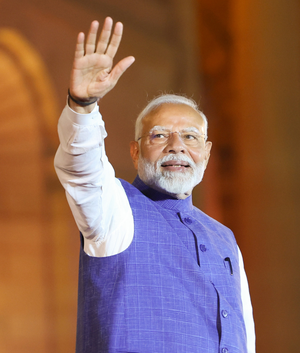
New Delhi, June 8 (IANS) Prime Minister Narendra Modi-led National Democratic Alliance (NDA) government will achieve a milestone on Tuesday, marking 12 years of uninterrupted rule in its third consecutive term, celebrating another year defined by ambitious welfare programmes, economic resilience, and India’s strengthened global stature.
“Over the last 12 years, India has witnessed many transformations and at the core of these changes is the welfare of the poor and downtrodden. We have always been inspired by Antyodaya, and our effort has always been to ensure that the benefits of development reach those who were left behind for decades. From Jan Dhan accounts and Direct Benefit Transfer to Swachh Bharat, PM Awas Yojana, Jal Jeevan Mission, Ayushman Bharat and more, every initiative has been driven by a simple objective of ensuring people have dignity and opportunity,” highlighted the PM on ‘X’.
Modi 3.0 witnessed unprecedented expansion of welfare programmes, and government initiatives demonstrated commitment to targeted delivery. Since coming to power the first time in 2014, Modi’s administration has been credited for successfully ushering India’s political culture towards optimism with good governance and citizens’ welfare etched in “golden letters” as observed by the then Bharatiya Janata Party (BJP) president Jagat Prakash Nadda last year.
The last Lok Sabha election, held in 2024, saw the NDA secure 293 seats in the 543-member House, with its principal constituent, the BJP, winning 240 seats. The outcome was widely seen as an endorsement of stable governance and decisive leadership, while also reflecting public expectations for faster economic growth, expanded infrastructure development, and greater employment opportunities.
Despite global economic uncertainties, the government successfully navigated complex economic waters. India maintained a steady growth trajectory, emerging out of the Covid-induced slowdown.
Modi’s third term also amplified India’s global voice, while maintaining diplomatic momentum and neutrality in international relations. It expanded trade diplomacy with major countries and blocs, signing, or entering advanced stages of negotiations for, new agreements, including the US, Oman, United Arab Emirates, Australia, Canada, the European Union, while leveraging regional groupings like Association of South East Asian Nations (ASEAN), Bay of Bengal Initiative for Multi-Sectoral Technical and Economic Cooperation (BIMSTEC), and BRICS to deepen market access. These deals aim to boost exports, secure preferential access, and strengthen India’s role in global supply chains.
Against terrorism, the country has exhibited zero tolerance, making no distinction between terrorists and their state sponsors. Every attack met with a calibrated military response, escalating from surgical raids to deep strikes. Pakistan’s nuclear blackmail could not deter India’s resolve under a strong leader. The government authorised multiple high-profile military operations against Pakistan-based terror infrastructure, most notably the 2016 surgical strikes, the 2019 Balakot airstrikes, and the 2025 Operation Sindoor.
Domestically, over the years, the Modi government has introduced a series of structural measures aimed at modernising India’s economy and governance. The Goods and Services Tax (GST), rolled out in 2017, unified more than a dozen separate central and state taxes into a single indirect tax regime, simplifying compliance and reducing cascading‑tax effects on manufacturers and traders.
After assuming office for the first time, he accelerated the pace of Pradhan Mantri Jan Dhan Yojana (PMJDY), expanding formal banking access to hundreds of millions of unbanked citizens, laying the groundwork for direct benefit transfers. The Modi era is also closely associated with a rapid digitalisation of governance.
The “Digital India” initiative promoted e‑governance, broadband connectivity in rural areas, and a push toward paperless, remote services. Direct Benefit Transfer (DBT) system, tying subsidies to Aadhaar‑linked bank accounts, helped reduce leakages in schemes such as LPG subsidies and rural employment guarantees.
Flagship welfare programmes like the Pradhan Mantri Awas Yojana (housing for all), Ujjwala Yojana (free LPG connections for poor women), and the Ayushman Bharat health‑insurance scheme have been cited as evidence of a broad‑based social‑security push.
“It is also gladdening that technology has played a vital role in ensuring a better quality of life for the poor. Through Direct Benefit Transfer and digital platforms, support is reaching people directly and transparently. This has reduced leakages, improved efficiency and strengthened trust in governance. This is how the journey of furthering Garib Kalyan has become a collective movement towards human empowerment and realising our dream of a Viksit Bharat,” posted the PM.
The “Make in India” campaign was launched to attract manufacturing investment, simplify regulatory clearances, and develop industrial corridors and smart cities.
The Modi years also witnessed a transformation in how political communication and public information are delivered. The Prime Minister has repeatedly emphasised the importance of empowering women, youth, and farmers as key pillars of the Viksit Bharat initiative. These include flagship programs like Beti Bachao Beti Padhao, Mission Shakti, Pradhan Mantri Matru Vandana Yojana, and Ujjwala Yojana, transforming women’s lives across India. These initiatives reflect a shift from “women’s welfare” to “women-led development”. The government also introduced Nari Shakti Vandan Adhiniyam, which aims to empower women across all stages of life.
Contributing significantly to youth empowerment through time, Rozgar Mela, an employment drive initiated by Modi about three years ago, added to India’s Vikas Yatra that has attracted global interest. The government has simultaneously rolled out a comprehensive set of farmer-centric welfare schemes aimed at income support, risk management, infrastructure development, and market access.
Flagship programmes include PM-Kisan Samman Nidhi, PM Fasal Bima Yojana, and the Agriculture Infrastructure Fund, among others, directly benefiting millions of farmers across India.
“Sabka Saath, Sabka Vikas, Sabka Vishwas” has been Modi’s governance mantra aimed at inclusive development, ensuring collective participation, equitable growth, and public trust in government initiatives. The slogan embodies a commitment to inclusive governance, social justice, and participatory democracy. It reflects the vision of Viksit Bharat@2047, aiming to ensure that no citizen or community is left behind in India’s development journey.
As the government completes its 12 years, the administration looks secure and confident under Modi; strong performance has exceeded expectations, with alliance partners standing committed under Modi’s leadership.
–IANS
jb/snj/skp