

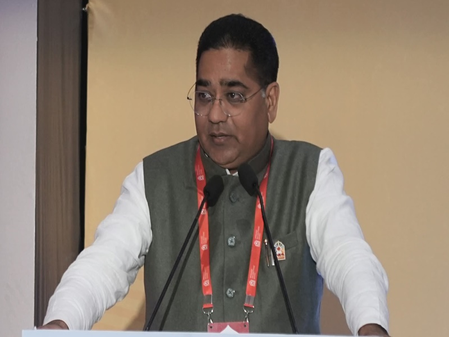
Jaipur, Feb 19 (IANS) Water Resources Minister Suresh Singh Rawat stated that the Rajasthan government is fully committed to bringing Yamuna water from the Hathinikund Barrage to the Shekhawati region.
This initiative, led by Chief Minister Bhajan Lal Sharma and supported by the Central Government, has reached a historic milestone with the signing of a Memorandum of Understanding (MoU) with Haryana, ensuring Rajasthan’s share of water.
Minister Rawat explained that, under the vision of Prime Minister Narendra Modi, the MoU between Rajasthan and Haryana was signed on February 17, 2024, under the chairmanship of the Union Jal Shakti Minister, to prepare a joint Detailed Project Report (DPR). A joint task force has also been formed by both states. Haryana’ written approval has been received for the alignment suggested by the consultants appointed by the task force.
The joint DPR will soon be submitted to the Central Water Commission. After obtaining the necessary approvals from various departments, work on the project will commence in the 2026-27 financial year.
A provision of Rs 32,000 crore has been made in the state budget for this long-awaited project.
Minister Rawat emphasised that the project is crucial for meeting the 30-year-old drinking water and other requirements of Sikar, Churu, Jhunjhunu, and surrounding areas. It is expected to significantly improve social, educational, economic, and health standards in the region.
To ensure year-round availability of Yamuna water, the project proposes constructing three dams in the Yamuna basin above Hathinikund Barrage. Construction on two of these dams — Renukaji and Lakhwar — is already underway.
Shekhawati region of Rajasthan comprises the districts of Sikar, Jhunjhunu and Churu.
The semi-arid region is known for its painted havelis, strong trading communities and a long tradition of migration to metropolitan cities and abroad.
Despite its cultural prominence, Shekhawati has faced persistent drinking water scarcity due to low rainfall and depleting groundwater levels.
Large parts of the region depend on tanker supply and groundwater extraction.
Agriculture remains largely rain-fed, with farmers vulnerable to drought cycles.
Over the years, demand for a reliable surface water source, including Yamuna water, has remained a key public issue in the region.
–IANS
arc/pgh