

New Delhi, Aug 9 (IANS) As India debates the integrity of competitive examinations, thousands of young people are demanding a fair chance. Their anger is justified. An education system commands legitimacy only when merit is protected and every student believes that hard work will be rewarded.
However, while the country protests leaked examination papers, there is another generation of children who were denied something far more fundamental than a fair examination—an opportunity to study at all.
Their story lies deep inside the forests of Bastar, Abujhmad, and Gadchiroli.
Over the last few months, I have traveled extensively through these regions, speaking to surrendered Maoists, security personnel, tribal families, and administrators. One conversation, in particular, has refused to leave me.
It was with Mallojula Venugopal Rao, better known as Sonu alias Bhupati, one of the CPI-Maoist’s most influential Politburo members. For decades, he held the highest decision-making position within the organisation. His surrender was seen by security officials as one of the most significant setbacks to the Maoist movement, marking the beginning of the end for an insurgency that once controlled vast stretches of central India.
What surprised me during our conversation was not the man I expected to meet. It was the man sitting before me.
He spoke with unusual respect about women, arguing that they deserved equality and dignity. He admitted that violence could not remain the answer forever. He revealed that political parties from both the ruling side and the Opposition had approached him after his surrender, but he had consciously refused to join any of them because, in his words, every political party ultimately serves an agenda. He preferred to remain outside politics and rebuild his life.
Listening to him, one question kept returning to my mind. If this movement genuinely sought to protect the rights of tribal communities, what became of the children within those communities?
What happened to their education?
India has failed to ask this question for nearly six decades.
The Maoist movement incessantly spoke about justice, exploitation, and revolution. Yet, one of its most significant victims turned out to be the tribal child.
For decades, violence ensured that schools remained inaccessible, teachers feared posting in remote villages, roads were blown up, bridges became targets, contractors abandoned projects, and private educational institutions never considered entering large parts of Bastar. Every development project was viewed with suspicion because connectivity was perceived as strengthening the state.
The result was devastating.
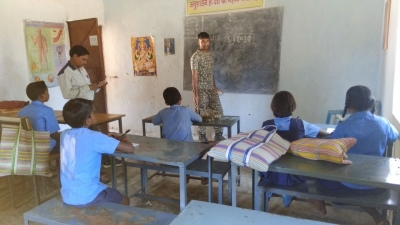
While children elsewhere in India competed for prestigious institutions like IITs, AIIMS, civil services, and global universities, generations of tribal children were still waiting for a functioning school, a qualified teacher, a safe road, or even uninterrupted classes.
Today, the debate revolves around fairness within an examination hall. The children of Bastar never even reached the examination hall. They lost the race before the starting line was drawn. The greatest tragedy is that this deprivation was romanticised.
For decades, sections of India’s urban intellectual class celebrated the Maoist movement as a people’s revolution. Conferences were organised, research papers were published, doctoral theses were written, and seminars discussed the philosophy of armed revolution.
However, very few paused to ask a far simpler question:
Why did the revolution never produce educated tribal children?
Why did those who claimed to fight for the poor never ensure that the poorest child could read, write, and dream beyond the forest?
Many who defended the movement went on to earn prestigious degrees, build academic careers, and teach in universities. However, the tribal child, meanwhile, remained trapped in a conflict that robbed them of the very education that could have transformed an entire generation.
This contradiction deserves scrutiny. Supporting or romanticising an armed movement that systematically obstructed development cannot be divorced from its consequences. Whether directly or indirectly, such narratives helped legitimise an ideology that left tribal communities more isolated, less educated, and economically weaker than before.
No revolution can claim moral legitimacy if its own children emerge as its greatest casualties.
As I travelled through Bastar, I often wondered how many dreams disappeared before they even had a chance to exist. Can a founder of the biggest technology company be born in a village where there is no school? Perhaps the answer is a no.
Perhaps a future scientist became a foot soldier, perhaps a brilliant doctor never learned to read.
Talent was never the problem, opportunity was. The irony is impossible to ignore.
A movement launched in the name of empowering tribal communities ended up pushing many of them decades behind the rest of the country.
In educational terms, entire regions were left sixty or seventy years behind mainstream India. Instead of creating leaders, innovators, and entrepreneurs, conflict produced generations whose first battle was simply surviving.
Today, rehabilitation policies are helping many surrendered cadres rebuild their lives. Some have joined the police, while others work in government departments or rehabilitation programs. These initiatives deserve appreciation because they replace violence with hope.
However, the future of Bastar cannot depend solely on government employment.
Its future lies in classrooms, universities, industries, tourism, entrepreneurship, healthcare, and private investment. It lies in creating an ecosystem where tribal children can aspire not only to secure jobs but also to create them.
Development is not just a slogan.
In Bastar, development means a school that operates throughout the year, teachers who are willing to stay, internet connectivity, laboratories, libraries, skill centres, and industries that foster aspirations beyond survival.
None of this is possible without peace.
The security forces paid a tremendous price to create that possibility. Roads that now connect remote villages were built despite repeated attacks, landmines, and ambushes. Behind every kilometre of connectivity lies the sacrifice of soldiers, policemen, engineers, laborers, and ordinary villagers who refused to succumb to fear.
As the Gen Z demands fairness, the children of Bastar, too, deserve a place in that conversation.
Because fairness does not begin with a question paper. It begins with providing every child with an equal chance to reach the classroom. The greatest tribute India can pay to Bastar is not another ideological debate over who was right and who was wrong.
It is ensuring that the next tribal child grows up with the same opportunities as a child in Bengaluru, Delhi, or Mumbai.
The day a young entrepreneur from the forests of Chhattisgarh builds a global company, or a tribal girl from Abujhmad becomes a scientist, surgeon, or university professor, India will finally have proof that peace achieved what decades of armed revolution never could.
Perhaps that is the only revolution the children of Bastar ever truly needed.
(The writer is a bestselling author known for transforming years of meticulous research into powerful human stories. Her work explores conflict not through battles alone, but through the lives, sacrifices, and resilience of those who endure it.)
–IANS
bhavna/khz