

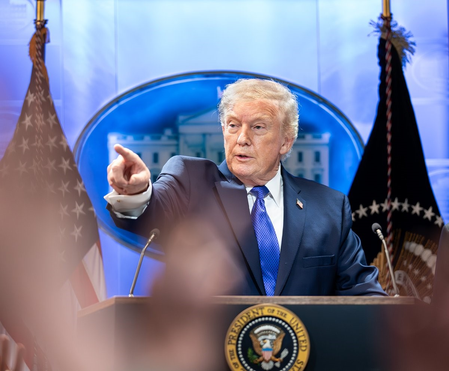
Washington, April 6 (IANS) The latest threat by US President Donald Trump to strike Iranian civilian infrastructure has triggered a domestic backlash with legal experts warning that such actions could violate international law, as tensions with Tehran escalate over the Strait of Hormuz.
Trump warned that the United States could target Iran’s power plants and bridges if Tehran does not reopen the Strait of Hormuz, according to multiple media reports.
“Tuesday will be Power Plant Day, and Bridge Day, all wrapped up in one, in Iran,” Trump wrote on Truth Social, as first reported by Politico. “There will be nothing like it!!! Open the Fuckin’ Strait, you crazy bastards, or you’ll be living in Hell – JUST WATCH!”
The remarks marked a sharp escalation as tensions rise over the strategic waterway, a key route for global oil shipments.
Trump also set a deadline for Iran to reopen the strait. According to CNN, he “appeared to set a new deadline for Iran to reopen the Strait of Hormuz,” warning of possible strikes if Tehran fails to act.
The White House sought to limit the fallout. Press secretary Karoline Leavitt said the United States “will always act within the confines of the law,” Politico reported.
Legal experts said targeting civilian infrastructure raises serious concerns under international humanitarian law.
According to The New York Times, facilities such as power plants and transport systems “are the foundations of civilian life in Iran,” and their destruction “in most cases would be considered a war crime under international law.”
International law prohibits attacks on civilian objects unless they are used for military purposes and the expected military gain outweighs harm to civilians.
A legal expert told The Washington Post that “a threat to attack all bridges or power plants or to attack them without distinguishing between lawful and unlawful targets would be a threat to commit war crimes.”
The comments have drawn criticism from lawmakers in both parties.
Senator Chris Murphy called Trump’s remarks “completely, utterly unhinged,” according to The New York Times. Representative Don Bacon, a Republican, said Americans “don’t want their president to be profane and vulgar,” adding that “part of leadership is self-control.”
House Minority Leader Hakeem Jeffries said the administration had drawn the United States into a “reckless war of choice without any plan,” the report said.
Some Republicans defended the administration. Representative Mike Lawler described the military campaign as an “incredible operation,” according to The New York Times.
Iran has rejected US pressure. A senior Iranian official said the Strait of Hormuz “will remain blocked until Iran receives pay for war damages,” CNN reported.
Trump has continued to escalate his rhetoric. In an interview with The Wall Street Journal, he said Iran could lose “every power plant and every other plant they have in the whole country” if it does not comply.
“If they don’t do something by Tuesday evening, they won’t have any power plants and they won’t have any bridges standing,” Trump said, according to the newspaper.
The remarks have raised concerns among US allies. According to The Washington Post, the statements caused “whiplash for allies” as Washington also pursues diplomatic efforts.
Analysts said the approach reflects a mix of pressure and negotiation but carries risks of escalation.
“The administration’s language and actions could have far-reaching consequences,” The New York Times reported, warning that such rhetoric may weaken international norms.
The Pentagon has not confirmed any plans to target civilian infrastructure. Officials have referred questions to US Central Command.
Trump has defended his strategy, saying pressure on Iran is necessary. He also suggested that negotiations could still take place.
“We have it under control, seriously under control,” Trump said in remarks cited by Fox News.
The standoff centres on the Strait of Hormuz, through which about a fifth of global oil passes. Any disruption there can affect energy markets and global trade.
The current tensions mark one of the most serious phases in US-Iran relations in recent years, combining military pressure, economic risks and sharp rhetoric.
Past conflicts have shown that threats against civilian infrastructure can draw international scrutiny and increase the risk of wider escalation. Analysts say the situation remains fluid as diplomatic and military pressures continue to build.
–IANS
lkj/rs