

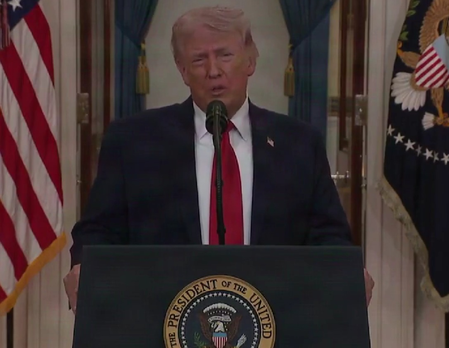
Washington, April 2 (IANS) US President Donald Trump stated during a prime-time address that the conflict with Iran was “nearing completion”, but left critical questions regarding strategy, escalation, and the endgame of the war unanswered, according to reports from American media following his speech.
The President offered no clarity on whether US ground troops would be deployed in Iran, despite ongoing discussions in Washington about potential operations, reports said.
He also avoided outlining any diplomatic pathway or exit strategy, even as he said the conflict could last another two to three weeks, according to coverage by The New York Times and The Washington Post.
Trump made only a limited reference to the strategic Strait of Hormuz, suggesting other countries — particularly those dependent on Middle East oil — should take the lead in reopening it.
“We will be helpful, but they should take the lead,” he said, adding that the waterway would “open up naturally” once the conflict ends, as cited in US media reports.
The New York Times said that Trump did not detail the role of key allies, including Israel, despite the joint nature of military operations in the region. Nor did he address coordination with NATO partners, even as reports indicated earlier tensions over alliance support.
On Iran’s political future, Trump said “regime change was not our goal,” even as he suggested leadership changes had already taken place following US and Israeli strikes, according to The Washington Post’s live coverage.
However, the speech did not mention Iran’s emerging leadership structure or figures such as Mojtaba Khamenei, who has been identified in reports as a key power centre after the deaths of senior officials, The New York Times noted.
Trump also did not address whether the US would attempt to secure Iran’s nuclear material, with experts warning that retrieving enriched uranium buried deep underground would require risky ground operations, according to The New York Times analysis.
While he repeated claims that Iran’s military capabilities had been “dramatically curtailed”, reports said Tehran continues to launch missile and drone attacks across the region.
The address largely reiterated existing talking points, with no new announcements on military or diplomatic fronts, US media outlets reported.
Analysts quoted across reports said the absence of specifics on ground operations, Hormuz security and post-war governance leaves uncertainty about the next phase of the conflict.
The Strait of Hormuz remains a critical chokepoint for global energy supplies, with disruptions already affecting markets and supply chains worldwide.
The war, now in its second month, continues to raise questions about escalation risks, regional stability and the long-term US strategy in the Middle East.
–IANS
lkj/dpb