

Agartala, April 12 (IANS) More than 81 per cent of the 9,62,697 eligible voters exercised their franchise in the politically significant elections to the Tripura Tribal Areas Autonomous District Council (TTAADC), held across all eight districts of the state to decide the fate of 173 candidates, including eight women, officials said.
The 30-member TTAADC, comprising 28 elected representatives and two members nominated by the state government, administers nearly 70 per cent of Tripura’s 10,491 sq km geographical area. This makes it a strategically important constitutional body, second only to the state Assembly in terms of political significance.
According to officials from the State Election Commission (SEC), over 81 per cent of voters had cast their votes by the end of polling at 4 p.m.
An SEC official, however, added that the turnout figure is likely to rise slightly once complete reports are received from all 1,257 polling stations spread across eight districts.
Except for a few isolated incidents, no major disturbances were reported from anywhere in the state, a senior police official said. He noted that minor clashes between rival political parties occurred in three districts — Khowai, Sepahijala, and South Tripura — leaving around 10 party workers injured.
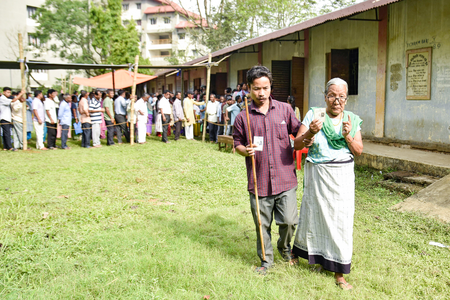
SEC officials said that, as seen in previous elections, tribal men and women dressed in traditional attire turned out in large numbers even before polling began at 7 a.m., forming long queues at most polling stations. In some booths, voting continued beyond the scheduled closing time due to the heavy turnout.
Following a month-long high-voltage campaign marked by intense political activity and sporadic clashes, the TTAADC elections are expected to play a key role in shaping the future political landscape of the Northeastern state.
A total of 9,62,697 voters, predominantly from tribal communities, including 4,80,666 women, were eligible to vote across 28 constituencies in eight districts. They are deciding the fate of 173 candidates, including eight women.
The electoral contest features three national parties — the ruling Bharatiya Janata Party (BJP), the opposition Communist Party of India (Marxist)-led Left Front, and the Congress — along with two prominent regional parties, the Tipra Motha Party (TMP) and the Indigenous People’s Front of Tripura (IPFT). Several smaller parties and independent candidates are also in the fray.
According to SEC officials, the BJP, TMP, and the Left Front have fielded candidates in all 28 constituencies. The Congress is contesting in 27 seats, while the IPFT has fielded candidates in 24. In addition, 38 independent candidates and nominees from smaller parties are also contesting.
Meanwhile, the BJP’s two tribal-based allies — TMP and IPFT — are contesting separately after failing to forge an electoral alliance for the TTAADC polls.
The one-and-a-half-month-long campaign witnessed several clashes, particularly between BJP and TMP supporters, leaving more than 50 leaders and party workers injured across various districts.
Despite the tensions, leaders from all major parties have expressed confidence in securing victory.
To ensure peaceful polling, extensive security arrangements were put in place.
Tripura Director General of Police Anurag earlier said that more than 13,500 Central and state security personnel were deployed across the 28 constituencies.
He added that the Central government had provided 24 companies of Central Armed Police Forces (CAPF), comprising around 1,500 personnel. In addition, around 12,000 personnel from the Tripura State Rifles (TSR) and the state police were deployed to maintain law and order.
“Of the total 1,257 polling stations, 311 have been categorised as highly critical, 693 as vulnerable, and 253 as normal,” the police chief said, urging voters to cast their votes without fear and cooperate with authorities to maintain peace.
Since 2021, the Tipra Motha Party (TMP), an ally of the BJP, has governed the strategically important council, widely regarded as the second most significant constitutional body in Tripura after the state Assembly.
The TTAADC was constituted under the Sixth Schedule of the Indian Constitution in June 1985 to promote the socio-economic development of tribal communities, who continue to play a vital role in the state’s political dynamics.
Tribal communities account for nearly one-third of Tripura’s 4.2 million population. The results of the TTAADC elections will be announced on April 17.
–IANS
sc/uk