

New Delhi, June 8 (IANS) The Trinamool Congress, once the formidable force that ended three decades of Left Front rule in West Bengal, today resembles the Biblical parable of a house built on sand that collapses when storms arrive.
Following the state election defeat, its organisational base — weakened by corruption, factionalism and overreliance on professional consultants — is being battered by storms of scandal and dissent.
About five days after a breakaway faction comprising 58 of the Trinamool’s 80 elected MLAs laid claim to recognition as the “original party” in the West Bengal Assembly, 20 of its 28 Lok Sabha MPs have reportedly made a similar request to the office of the Lok Sabha Speaker.
One of West Bengal’s 42 Lok Sabha seats, Basirhat, remains vacant following the death of the sitting Trinamool MP.
Among the party’s 13 Rajya Sabha MPs, Sukhendu Sekhar Roy on Monday announced his resignation from both the Upper House and the party’s primary membership.
Roy’s current tenure in the Rajya Sabha was scheduled to end in 2029.
The 77-year-old MP was already in trouble within the party following his open support for protesters seeking justice after the rape-murder of an intern at Kolkata’s RG Kar Medical College and Hospital in August 2024, even as the then Mamata Banerjee-led government faced criticism over its response to the incident.
Since the Trinamool’s Assembly poll defeat, he has publicly criticised the party over corruption-related issues.
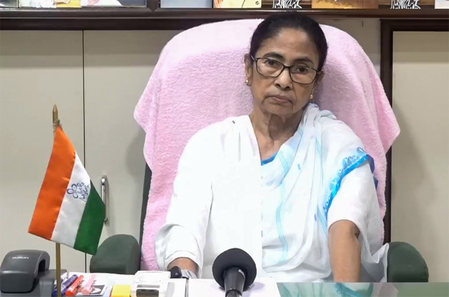
Mamata Banerjee, once the fiery street-fighter who toppled the state’s communist regime in 2011, now appears increasingly detached from the party’s grassroots.
Her nephew, Abhishek Banerjee, entrusted with organisational control, leans heavily on professional consultants whose strategies allegedly often lack resonance with West Bengal’s political culture.
Discontent had been simmering within the party, with many leaders feeling sidelined or coerced.
The current rebellion has drawn comparisons with Maharashtra, where splits in the Shiv Sena and Nationalist Congress Party led to breakaway factions being recognised as the “real” parties.
In West Bengal, meanwhile, from the Sandeshkhali episode to the RG Kar incident, widespread reports of corruption, and now the signature scandal, each controversy has chipped away at the party’s moral authority.
While Ritabrata Banerjee, a former Communist Party of India (Marxist) parliamentarian, led the rebel MLAs out of the fold in Kolkata, about 1,300 km away in New Delhi, Kakoli Ghosh Dastidar reportedly organised dissident MPs.
The 66-year-old physician was upset with the party leadership after being removed unceremoniously as party Whip and had earlier resigned from all organisational positions.
She has reportedly forwarded a list of the rebel MPs to the Speaker’s office, seeking recognition as a separate bloc aligned with the ruling National Democratic Alliance.
Sources said she believes that the party’s latest intimation regarding her removal as Chief Whip has not yet reached the Speaker’s office and that she therefore continues to hold the position officially.
In a similar development recently, disgruntled Aam Aadmi Party Rajya Sabha MPs, led by Raghav Chadha, left the party and merged with the Bharatiya Janata Party without attracting anti-defection provisions.
While the final decision will rest with the Election Commission and the respective presiding officers of the Assembly and Parliament, the party founded by Mamata Banerjee 28 years ago appears to be under severe strain.
Just as a sandy foundation struggles to withstand a storm, the Trinamool is facing an internal crisis within about a month of its defeat in the state election.
The fragility of the Trinamool’s foundations becomes clearer when viewed against Bengal’s political history.
The Left Front fell after 34 years of uninterrupted rule in the state amid allegations of corruption, arrogance and detachment from grassroots realities.
The political storm gathered momentum in the form of Singur and Nandigram, where land acquisition controversies exposed what critics described as the party’s disconnect from people’s struggles.
Critics argue that Mamata Banerjee later watched her party follow a similar path.
Her rise was built on her image as “Didi” — the benevolent leader who almost single-handedly spearheaded the movement against what was portrayed as the Left’s arrogance.
Today, critics allege that her party is increasingly associated with corruption, unable to rein in controversial leaders, and embroiled in controversies over signatures and internal functioning.
Authenticity, they argue, is eroding, and the house built on sand has begun to crumble.
–IANS
jb/pgh