

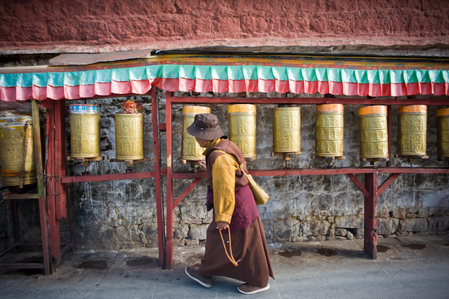
Lhasa, Sep 17 (IANS) People of Tibet have no trust in the Chinese Communist Party (CCP) after 77 years, as the party’s occupation in the region has been marked by broken promises, suppression of culture, and systematic efforts to erase Tibetan identity. The CCP has not been able to win the hearts and minds of Tibetans but has only hardened their conviction that Tibet must be free, a report has detailed.
Tibetans feel that living under China’s control has been by force instead of willingness. The CCP entered Tibet under the guise of “liberation” in 1950, promising autonomy and respect for Tibetan traditions. However, the promises of the CCP collapsed within 10 years, and Tibetans now reject the CCP’s rule after 77 years, according to a report in The Tibet Express.
CCP governs Tibet through coercion, with surveillance cameras, checkpoints and digital monitoring suffocating daily life of people. CCP has sidelined the Tibetan language, and children of Tibet are forced to study in Mandarin-only boarding schools.
The authorities carry out raids in monasteries, arrest monks, and ban has been imposed on pictures of the Dalai Lama in Tibet. These measures implemented by the CCP have not built trust but increased alienation. The outcome would be clear if a referendum is held in Tibet and people are allowed to vote freely, according to a report in The Tibet Express.
“After sixty-seven years, Tibetans have no trust in the CCP. The occupation has failed to win hearts or minds; it has only hardened the conviction that Tibet must be free. Should a referendum ever take place, Tibetans would choose secession—not out of ideology, but out of lived experience. China’s track record leaves them no other path,” Khedroob Thondup, the nephew of the 14th Dalai Lama, wrote in The Tibet Express.
Recently, a leading international press freedom organisation has strongly condemned the sweeping restrictions imposed by the Chinese authorities on media professionals from accessing vital information regarding the Tibetan region following the devastating flash floods.
Expressing grave concern, Reporters Without Borders (RSF) said that no independent Tibetan media outlet or international news organisation has been granted access to the disaster-stricken area.
The organisation said this “reflects a long-standing practice of the Chinese regime, which exercises some of the strictest control in the world over media professionals.”
In the aftermath of the disaster, it said, the Chinese authorities have only authorised state media to cover the floods in Tibetan areas, with reports highlighting Beijing’s achievements and successes in relief efforts rather than providing a comprehensive account of the scale and impact of the devastation.
Criticising the restrictions on media coverage, Aleksandra Bielakowska, Head of Advocacy, RSF Asia-Pacific, said that in recent years, under Chinese President Xi Jinping’s leadership, Tibet has become a “de facto information black hole”.
“No independent Tibetan media, nor any international media, are permitted to freely cover news from this autonomous region. The only outlets allowed to operate are those controlled by the state and its propaganda organs, which report on events in according to the guidelines approved by the Chinese Communist Party’s Propaganda Department. Under these circumstances, it is virtually impossible to gauge the true scale of the tragedy, as the regime seeks to whitewash its international image and stifle any information that might cast it in an unfavourable light,” Bielakowska stated.
The massive flood that struck Nepal’s Rasuwa originated in the Tibetan region of China on August 26. It swept through the transboundary Bhote Koshi River, leaving over a thousand dead and causing massive destruction in the Himalayan nation.
–IANS
akl/as