

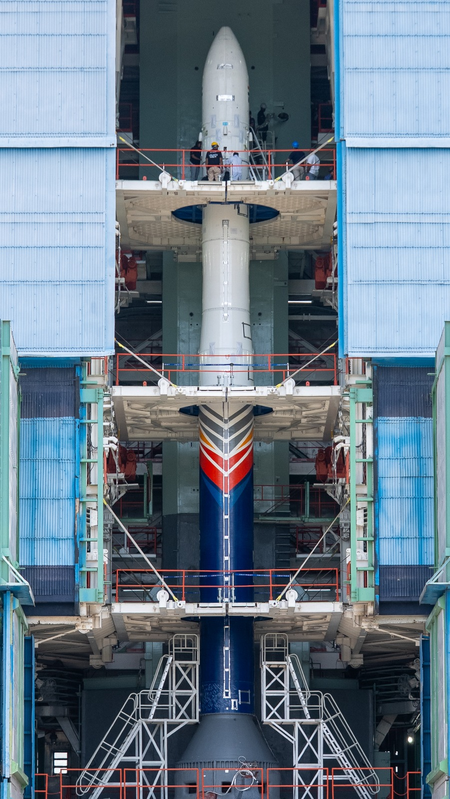
New Delhi, July 2 (IANS) India is set to witness a landmark moment in its space journey as Skyroot Aerospace has opened the launch window for the maiden test flight of Vikram-1, the country’s first privately developed orbital-class rocket, it was announced on Thursday.
The mission, named Mission Aagaman, is scheduled for launch no earlier than July 12, subject to the successful completion of final assembly and testing at the Satish Dhawan Space Centre (SDSC-SHAR) in Sriharikota, as well as favourable weather, safety, and range clearance conditions.
The launch window will remain open until August 4.
The flight will be the first attempt by a privately developed Indian orbital-class rocket to reach orbit, representing a major step forward for the country’s commercial space industry.
According to Skyroot Aerospace, the primary objective of Mission Aagaman is to collect comprehensive in-flight performance data across every stage of Vikram-1’s ascent.
The company said the mission has been designed primarily as a technology demonstration and learning exercise, with the data gathered expected to validate vehicle performance and guide future upgrades for its commercial launch programme.
“This mission is about understanding how the rocket performs in real flight conditions, something that cannot be fully replicated through ground testing. The moment Vikram-1 lifts off, India’s private space industry will cross a threshold it has never crossed before,” said Pawan Kumar Chandana, Co-founder and Chief Executive Officer of Skyroot Aerospace.
Mission Aagaman follows the successful launch of Vikram-S in November 2022, which became the first privately developed rocket to reach space from Indian soil. While Vikram-S demonstrated the company’s foundational technologies, Vikram-1 is intended to showcase Skyroot’s ability to place payloads into orbit.
The company plans to begin regular commercial launch services after one or two successful demonstration missions. The maiden flight will carry a combination of domestic and international customer payloads as part of a partially commercial mission.
Naga Bharath Daka, Co-founder and Chief Operating Officer of Skyroot Aerospace, said the journey from conceptualising an Indian private launch vehicle to preparing for an orbital mission has been transformative. He noted that the success of Vikram-S laid the technological foundation for the company, while Vikram-1 represents its biggest leap towards building a reliable, high-frequency launch service. He also acknowledged the support of the Government of India, IN-SPACe, ISRO, investors, customers, and Skyroot’s team of more than 1,000 employees in making the mission possible.
Skyroot confirmed that all stages of Vikram-1 have now been integrated and stacked at the launch pad. During the mission, engineers will closely monitor propulsion systems, stage separation, guidance, navigation, control systems, and overall vehicle performance to support the company’s transition into a fully operational commercial launch provider.
–IANS
pk