

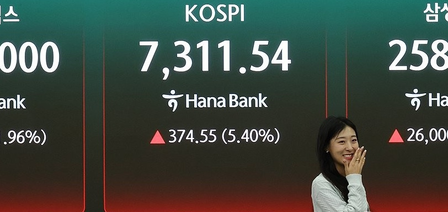
Seoul, May 8 (IANS) South Korean stocks started lower on Friday on profit hunting following a recent rally and renewed military tensions in the Middle East after the United States and Iran exchanged fire.
Opening 1.82 percent lower, the benchmark Korea Composite Stock Price Index (KOSPI) lost 163.99 points, or 2.19 per cent, to 7,326.06 as of 9:15 a.m, reports Yonhap news agency.
The index had been on a bullish run to hit record highs for three consecutive sessions starting Monday, gaining nearly 1,000 points to close at a fresh high of 7,490.05 on Thursday.
Overnight, the U.S. and Iran clashed in the Strait of Hormuz, putting ongoing progress in the Washington-Tehran peace talks in doubt.
Iran claimed that the U.S. targeted Iranian ships entering the strait, while the U.S. military said it acted in self-defence after Iran attacked its navy destroyers that were passing through the waterway.
Against this backdrop, Wall Street finished lower. The Dow Jones Industrial Average declined 0.63 percent, the S&P 500 0.38 percent and the tech-heavy Nasdaq composite 0.13 percent.
In Seoul, most shares opened lower. Market bellwether Samsung Electronics sank 3.5 percent, and chip giant SK hynix dipped 2.72 percent.
Leading battery maker LG Energy Solution declined 1.66 percent, and energy company Doosan Enerbility tumbled 5.28 percent.
Major shipyard HD Hyundai Heavy Industries lost 4.33 percent, and defence giant Hanwha Aerospace slipped 1.97 percent.
The Korean won was trading at 1,461.15 won against the U.S. dollar at 9:15 a.m., down 7.15 won from the previous session.
Meanwhile, the government froze the price ceilings on fuel products for the third consecutive time Thursday, in the face of continued volatility in global energy prices.
The move is expected to help lower the living costs for ordinary people.
Maximum prices for regular gasoline, diesel and kerosene supplied to gas stations by local oil refineries will remain unchanged at 1,934 won (US$1.33), 1,923 won and 1,530 won per liter, respectively, for the next two weeks, according to the Ministry of Trade, Industry and Resources.
The government sets maximum prices for fuel products every two weeks under the price cap system introduced in mid-March to stabilize domestic fuel prices.
—IANS
na/