

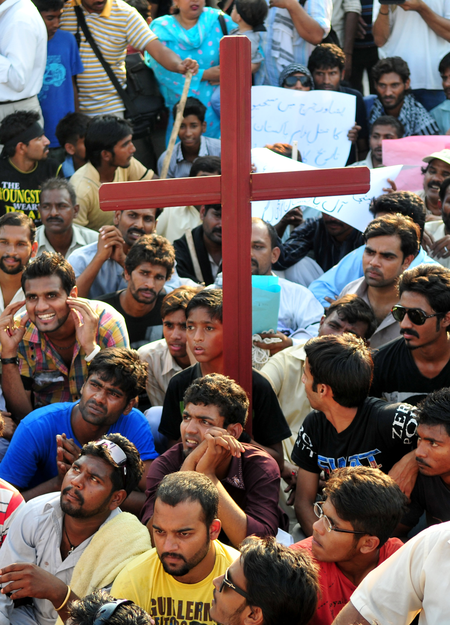
Islamabad, May 25 (IANS) Minority rights organisations have requested Pakistan’s federal government to introduce constitutional reforms with a goal to strengthen protection for religious minorities, women and children as part of the proposed 28th Constitutional Amendment Bill, a report has stated.
Addressing a press conference in Islamabad, leaders of the Minorities Alliance Pakistan (MAP) and allied groups presented a reform package that calls for introducing changes to constitutional provisions linked to political representation, religious freedom, and child protection, a report in Eurasia Review mentioned.
During the event, MAP chairman Akmal Bhatti said Pakistan could not function as a pluralistic democracy as constitutional provisions restricted non-Muslims from taking the offices of President and Prime Minister and minority communities did not have direct democratic representation.
Bhatti, according to the report, said that proposed reforms were aimed to ensure equality before the law and equal opportunities for everyone in Pakistan. He stated that constitutional and legal structures should protect children from forced religious conversion and child marriage. The proposals presented by the MAP call for banning the religious conversion of people aged below 18 years until free and informed consent is recorded before a judicial magistrate.
Bhatti demanded amendments to Articles 51 and 106 to introduce direct elections for seats reserved for non-Muslims and women in the National Assembly and provincial assemblies. Akmal Bhatti urged Parliamentary Committee on Constitutional Reforms to hold talks with minority communities, legal experts, and civil society organizations before preparing the final amendment package.
Earlier this month, a minority rights advocacy group associated the recent deaths of sanitation workers in Pakistan to what it termed as “systemic discrimination” against Christians, who are involved in sewer cleaning jobs, a report stated.
In a statement, Minority Concern said Christian sanitation workers in Pakistan were facing unsafe working conditions, inadequate protective equipment and limited employment opportunities beyond sanitation work due to deep-rooted discrimination in the country, EWTN News reported.
On May 7, Shabbir Masih (33) died after he inhaled toxic gas in a 25-foot-deep sewer line in Faisalabad. Three days prior to his death, Shakeel Masih and Samar Masih died while cleaning a sewer line in Sahiwal. In April, three Christian workers died in similar incidents in Karachi, according to the report.
Minority Concern Director Alexander Mughal said, “Sanitary workers are indispensable members of society. No individual should risk their life simply for carrying out essential public service work.”
“Protecting the rights and safety of Christian sanitary workers is not only a labour issue — it is a matter of human dignity, equality, and justice,” Mughal added.
Christians comprise about 1.37 per cent of Pakistan’s population and have complained about being pushed into low-paid sanitation work historically linked to marginalised castes in South Asia.
Christian sanitation worker Shafiq Masih has rejected official claims that proper Personal Protective Equipment (PPE) is being provided to workers.
Speaking to EWTN News, he said, “Each of the Water and Sanitation Authority field office responsible for sewer maintenance reportedly has only one PPE suit, shown only to visiting officials or media. Even that imported suit from Japan is not suitable for local conditions — it is heavy and impractical. The death toll is higher than reported.”
Rights groups like Minority Concern have called on Pakistani authorities to end discriminatory hiring practices that push minorities into hazardous work.
–IANS
akl/as