

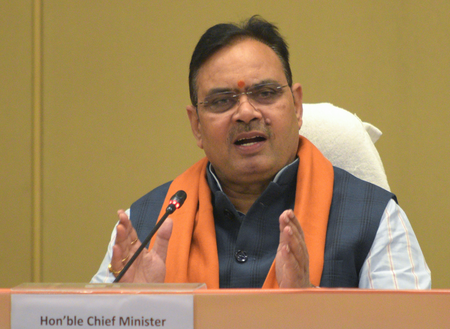
Jaipur, March 21 (IANS) With the launch of the Rajasthan Aerospace and Defence Policy – 2026 by Rajasthan Chief Minister Bhajan Lal Sharma, the state is set to emerge as a key contributor to India’s strategic self-reliance.
The policy envisions Rajasthan as a major hub for the manufacturing of aircraft, helicopters, drones, missiles, avionics, satellite buses, armoured vehicles, radars, navigation, communication and control systems, robotics, and defence electronics — providing a strong boost to the Make in India initiative.
To attract investment, the policy offers a comprehensive package of financial and non-financial incentives, along with plug-and-play infrastructure, skill development support, and time-bound clearances, officials said on Saturday.
The policy aims to build a globally competitive ecosystem by promoting manufacturing, research, testing, and services across the aerospace and defence value chain.
It encourages participation from Original Equipment Manufacturers (OEMs), system integrators, MSMEs, start-ups, and skilling institutions. It is also aligned with key national initiatives such as the Defence Production and Export Promotion Policy (DPEPP), iDEX, Atmanirbhar Bharat, and Make in India.
Rajasthan’s strong industrial base, supported by connectivity through the Delhi-Mumbai Industrial Corridor, a wide network of national highways, availability of land, and access to key metals, positions the state as an ideal destination for aerospace and defence investments.
The metal machining sector, including units working with steel, copper, and brass, will play a crucial role in manufacturing ammunition and defence components. Additionally, the state’s robust automotive ecosystem will support the supply of mechanical and electronic components.
Projects are categorised as large, mega, and ultra-mega under the policy.
Under manufacturing, large projects include investments from Rs 50 crore to Rs 300 crore, mega projects from Rs 300 crore to Rs 1,000 crore, and ultra-mega projects above Rs 1,000 crore.
Under service sector projects, large projects include investments from Rs 25 crore to Rs 100 crore, mega projects from Rs 100 crore to Rs 250 crore, and ultra-mega projects above Rs 250 crore.
The policy provides flexibility to choose from capital subsidies, investment grants, or turnover-linked incentives. Additional ‘top-up’ incentives are offered for employment generation, sunrise sectors, anchor units, and thrust industries.
Key benefits include exemptions on banking, wheeling, and transmission charges, flexible land payment options, and subsidies on office space lease rentals.
To support long-term industrial growth, the policy also offers 100 per cent exemption from electricity duty for seven years, 100 per cent reimbursement of mandi fees for seven years, and 75 per cent exemption along with 25 per cent reimbursement on stamp duty and land conversion charges.
Additional provisions for green initiatives, skill development, training, and intellectual property creation further enhance the attractiveness of the policy.
Under the leadership of Prime Minister Narendra Modi, India’s defence and aerospace sectors have witnessed significant growth, driven by reforms such as transparent procurement systems and improved ease of doing business, a statement noted.
These efforts have strengthened domestic production and advanced the goal of strategic autonomy.
India has demonstrated notable capabilities in aerospace manufacturing, with platforms such as the LCA Tejas, ALH Dhruv, and Sukhoi-30. The Make in India initiative has also facilitated strong collaborations between global aerospace firms and domestic companies, resulting in a robust ecosystem of Tier-1, Tier-2, and Tier-3 suppliers, the statement added.
–IANS
arc/pgh