

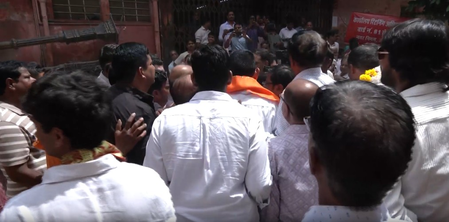
Jaipur, Sep 3 (IANS) For years, Rajasthan’s electoral politics has largely revolved around familiar equations: party loyalty, caste networks, local leadership and the strength of organisational machinery. But ahead of the civic body elections, an unusual political undercurrent is beginning to surface. In several parts of the state, sections of the upper-caste community are openly expressing dissatisfaction with both the Bharatiya Janata Party (BJP) and the Congress.
What began in some places as anger over ticket distribution has now moved into street protests, community meetings, bike rallies and calls to support independent candidates. The message emerging from these gatherings is striking: some community groups are questioning whether their traditional political choices should continue unchanged.
Whether this discontent will translate into votes is difficult to predict. But its emergence ahead of urban local-body elections has certainly added another layer to Rajasthan’s already competitive political landscape. Candidate selection is often one of the most sensitive stages of an election.
Aspirants denied tickets frequently rebel, while supporters can turn against party leadership. In Rajasthan this time, however, protests in some areas are being framed as a broader community issue.
In Abu Road, members of the Brahmin community protested over ticket distribution by both the BJP and Congress. Protesters gathered at Parashuram Bhavan in Brahmpuri Colony and alleged that the community had not received adequate representation despite its support for the two parties.
The protesters questioned the local leadership of both parties and demanded an inquiry into the ticket distribution process. They also sought the removal of BJP district president Raksha Bhandari and Congress district president Leelaram. For the protesters, therefore, the issue is not merely about individual candidates. It is being presented as a question of political representation and recognition.
The discontent has taken a different form in Gangapur City, where a group representing sections of the upper-caste community has announced plans to support independent candidates rather than the BJP or Congress.
A bike rally was organised on Wednesday from the Hanuman Temple in Ward 30. Participants first held a collective recitation of the Hanuman Chalisa before moving through the main market towards the committee office in Ward 35. The gathering also raised issues related to the UGC and other demands being raised by the community.
According to community spokesperson Vedprakash Mangal, more than three dozen independent candidates from different wards have approached the committee seeking support. Applications are being accepted until Thursday, with a decision on supported candidates expected on Friday.
The group has said it plans to campaign for selected candidates through street-corner meetings, rallies and other public programmes. If this strategy gains traction, it could create a particularly interesting dynamic in closely contested wards: the issue may not be whether these voters shift entirely from one major party to another, but whether they fragment their votes among independent candidates.
The issue has also received a wider political push from Mahipal Singh Makrana, National President of the Shri Rajput Karni Sena. Makrana has called for a boycott of the BJP and Congress in Bikaner, arguing that the upper-caste community should demonstrate the strength of its vote.
His intervention gives the local protests a larger political dimension. Rather than treating dissatisfaction as an internal dispute over tickets, the campaign seeks to turn it into a collective electoral message. Makrana has also said that the movement over UGC-related demands will continue and warned that the agitation could intensify if the government does not respond to the concerns being raised.
The political mobilisation is unfolding alongside a broader movement involving demands related to the UGC Act, SC/ST Act and reservation system. Sections of the upper-caste community have raised concerns about provisions associated with the UGC and have argued that some existing arrangements could affect the educational environment. Protests and public programmes around these issues are being organised in Rajasthan as well. However, these claims and demands are being made by particular groups and do not necessarily represent the views of the entire upper-caste population.
The extent of support for the movement will become clearer as the election campaign progresses. Urban local-body elections may appear smaller than Assembly or Lok Sabha elections, but they can be politically significant.
Councillor elections are fought ward by ward, often bringing local equations, community networks, personal relationships and candidate popularity directly into play. A relatively small shift in votes can change the outcome in an individual ward. This makes organised community mobilisation particularly relevant. If even a portion of voters who traditionally supported one of the major parties decides to back independents, the BJP and Congress could face three-cornered contests in several wards. The impact could be more pronounced where the margin between the leading candidates is narrow.
There are two ways to read the current developments. The first is that this is a familiar election phenomenon: ticket distribution creates disappointed aspirants, community organisations mobilise temporarily, and after polling, much of the agitation fades.
The second possibility is more significant: that these protests reflect a deeper dissatisfaction with political representation and could influence voting behaviour beyond individual wards.
At present, there is no evidence to conclude that the BJP or Congress is facing a statewide collapse in support among upper-caste voters. Nor is it clear that independent candidates will be able to convert community mobilisation into electoral victories. But the fact that the issue has moved from private discussions to public protests and an organised call for independent candidates makes it politically noteworthy.
The BJP and Congress remain the two principal forces in Rajasthan’s electoral politics, and both have established organisational networks across the state. The emerging protests, therefore, are unlikely to overturn the political landscape overnight. But civic elections are often decided by small margins, and localised voter shifts can have an outsized impact.
A handful of wards changing hands because of community dissatisfaction could alter the political narrative surrounding the elections. For now, the message from the protesters is clear: traditional political support cannot be taken for granted. Whether that message becomes a genuine electoral shift or remains an election-season expression of anger will be decided not on the streets, but at the ballot box.
–IANS
arc/snj/skp