

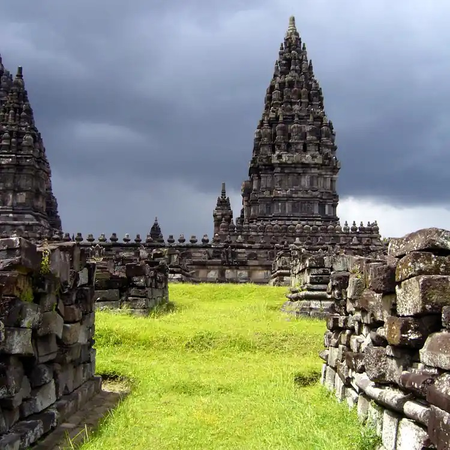
Jakarta, July 8 (IANS) Ahead of Prime Minister Narendra Modi’s visit to the historic Prambanan Temple in Indonesia on Wednesday, the occasion has once again highlighted India’s sustained efforts to preserve and revive shared civilisational and cultural heritage across Asia under his leadership.
On July 7, India and Indonesia exchanged a Letter of Intent for an India-backed conservation and restoration project at the Prambanan Temple complex in Yogyakarta, a UNESCO World Heritage Site. The exchange took place on Tuesday after talks between Prime Minister Narendra Modi and Indonesian President Prabowo Subianto, as the two sides sought to deepen their Comprehensive Strategic Partnership and discuss ways to ensure a peaceful Indo-Pacific.
Built in the 10th century, the Prambanan Temple is the largest Hindu temple complex in Indonesia and is dedicated primarily to Lord Shiva. The magnificent complex features towering temples devoted to the Hindu trinity — Shiva, Vishnu and Brahma — along with shrines dedicated to their divine vehicles. The temple walls are adorned with intricate reliefs depicting scenes from the epic Ramayana, reflecting the deep cultural and spiritual links between India and Southeast Asia.
At the heart of the complex stands the 47-metre (154-foot) Shiva temple — the tallest structure at Prambanan and one of the finest examples of ancient Hindu architecture. The sprawling complex originally consisted of 240 temples, making it one of the largest Hindu temple sites anywhere in the world. Its stone reliefs narrate stories from the Ramayana and other Hindu epics.
Over the past decade, the Modi government has actively supported the restoration and conservation of several important religious and heritage sites across neighbouring countries.
In Bangladesh, India announced assistance for the reconstruction of the historic Ramna Kali Temple, which was destroyed during Pakistan’s Operation Searchlight in 1971. The temple was inaugurated in 2021, restoring a significant Hindu shrine and reinforcing the centuries-old cultural ties between India and Bangladesh.
India also financed the restoration of the nearly 300-year-old Joy Kali Mata Temple in Natore through grant assistance in 2020. Additionally, the government supported the restoration of the Anandomoyee Kali Mata Mandir and the Ramakrishna Temple, preserving important centres of Hindu faith in the country.
In Vietnam, a Memorandum of Understanding (MoU) signed in 2014 enabled India to undertake conservation work at the UNESCO-listed Mỹ Sơn Sanctuary, one of Southeast Asia’s most important Shaivite temple complexes and the religious centre of the ancient Champa Kingdom.
In Myanmar, India signed an MoU in 2017 to restore earthquake-damaged monuments in the UNESCO-listed Bagan Archaeological Zone. The Archaeological Survey of India (ASI) restored 12 historic pagodas and completed conservation work at the renowned Ananda Temple.
Following the devastating 2015 earthquake in Nepal, India launched restoration and conservation of 28 cultural heritage sites under its US$50 million reconstruction assistance programme. These include the Seto Machhindranath Temple and the Budhanilkantha Temple Dharamshala.
Since 2022, India has continued conservation efforts at Cambodia’s Angkor Heritage Complex, including Ta Prohm, Angkor Wat, and Preah Vihear, reaffirming its commitment to preserving one of the world’s greatest centres of Hindu civilisation outside India.
In Laos, India restored key structures of the UNESCO-listed Vat Phou Temple, a nearly 1,000-year-old Shiva temple and one of Southeast Asia’s oldest surviving symbols of Sanatan civilisation.
During his historic 2019 visit to Bahrain, Prime Minister Modi inaugurated the US$4.2 million redevelopment project of the 200-year-old Shreenathji (Shri Krishna) Temple in Manama, preserving one of the Gulf region’s oldest Hindu temples.
In Sri Lanka, India reactivated the restoration project for the historic Thiruketheeswaram Temple. Under an MoU signed in July 2015, India extended LKR 326 million in grant assistance to restore one of Sri Lanka’s five ancient Pancha Ishwarams dedicated to Lord Shiva.
–IANS
jk/dpb