

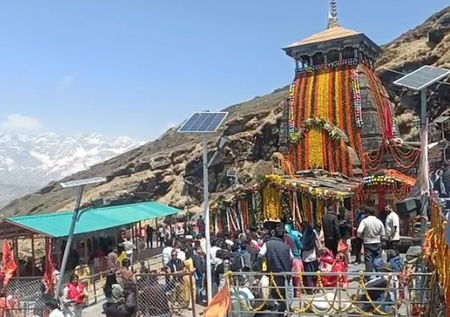
Dehradun, May 27 (IANS) The sacred region of Tungnath Temple, located in the Garhwal Himalayas in Uttarakhand and revered as the third Kedar, along with the picturesque valleys of Chopta, continues to draw thousands of devotees, trekkers and nature enthusiasts every year.
While some visitors arrive to witness the snowfall blanketing the Himalayan landscape, others undertake the challenging trek to seek blessings at the shrine of Baba Tungnath. However, the breathtaking natural beauty of the region is increasingly being overshadowed by mounting plastic waste and litter scattered across the area.
The Tungnath-Chopta trekking route is now visibly dotted with discarded plastic bottles, food packets, wrappers and other waste materials. Locals and environmentalists have expressed concern that despite the rising number of tourists and pilgrims visiting the region, awareness and responsibility towards maintaining cleanliness remain alarmingly inadequate.
The growing accumulation of garbage amidst the lush greenery and serene mountain environment is now being viewed as a serious ecological threat. Environmental experts warn that if immediate corrective measures are not taken, the fragile Himalayan ecosystem could suffer long-term damage.
Expressing deep concern over the deteriorating condition of the region, Anil Prakash Joshi, Padma Shri awardee, noted environmentalist and founder of Himalayan Environmental Studies and Conservation Organisation (HESCO), said that simply imposing restrictions or bans would not be enough to tackle the issue effectively.
Referring to the example of Sikkim, Joshi pointed out that the Himalayan state had managed to successfully implement a ban on plastic only after making extensive and well-planned preparations beforehand.
“Today, approximately 70 per cent of food products are designed for on-the-go consumption and rely entirely on plastic packaging. Consequently, if a ban is imposed without first developing viable alternatives, numerous practical challenges are bound to arise,” Joshi said.
He further explained that dependence on plastic could be substantially reduced by encouraging local manufacturing and promoting regional products.
Highlighting the agricultural potential of the hill regions, Joshi said that mountain-grown potatoes are already famous across the country, and products such as potato chips and other food items could be manufactured locally.
“By integrating agriculture and horticulture with the tourism sector, both local employment opportunities can be boosted, and the usage of plastic can be curtailed,” he said.
Joshi stressed that regulations alone would not solve the problem unless tourists and visitors developed a stronger sense of environmental responsibility and sensitivity towards nature.
“Simply formulating regulations will not suffice; rather, it is imperative to cultivate a sense of understanding and sensitivity towards nature among travellers and tourists. Tourists visit this place, offer their prayers, and depart; however, truly experiencing the essence of nature — and, crucially, safeguarding it — is a responsibility of equal importance,” he said.
The environmentalist further stated that there is now an urgent need to foster a new mindset focused on reducing plastic use and conserving nature, beginning from the Kedar Valley itself, so that future generations can also experience the untouched beauty and spiritual charm of the Tungnath-Chopta region.
–IANS
sd/uk