

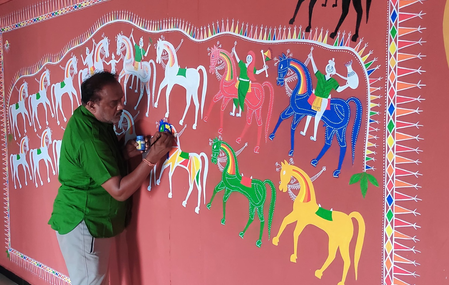
Vadodara, June 26 (IANS) Pithora painting, a traditional tribal art form from Central Gujarat, will be showcased at the upcoming Vibrant Gujarat Regional Conference (VGRC) and the Vibrant Gujarat Regional Exhibition (VGRE), highlighting its transition from ritual wall art to a commercially viable craft reaching wider markets.
The VGRC for the Central Gujarat region is scheduled for June 29 and 30 at GSFC University in Vadodara, while the VGRE will run from June 29 to July 3.
According to officials, the events are intended to promote industrial and economic development alongside the state’s handicrafts and cultural heritage on a broader platform.
Aligned with the vision of “Developed India@2047” and “Vocal for Local”, the initiative will feature several GI-tagged products and traditional crafts from central Gujarat.
Authorities said the objective is to connect artisans with national and international markets and expand livelihood opportunities through institutional support and exposure.
Among the key exhibits will be Pithora painting, a ritual art form traditionally practised by the Rathwa, Bhil and Bhilala communities in Chhota Udepur, Vadodara and Panchmahal districts.
Historically created on the mud walls of tribal homes, the paintings were made as part of religious ceremonies and as symbolic prayers to maintain harmony between humans, nature and spiritual forces.
Over time, the practice has moved beyond its original context, finding expression on canvas, paper and other modern materials.
This shift has enabled the art form to reach wider audiences while also creating additional income opportunities for artists, particularly younger practitioners who have adapted traditional motifs to contemporary formats without abandoning their cultural roots.
The art received a geographical indication (GI) tag in 2021, recognising its regional identity, authenticity and cultural significance.
Despite its evolution in medium and market, practitioners note that the symbolic language of Pithora painting remains consistent, even as individual artistic interpretation varies in colour choices, composition and the inclusion of motifs.
Traditional elements such as bows and arrows continue to appear alongside modern imagery, including vehicles and scenes from contemporary life, reflecting gradual social change within the artistic tradition. Institutional support has played a significant role in this transition.
The Gujarat State Handloom and Handicrafts Development Corporation Limited, through its “Garvi Gurjari” initiative, has been working with artisans through training programmes, design development, exhibitions and direct procurement of artworks.
Over the past five years, the corporation has purchased Pithora artworks worth more than Rs 6.2 lakh directly from artists, with officials estimating a 15 to 30 per cent increase in income for participating artisans.
The organisation currently works directly with five master artists and supports thousands of rural households indirectly through craft-based livelihoods.
Pithora artist Naran Rathwa said that institutional support has helped expand access to markets beyond local demand.
“The workshops, exhibitions and fairs organised have been very useful for us. Earlier, our income was limited to work available in the village, but now, due to access to new markets and customers, our sources of income have significantly increased,” he said.
Another artist, Padma Shri awardee Paresh Rathwa, said the initiative has contributed to both recognition and economic stability for artisans. “It has truly made me and my fellow local artisans self-reliant. The institution has taken the heritage of our tribal community and the essence of our soil to different parts of the world,” he said.
He added that engagement with organised platforms had helped artists better understand market expectations and presentation, while also providing greater visibility for their work.
Officials said additional measures, such as transport and stall support, live demonstrations, and opportunities for buyer interaction, have further enabled artisans to participate in exhibitions.
Regular design development workshops have also encouraged diversification into products such as home décor items and lighting accessories, extending the application of Pithora motifs beyond traditional formats.
Digital initiatives, including online campaigns promoting Gujarat’s handicraft sector, have further increased visibility.
As VGRC and VGRE prepare to bring together industry, policymakers and artisans, Pithora art is expected to be among the cultural highlights, reflecting both continuity and change within one of Gujarat’s recognised tribal art traditions.
–IANS
mys/dan