

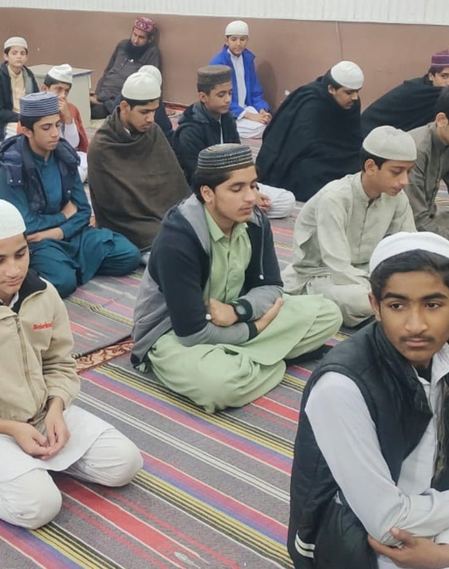
Rome, May 23 (IANS) Pakistan’s education crisis exposes a deep governance failure, where official claims of combating extremism are undermined by allowing school materials and public narratives that reinforce the ideology sustaining it. For years, the education system in the country has remained a major concern among human rights advocates, minority representatives and education reformers, a report had detailed.
Europe’s stance on human rights appears inconsistent when it overlooks the ideological formation of future generations in Pakistan, a major beneficiary of the Generalised Scheme of Preferences Plus (GSP+) under the European Union, Dimitra Staikou, a Greek lawyer, writer, and journalist, wrote in EU Today.
She highlighted that the criticism goes beyond Pakistan’s underfunded schools, uneven access to education or poor learning outcomes — pointing to curriculum content that continues to reinforce a narrow definition of national identity linked to religious conformity and suspicion of those outside the dominant narrative.
“That matters beyond Pakistan’s borders. For the European Union, Pakistan is not a distant or marginal case. It is a beneficiary of preferential trade access under the EU’s GSP+ scheme, which is formally linked to the implementation of international conventions on human rights, labour rights, environmental protection and good governance. The content of Pakistani classrooms, therefore, has a direct bearing on how Europe assesses Pakistan’s long-term direction, its treatment of minorities and its willingness to confront extremism at its roots,” Staikou stated.
“At the centre of the concern is the role of education in shaping civic identity. In a healthy system, schools should encourage critical thinking, social mobility and coexistence. In Pakistan, critics argue that the opposite too often occurs. Textbooks and classroom materials have been accused of presenting religious minorities as peripheral to the national story, framing India as a permanent enemy, and merging patriotism with religious orthodoxy,” she added.
According to the expert, the outcome is not simply poor education, but the reproduction of a worldview in which diversity is viewed with suspicion and conformity is framed as a civic virtue.
Staikou stressed that this is a serious challenge in Pakistan, which is already grappling with sectarian violence, attacks on minorities, blasphemy-related abuses and the persistent influence of extremist networks.
Emphasising that Europe should not treat extremist ideological narrative in Pakistan as a remote South Asian debate, Staikou said, “Radicalisation today travels through digital networks, diaspora communities, encrypted platforms and informal ideological ecosystems. Narratives of grievance, exclusion and religious confrontation do not remain within national borders. They circulate, adapt and find audiences among vulnerable individuals far from the places where they first emerge.”
–IANS
scor/as