

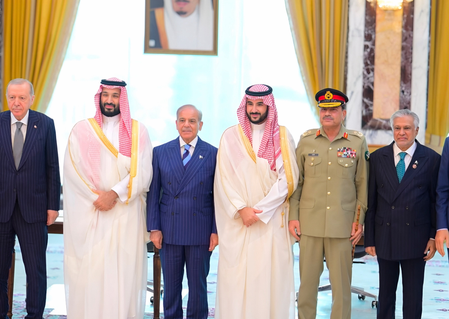
Islamabad/New Delhi, Aug 22 (IANS) Pakistan’s participation in various alliances is largely driven by the need for financial assistance amid its persistent economic crisis. Islamabad’s reliance on oil-rich Middle Eastern countries for short-term economic relief highlights the absence of the country’s long-term economic strategy, a report has stated.
On August 7, Turkey, Pakistan, and Saudi Arabia signed the Mecca Joint Defence Agreement, under which “any armed attack against any one of the three states shall be regarded as an attack against them all.” The pact raises significant questions about the formation, effectiveness, and durability of alliances in the Middle East, a report in ‘Politeia Research Foundation’ mentioned.
“Unlike its South Asian counterparts, Pakistan seems addicted to alliances. With the United States, Pakistan signed the Mutual Defence Assistance Agreement in 1954. Subsequently, Pakistan was a member of the Southeast Asia Treaty Organisation, (SEATO, 1954–1973), was a member of the Central Treaty Organisation (1955–1979), played an important role in facilitating the emergence of the China-Pakistan-US alignment in 1971, and was a member of the Islamic Military Counter Terrorism Coalition (2015) and signed a Strategic Mutual Defence Agreement (SMDA) with Saudi Arabia in September 2025,” the report detailed.
“Although not a formal alliance, Pakistan also has an ‘all-weather strategic cooperative partnership’ with China, and the two coordinate closely on regional and global issues. Given the close relationship and the need for Chinese support to contain India, Pakistan may find it difficult to act unilaterally on crucial issues in the Middle East without Chinese consent,” it mentioned.
According to the report, Pakistan’s record as an alliance partner raises serious questions about its loyalty. Despite being a member of SEATO, it said, Pakistan did not provide support to the US during the Vietnam War in the 1970s. Likewise, after receiving what Islamabad viewed as inadequate assistance from CENTO members during the 1965 and 1971 conflicts, Pakistan withdrew from the alliance framework.
The report noted that following the Soviet invasion of Afghanistan in 1979, Pakistan played a key role in channeling US military assistance to the Mujahideen, while using that support to strengthen its military capabilities against India. However, after the 9/11 terrorist attacks, it said, Pakistan pursued a dual policy, backing the US-led military intervention while also providing shelter to the Taliban.
“During the recent Iran War, Pakistan preferred to act as a neutral mediator rather than lean in support of Arab friends. Despite such a less-than-satisfactory record as an alliance partner, Pakistan has been roped into the Mecca Defence Agreement. Perhaps the presence of nuclear weapons is prompting the countries in the Middle East to engage with Pakistan. For Turkey, Pakistan is a significant defence market,” the report noted.
–IANS
scor/as