

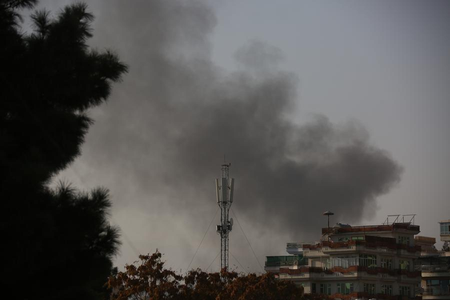
New Delhi, June 29 (IANS) In another round of military strikes, Pakistan security forces Sunday carried out ground operations along the Afghanistan border, coupled with airstrikes deeper inside, said reports.
Pakistan claimed that the attacks were targeted at militants in response to multiple attacks across the border, while the Afghan government said that they left dozens of civilians dead or injured, including women and children, the reports said.
Since October 2025, Pakistan has escalated its military campaign against Afghanistan, striking Kabul, Kandahar, Jalalabad, and Paktika in what Islamabad frames as counterterrorism operations against Tehrik-e-Taliban Pakistan (TTP) insurgents.
However, Kabul’s Taliban government has denounced these strikes as violations of sovereignty, reporting civilian casualties and accusing Islamabad of using Afghanistan as a scapegoat for its own internal failures.
Border clashes across Khyber Pakhtunkhwa, Bajaur, Kurram, and Balochistan have left dozens dead, while closures of crossings like Torkham and Chaman disrupted trade and humanitarian flows for about eight months.
A brief ceasefire, brokered by Qatar and Turkey in mid-October, collapsed within days, and by February this year, Pakistan declared “open war” against its neighbour. But rather than decisively weakening the Taliban, it has deepened hostility, destabilised the region, and underscored Pakistan’s reliance on external aggression to mask an imminent domestic collapse.
Earlier, faced with strong diplomatic and military responses from New Delhi, Pakistan had to scale back its efforts to destabilise its eastern neighbour through terrorism.
Meanwhile, Islamabad’s 27th Constitutional Amendment, 2025, entrenched military supremacy by strengthening the army chief’s role, sidelining civilian institutions. Incarcerating Imran Khan and trying to isolate his Pakistan Tehreek-e-Insaf (PTI) party from politics, too, has deepened legitimacy crises.
Opposition alliances demand constitutional supremacy, but mass arrests and shrinking democratic space continue instead.
Pakistan is also facing an economic collapse, with poverty reportedly at 42 per cent, and an International Monetary Fund (IMF) bailout negotiation currently stalled, the country is desperately trying for assistance simultaneously from China and the United States.
Meanwhile, secessionist movements continue to haunt the country, many led or fed by inbred terror elements.
In Balochistan, the Baloch Liberation Army (BLA) continues insurgent attacks, often targeting Chinese-funded projects under the China-Pakistan Economic Corridor (CPEC).
In Sindh and Pakistan-occupied Jammu and Kashmir (PoK), demands for autonomy or independence simmer, fuelled by reported exploitation and neglect.
Rulers in Islamabad find governance defined by military dominance, where the army frames political disputes as security problems, replacing governance with military management, especially in the border regions.
Military rulers from the garrison town of Rawalpindi define foreign policy, security, and even economic domains. Civilian institutions thus lack legitimacy and capacity, leaving Pakistan unable to effectively address poverty, education, or healthcare crises. Instead, resources are diverted to defence, perpetuating fragility.
Blaming Kabul for harbouring militants is a desperate bid to shift public angst away from the economic collapse and political repression.
For the Pakistan Army, external conflicts serve as a means to justify its dominance, presenting itself as the guardian of sovereignty. Despite having spawned the Taliban, and its precursor – the Mujahideen militia against the then Soviet forces occupying Afghanistan — Kabul is now the target.
Pakistan’s war against Afghanistan is less about defeating the Taliban than about masking its own failures. But the Taliban’s resurgence has instead created a formidable foe. The war on Afghanistan is a dangerous diversion. It reflects a state unable to contain its own internal turmoil, lashing out at a weaker neighbour to preserve the illusion of strength.
Pakistan now risks deepening its isolation, destabilising the region, and accelerating internal fragmentation. Afghanistan, though militarily weaker, has shown resilience in past conflicts. For Islamabad, the greatest threat is not its neighbours – it lies within.
–IANS
jb/snj/skp