

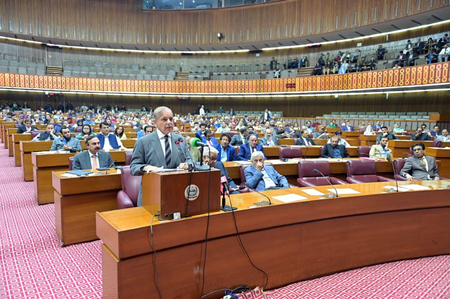
Islamabad, July 2 (IANS) Pakistan’s federal budget for Fiscal Year (FY) 2026-27 has prioritised military spending over public welfare by increasing defence spending by 18 per cent to three trillion Pakistani Rupees (PK), showcasing the armed offers as the clear winner during attempts to meet economic stabilisation targets. The budget offers little to the human resources that actually drive economic growth.
“The combined federal allocations for higher education, primary schooling, and healthcare account for only a fraction in comparison to the military’s multi-billion-dollar budget. Roughly 46 billion rupees ($165 million) for higher education and 25 billion rupees ($89 million) for healthcare were allocated. Their combined total pales in comparison to the massive federal defence budget,” Uzay Bulut, a Turkey-born journalist formerly based in Ankara, wrote in PJ Media.
In recent years, poverty levels in Pakistan have increased dramatically. According to the Pakistan Economic Survey 2025-26, the national poverty headcount ratio rose to 28.9 per cent in FY2024-25, up from 21.9 per cent in FY2018-19, resulting in approximately 27 million additional people getting pushed into poverty, bringing the total number to around 70 million. Rural poverty increased from 28.2 per cent to 36.2 per cent while urban poverty surged from 11 per cent to 17.4 per cent.
In addition, a large chunk of the budget has been granted to debt servicing (interest payments), leaving limited space for social expenditure and asset creation. Debt servicing has been granted a massive share of the budget at around 8.054 trillion rupees.
Along with defence, these two-line items account for more than 60 per cent of the total federal outlay (over PKR 11 trillion), resulting in very constrained space for social protection, education, health, infrastructure, and development spending.
“The defence budget is nearly three times the entire federal development budget and significantly higher than combined federal allocations for education and health. Social protection (mainly Benazir Income Support Programme) has increased to 838 billion rupees ($3.01 billion/up ~17 per cent), but overall social sector spending remains insufficient relative to rising needs. The sectors that directly uplift human capability such as education have thus been given a mere pittance,” Bulut wrote in PJ Media.
The allocation of national resources reflects the prioritises of a nation. Through the latest budget, Pakistan’s government heavily taxed salaried people and formal businesses to increase defence spending by 18 per cent while people of the country do not have basic health, literacy, education, employment, infrastructure, and economic opportunities.
–IANS
akl/as