

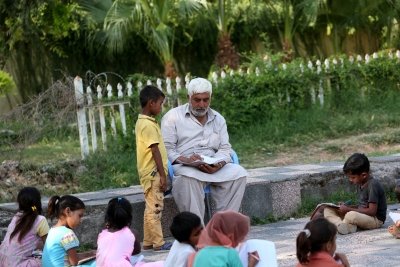
Islamabad, June 4 (IANS) Pakistan needs to raise its education spending to international levels – at least four-six per cent of Gross Domestic Product (GDP) – as suggested by the United Nations Educational, Scientific and Cultural Organisation (UNSESCO) and United Nations International Children’s Emergency Fund (UNICEF), a report has stated.
Pakistan’s literacy rate is 60 per cent while male literacy stood at 68 per cent and female literacy is at 52 per cent. The literacy rate in Pakistan is highest in Punjab province at 66 per cent while Balochistan is at the last spot among four provinces with 42 per cent literacy rate, Assistant Professor Mujeeb Ali wrote in The Express Tribune.
Various reports have revealed that 26.8 million children in Pakistan are out of school. In recent years, university enrolment in Pakistan dropped by 13 per cent and only five out of every 100 students, who begin primary school, reach a university classroom.
Increase in tuition fees along with shrinking scholarships, has turned higher education into an unaffordable privilege for many working-class families. Pakistan’s education spending has reduced to 0.8 per cent of GDP while international benchmarks recommend allocating more than four per cent of GDP to education sector.
“Countries that neglect education are left vulnerable to poverty, corruption and instability. To achieve the highest educational standards, Pakistan needs to raise its education spending to international levels – at least 4-6 per cent of GDP, as recommended by Unesco and Unicef,” wrote Professor Mujeeb Ali in The Express Tribune.
“Alongside this, it is essential to ensure safe and inclusive learning environments for both girls and boys in rural as well as urban areas of the country. Moreover, there should be strict checks not only on enrolment but also on attendance and learning outcomes of students and teachers at school, so as to ensure that education is not just about qualifications but for life,” he added.
In March, a government report titled ‘Public Financing in Education 2025–26’ revealed that Pakistan’s education system is struggling with severe underfunding and weak learning outcomes as millions of children are left behind.
According to the statistics presented in the report, more than 25.37 million children remain out of school, and 77 per cent of the school-going 10-year-olds are virtually illiterate. These numbers showcase a national emergency that poses a threat to Pakistan’s social progress and economic development.
“One of the most troubling aspects revealed in the report is the declining share of education spending in the national economy. Education expenditure has consistently remained below international benchmarks, averaging less than two per cent of the GDP. Over the past five years the trend has been even more discouraging, reflective of the low priority education gets within the national fiscal framework,” an editorial in Pakistan-based ‘Business Recorder’ stated.
“Its share fell from 1.9 per cent of the GDP in 2019–20 to 1.4 per cent in 2020–21, briefly rose to 1.7 per cent in 2021–22, and then slipped again to 1.5 per cent in 2022–23. The provisional estimate of 0.8 per cent for 2024–25 is particularly worrying, indicating a further downward trend in government spending on education,” it added.
The continuous under-investment explains many of the structural problems in education sector. Schools in Pakistan often do not have basic infrastructure, teaching materials, and trained teachers.
Access to education remains uneven in rural and marginalised areas, with girls and children especially affected, according to the report in Business Recorder. If government does not provide adequate resources, students in classrooms are directly impacted due to overcrowding, poorly trained staff and outdated materials.
According to the report, 77 per cent of 10-year-olds in Pakistan cannot read and understand a simple text, showcasing a serious learning crisis.
–IANS
akl/as