

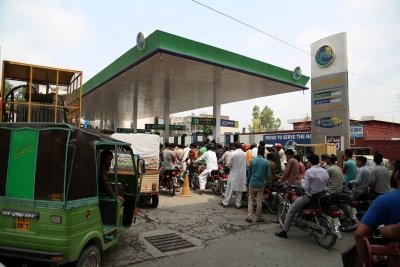
New Delhi, March 21 (IANS) As geopolitical tensions in West Asia entered 22nd day — with major oil fields reportedly damaged on both sides — Pakistan, an energy-import dependent economy, is facing heightened risks of economic and financial instability, a new report has said.
The report in The Express Tribune highlighted that Pakistan’s domestic crude production remains limited at around 81,000 barrels per day, while consumption is nearly 480,000 barrels — a gap of over 100 per cent — resulting in a large and persistent import dependence.
Around 80 per cent of Pakistan’s crude oil and almost all liquefied natural gas (LNG) imports transit the Strait of Hormuz, largely from Gulf suppliers, leaving the country dangerously exposed to external shocks due to overconcentration, it said.
These vulnerabilities are not merely structural; they are deeply entrenched and increasingly difficult to manage.
The neighbouring country remains highly exposed due to its heavy reliance on imported fuels to sustain industrial activity, electricity generation and transport.
Despite decades of policy awareness, Pakistan has failed to significantly reduce this dependence.
The report further stated that any instability in the Strait would immediately inflate Pakistan’s already burdensome oil import bill.
“Even minor fluctuations in global crude prices strain foreign exchange reserves that remain chronically under pressure,” it said.
For Pakistan, the substantial rise in oil prices since February 28 is not a temporary disruption but a recurring setback that deepens macroeconomic fragility.
The report noted that higher energy costs quickly ripple through the economy, adding that fuel is central to transportation, power generation and manufacturing, meaning rising prices feed directly into inflation.
In Pakistan’s case, where inflation has persistently eroded purchasing power, these shocks disproportionately affect lower- and middle-income households.
These weaknesses are compounded by slow progress in structural reforms.
Efforts to diversify energy sources, expand domestic production or invest meaningfully in renewables have been uneven and often delayed.
While the country has significant solar and wind potential in regions such as Sindh and Balochistan, policy inconsistency and financial constraints have hindered large-scale development.
The report also highlighted that energy inefficiency further exacerbates the problem.
High transmission losses, outdated infrastructure and weak regulatory enforcement continue to inflate demand and waste resources, increasing reliance on costly imports, it added.
–IANS
ag/na