
Quetta, May 13 (IANS) Journalists and rights activists have criticised the Sindh government in Pakistan for imposing 28-point conditions, including a ban on the participation or support of the Baloch Yakjehti Committee (BYC) and the Jeay Sindh Qaumi Mahaz (JSQM), in Karachi’s Aurat March.
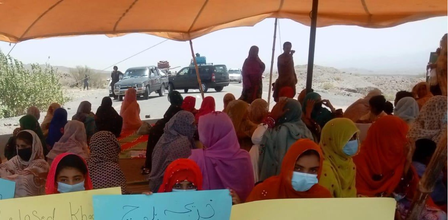
The permission letter issued by the office of the Deputy Commissioner South Karachi has prohibited the participation or support of “proscribed” organisations, including the BYC and JSQM, The Balochistan Post reported.
Journalist Kiyya Baloch termed several conditions imposed under which Aurat March has been given permission to protest “controversial.” However, he mentioned that the clause banning BYC and JSQM requires special attention.
While sharing the permission letter on X, Kiyya Baloch stated, “These are the conditions under which Aurat March has been granted permission to protest. Several points are controversial, but point 7 in particular demands attention: participation or support from organizations like BYC and JQSM will be strictly prohibited. If even protesting must remain within the bounds of the state’s will, then is this march one of resistance, or merely a token activity?”
Journalist Ahmad Noorani also slammed the Sindh government for imposing the conditions, questioning whether people of Balochistan were being treated as equal citizens, The Balochistan Post reported.
“Are the Baloch not part of Pakistan? Is a Baloch woman not a woman?”, wrote Noorani on X, adding that the state was depriving Baloch people of rights given to people in other provinces.
BYC leader Sabiha Baloch questioned the legal basis for calling BYC “proscribed”. She stated that the conditions under which Aurat March has been given permission to protest are not merely a few administrative directives but an open expression of the state’s fear of every voice that speaks out against Baloch genocide, enforced disappearances, and state repression. She called the ban on participation or support of organisations like the BYC and JQSM “undemocratic” and highly controversial from a legal and constitutional standpoint.
“The question is: Under which law has the Baloch Yakjehti Committee (BYC) been ‘proscribed’? When was it declared unlawful? Which court imposed a ban on it? If no such legal basis exists, then who granted the government the authority to impose restrictions on the participation of any political or social group in a public protest? Protest is a fundamental democratic right of the people, not a concession that the state can grant or revoke at will. When governments begin deciding who can participate in a protest and who cannot, it is not democracy but political engineering and a new form of martial law,” Baloch wrote on X.
“Such announcements do not raise questions but reveal the truth: In this country, democracy is merely a ceremonial veil, while real power lies in the hands of a system of repression, censorship, and fear. State institutions will have to answer why they fear the BYC so much. An organization whose central leadership has been imprisoned for a year on false charges, whose activists face Fourth Schedule listings, NACTA scrutiny, fabricated FIRs, and constant harassment, from whom forced confessions are extracted, and whose families are targeted with enforced disappearances. Even after all this, the state’s fear has not subsided. The situation now is such that even a platform like the Aurat March is being granted permission only on the condition that no individual or supporter of the Baloch Yakjehti Committee is present there,” she added.
Baloch stated that the ban is an admission that the BYC has built an effective resistance against Baloch genocide, enforced disappearances, and state violence.
“Because if our voice were ineffective, the state would not feel fear at the mere mention of the BYC even in the Aurat March. On one hand, the state persists with its plan to silently erase the Baloch, and on the other, the BYC stands as an obstacle in the path of this silent genocide. This is why efforts are being made to isolate the BYC from every forum, every street, every protest, and every voice. But history bears witness that repression always strengthens resistance further—it does not silence it,” she posted on X.
In a separate statement, the BYC slammed the Sindh government for calling the organisation “proscribed”. It said that the government’s decision to mention BYC and JSQM as banned amounts to what it described as “state fascism” against the Baloch people.
The BYC stated that it is a democratic public movement in Balochistan against human rights violations, enforced disappearances, extrajudicial actions and what it called as the “Baloch genocide”. It termed authorities’ decision to designate BYC as banned “shameful and condemnable.”
–IANS
akl/as