

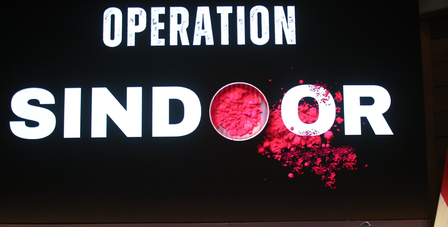
New Delhi, May 7 (IANS) On the intervening night of May 6-7, the Indian armed forces carried out Operation Sindoor to avenge the Pahalgam attack in which innocent lives were lost. The operation was so precise that it took down major infrastructure both in Pakistan occupied Kashmir (PoK) and Pakistan.
Some of the major infrastructure that was destroyed included the Jaish-e-Mohammad’s headquarters in Bahawalpur and the Lashkar-e-Taiba’s primary training facility in Muridke.
Experts say that the Indian armed forces fought on multiple fronts. While taking down infrastructure, the forces were dealing with a flurry of hostage drones that came from Pakistan. While taking down terror infrastructure seamlessly, every drone that came in from Pakistan was taken down effectively.
During this operation, Pakistan decided to activate its propaganda wings. These wings were in overdrive mode on social media, spreading false narratives. Officials say that this was done with the intention of demoralising the Indian armed forces.
The Indian government, however, managed to counter every false narrative and ultimately, revenge was sought for Pahalgam and the message to Pakistan was delivered. While the primary intention was to hit terror infrastructure in Pakistan, which has been used for years to carry out strikes in India, the Operation also aimed at sending a larger message.
The Indian doctrine changed, and the message to Pakistan is that every terror attack will be treated as an act of war. It has put Pakistan on the back foot, and the country will think ten times before it plots an attack. This explains the push for raising homegrown modules in India, another official said.
During Operation Sindoor, Pakistan also witnessed the power of the Indian Air Force’s Integrated Air Command and Control System (IACCS). This was instrumental in providing the shield during the operation.
Pakistan sent dozens of drones. At first, it was just harmless drones that flew in, meant to distract. Later, it was the larger drones, and despite trying to confuse and divert them, the IACCS managed to take down each one.
Pakistan was not just launching the drones against the Indian armed forces; attempts were made multiple times to target civilian territory, but they were shot down successfully.
The operation also made India realise the importance of upgrading technology for future scenarios. Wars would be fought using drones largely, and securing the nation against them has become a top priority for the Narendra Modi government.
Post the operation, the Government of India approved emergency procurements, including replenishing S-400 missile stocks, drones, counter-drone systems, Javelin anti-tank guided missiles, loitering munitions and precision munitions. Further, the IACCS equipment, which is at seven sites, is being refurbished with new components and equipment.
According to a request for proposal issued to the defence public sector undertakings by the IAF last week, this was needed to mitigate a single point of failure in networked tactical nodes (NTN). This is critical for the IAF’s operations in its air defence network.
An official added that Operation Sindoor was a huge success, and the slew of diplomatic measures that were taken in its aftermath also had a major impact. India suspended trade ties, diplomatic relations, and placed the Indus Waters Treaty in abeyance.
All this conveyed India’s strong stance against Pakistan-sponsored terrorism.
Operation Sindoor also set an example of the jointness among the Indian armed forces. The experts say that this was not just an operation to hit terror infrastructure. It signalled a strategic shift in India’s approach towards national security.
Prime Minister Narendra Modi said that Operation Sindoor was a reflection of the nation’s resolve to ensure justice and security.
–IANS
vn/dpb