

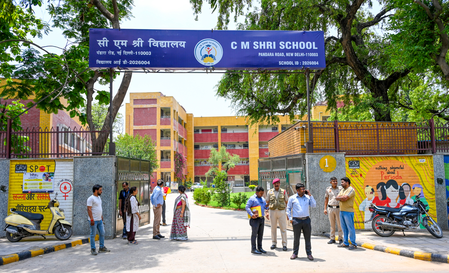
New Delhi, June 20 (IANS) The country’s largest medical entrance examination, the NEET-UG 2026 re-examination, is set to be held on Sunday, June 21, following the cancellation of the original May 3 examination amid allegations of irregularities.
The National Testing Agency (NTA), in coordination with the Central and state governments, police, district administrations and paramilitary forces, has put in place extensive security arrangements to ensure a leak-proof, fair and transparent process for more than 22 lakh aspirants seeking admission to MBBS, BDS and other undergraduate medical courses across the country.
The examination will be conducted at 5,440 centres across 551 cities in India and 14 international locations in English and 12 Indian languages.
The NTA said it is fully prepared to conduct the examination, with more than 95,000 examination rooms equipped with 1,38,560 CCTV cameras monitored live at the national, state and ministry levels.
The surveillance network will be supported by AI-based analysis of CCTV feeds and 51,311 jammers supplied by Electronics Corporation of India Limited (ECIL) and Bharat Electronics Limited (BEL).
Two invigilators will be deployed in every examination room, supported by more than 10 functionaries at each centre. A total of 38,795 frisking personnel and 48,448 biometric staff members have been deployed, with face authentication systems introduced to strengthen candidate verification.
Around 6,700 observers and more than 100 virtual observers will oversee the conduct of the examination, while each centre will have an average deployment of 40 to 50 security personnel.
Police, paramilitary forces, the Indian Air Force and the Department of Posts have also been mobilised to ensure the secure transportation of confidential examination materials, which have been verified at custodian banks. According to the NTA, more than 2.5 lakh security personnel have been mobilised nationwide.
Question papers and OMR sheets will be handled under sealed, end-to-end protocols, while Aadhaar-based biometric verification and frisking will be mandatory at all centres.
GPS-enabled transport vehicles and police escorts have been deployed for the movement of examination materials, with support from the Indian Air Force in sensitive areas.
A nationwide mock drill was conducted on June 20 to test all systems, including paper dispatch, entry processes, biometric verification and emergency response mechanisms.
The NTA said facilities such as drinking water, oral rehydration solution (ORS), ambulances, shaded waiting areas and seating arrangements for parents have been arranged at all centres. A wall clock will be installed in every examination room, additional rough sheets will be provided, including for left-handed candidates, and extra time has been allotted to offset entry-related formalities.
The agency has urged candidates to rely only on official communication channels and ignore rumours or false claims regarding paper leaks circulating on social media.
In the National Capital Region, Delhi and adjoining areas, including Gurugram, Ghaziabad and Noida, will host multiple high-security centres equipped with advanced surveillance systems.
Mumbai, Navi Mumbai, Pune, Nagpur, Nashik and Chhatrapati Sambhajinagar are among the major centres in Maharashtra, where authorities have deployed GPS-enabled transportation for question papers and biometric verification systems.
States in southern India, including Tamil Nadu, Karnataka, Telangana and Kerala, have strengthened security arrangements with additional personnel, while eastern cities such as Kolkata, Patna and Bhubaneswar, along with Lucknow and Prayagraj in Uttar Pradesh, are also operating under enhanced protocols.
The NTA said some venue changes, including in Prayagraj, have already been communicated to candidates.
International centres in the UAE, Kuwait, Saudi Arabia and other countries have also been activated to facilitate the participation of overseas candidates.
In Madhya Pradesh, Bhopal will host 32 dedicated centres. Local administrations, police authorities and the NTA have conducted mock drills at all centres to simulate examination-day scenarios and prevent malpractices.
The Railways, including the West Central Railway in Madhya Pradesh, have established help desks at stations such as Bhopal, Vidisha, Narmadapuram, Guna and Ashoknagar to assist candidates with travel and transport arrangements. Similar support measures have been put in place at major railway hubs across the country.
Authorities have prohibited the use of loudspeakers near examination centres and discouraged unnecessary vehicle parking to minimise congestion.
Reporting, frisking and biometric verification will commence at 11 a.m., while the entry deadline has been fixed at 1.30 p.m. No candidate will be permitted entry after the deadline.
The examination will be held from 2 p.m. to 5.15 p.m.
Candidates have been instructed to carry a printed admit card with a passport-sized photograph affixed, a postcard-sized 4×6-inch photograph, a valid photo identity proof — including Aadhaar, PAN card, voter identity card, passport or driving licence — and two additional passport-sized photographs.
Electronic devices, including mobile phones, smartwatches, Bluetooth devices, earphones and calculators, as well as notes, books and geometry boxes, will not be permitted inside examination centres.
Wallets, handbags, cameras, food items, except those permitted for diabetic candidates, and metallic ornaments are also prohibited.
Ballpoint pens will be provided at the centres.
Candidates have been advised to wear simple, light-coloured clothing without pockets or accessories to facilitate frisking.
The NTA said all arrangements were in place for the smooth conduct of NEET-UG 2026 and wished the aspirants success in the examination.
–IANS
sktr/pgh