

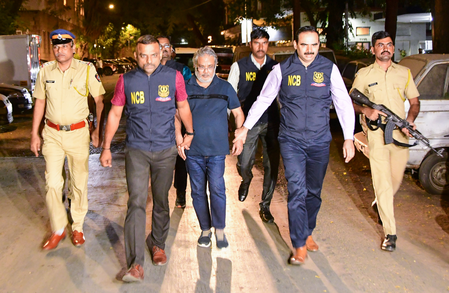
New Delhi, Aug 15 (IANS) The Narcotic Control Bureau (NCB) tracked down and extradited four high-profile international drug kingpins under its ‘Operation Global Hunt’, executing Prime Minister Narendra Modi’s directive to build a drug-free India, senior officials said.
The Centre’s diplomatic outreach has persuaded international partners regarding the security risks of harbouring transnational syndicate heads.
The extradited kingpins include Virender Singh Basoya, suspected mastermind of a Rs 13,000-crore international drug cartel brought back from the UAE, and Salim Dola, a key operative linked to Dawood Ibrahim who was arrested in Malaysia and deported via Turkiye. The Indian agencies also secured the extradition of Prabhdeep Singh from Azerbaijan and cross-border logistics supplier Ritik Bajaj from the UAE.
The Modi government adopted a tougher approach towards narcotics networks, with enforcement agencies increasingly focusing on the masterminds who operate drug cartels from abroad.
Since the government announced its objective of making India drug-free, the NCB, which is spearheading the campaign, has intensified its crackdown on local suppliers, middlemen, distributors and dealers. However, officials say dismantling the narcotics trade requires agencies to go beyond the domestic network and identify the kingpins controlling the operations from foreign countries.
According to officials, the NCB’s latest strategy has begun to yield results, with a growing number of suspected drug lords based overseas being traced and extradited to India. Recent examples include Salim Dola, Virender Singh Basoya, Prabhdeep Singh and Ritik Bajaj. Their extraditions were facilitated under Operation Global Hunt launched by the NCB.
Officials said a key factor behind these successes has been the agency’s “top-to-bottom” and “bottom-to-top” approach. “The strategy enables investigators to simultaneously target cartel leaders abroad and trace the domestic networks operating under them,” the officials said.
Under the top-to-bottom approach, the NCB seeks to identify the masterminds controlling drug operations from foreign locations. Investigators use intelligence inputs, international cooperation and Interpol channels to locate these individuals and build cases against them.
“The bottom-to-top approach starts at the operational level within India. Local intelligence is used to identify suppliers, middlemen, dealers and logistics operators. Their arrests and subsequent investigations provide investigators with access to digital footprints, financial transactions and communication trails. These leads can then be followed upwards to identify mid-level handlers, distributors, entry-point managers and, eventually, the cartel bosses,” the officials said.
This process has proved useful in connecting seemingly independent arrests and seizures to larger international narcotics networks, they added. “Tracing the chain upwards is one part of the challenge. The real success is when these persons are extradited to India,” an official said.
Basoya, who is suspected of being a mastermind behind a Rs 13,000-crore international drug cartel, was extradited from the UAE. Prabhdeep Singh was extradited from Azerbaijan, while Bajaj, described as a cross-border logistics supplier, was brought back from the UAE.
Dola, considered a major player in the international narcotics network and a close aide of fugitive underworld figure Dawood Ibrahim, was arrested in Malaysia and extradited to India through Turkiye.
Officials said cooperation from foreign governments has also improved as India has intensified its campaign against narcotics networks. They attributed this to sustained diplomatic engagement, stronger intelligence sharing and the preparation of detailed cases against suspected cartel operators.
The NCB has also worked to ensure that extradition requests are backed by substantial evidence, including financial records, digital evidence and details of the accused persons’ alleged roles in organised drug trafficking.
“This helps in easing the extradition process. Further, India has also managed to convince the international community about the ill-effects of holding such people in their respective countries,” an official said.
According to officials, the success of recent investigations lies in treating the narcotics trade as a connected chain. Local dealers, logistics suppliers, middlemen and international kingpins cannot be investigated in isolation. The twin top-to-bottom and bottom-to-top strategy allows the NCB to follow the network in both directions, with the larger objective of dismantling the cartel itself.
–IANS
vn/snj/skp