

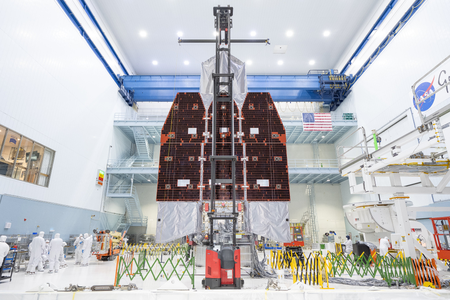
New Delhi, April 22 (IANS) US space agency National Aeronautics and Space Administration (NASA) unveiled the Nancy Grace Roman Space Telescope, a wide‑field observatory designed to scan the universe for planets outside the solar system and probe the mysteries of dark matter and dark energy.
NASA administrator Jared Isaacman said at a news conference at the Goddard Space Flight Center in Maryland that “Roman will give the Earth a new atlas of the universe.” The 12‑metre, silvery contraption with large solar panels will be moved to Florida for a launch into space by a SpaceX rocket in September at the earliest.
Named after NASA’s first chief astronomer, the ‘mother of the Hubble Space Telescope,’ the Nancy Grace Roman, the new telescope will have a field of view at least 100 times larger than Hubble’s, potentially measuring light from a billion galaxies in its lifetime, NASA said.
This observatory will also be able to block starlight to directly see exoplanets and planet-forming disks, complete a statistical census of planetary systems in our galaxy, and settle essential questions in the areas of dark energy, exoplanets, and infrared astrophysics, it added.
The Roman telescope was built at a cost of over $4 billion in more than a decade and will be positioned 1.5 million kilometres from Earth to probe vast regions of space.
At this special place in space, called the second Sun-Earth Lagrange point, or L2, gravitational forces balance to keep objects in steady orbits with very little assistance, the agency said in a blog post.
The thermal stability of an observatory at L2 will provide a ten-fold improvement beyond Hubble in much of the data Roman will gather.
It will send 11 terabytes of data a day down to Earth, said Mark Melton, a systems engineer at Goddard Space Flight Center.
–IANS
aar/pk