

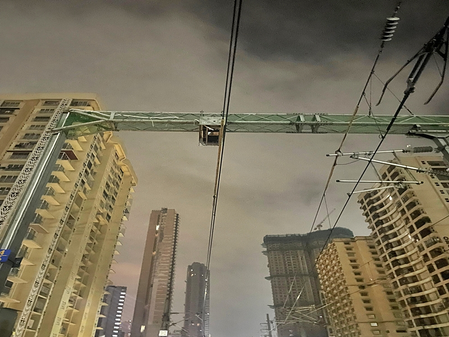
Mumbai, May 25 (IANS) The Mumbai Metropolitan Region Development Authority (MMRDA) has implemented the Automated Pantograph Condition Monitoring System (APCMS), marking a major advancement in predictive maintenance and intelligent metro asset management.
The deployment of the state-of-the-art system represents a significant shift from conventional manual inspection practices to continuous, real-time, data-driven monitoring of critical rolling stock components. By integrating artificial intelligence (AI), machine learning, high-speed laser scanning and advanced 3D imaging technologies into live metro operations, MMRDA has established a new benchmark in operational reliability, passenger safety and maintenance efficiency for urban rail systems in India.
In every electrified metro network, the pantograph serves as the critical interface between the train and the overhead power supply system. Even minor defects such as uneven carbon wear, cracks, structural deformation or misalignment can escalate into operational disruptions and costly infrastructure damage if not detected at an early stage, an MMRDA release said.
Traditionally, pantograph inspections were conducted manually during scheduled maintenance cycles, requiring significant manpower and inspection time while offering only periodic assessment of asset condition. The newly deployed APCMS fundamentally transforms this process by enabling automated, non-intrusive condition assessment of every passing pantograph in real time at operational line speeds.
Chief Minister Devendra Fadnavis said the deployment of India’s first APCMS reflects how Maharashtra is steadily moving towards next-generation AI-driven urban transport infrastructure.
“The integration of artificial intelligence, machine learning and real-time predictive diagnostics into metro operations is a major step in building world-class infrastructure standards for the Mumbai Metropolitan Region. Such intelligent systems not only strengthen passenger safety and operational reliability but also significantly reduce train downtime through faster fault detection and condition-based maintenance,” he added.
The fully automated wayside monitoring system uses a combination of high-speed laser scanners, precision imaging systems and 3D triangulation technology to capture detailed geometric and surface-level data without interrupting metro services. Artificial intelligence and machine learning-based analytics continuously process this information to detect abnormalities, deviations from standard operating parameters and early signs of component deterioration before they develop into operational failures.
Deputy Chief Minister and MMRDA Chairman Eknath Shinde said: “By integrating advanced AI-powered monitoring and predictive maintenance technologies into daily operations, we are creating a smarter, safer and more efficient metro ecosystem for Mumbai Metropolitan Region commuters.”
Designed for high operational reliability, the system delivers consistent and repeatable inspection results under all environmental conditions, including daytime and nighttime operations, rain, fluctuating lighting conditions and high-speed train movement, overcoming limitations associated with conventional camera-based inspection methods, the release said.
MMRDA Metropolitan Commissioner Sanjay Mukherjee said the world-class intelligent system would significantly reduce train downtime, improve fleet availability, strengthen operational reliability and minimise the risk of service disruptions.
“The initiative represents an important step towards transforming Mumbai’s metro network into a globally benchmarked public transport system driven by innovation, safety and sustainability,” he added.
–IANS
sj/pgh