

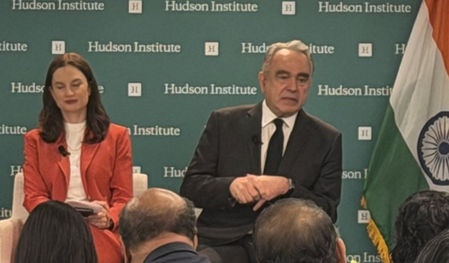
Washington, April 23 (IANS) Former US Deputy Secretary of State Kurt Campbell described India as America’s most important strategic partner of the 21st century, even as he acknowledged rising concerns over recent strains in the relationship.
“I believe the most important relationship for the United States in the 21st century is between the United States and India,” Campbell said at the New India Conference hosted by the Hudson Institute.
At the same time, he said it was “troubling… that we have to have a reminder around mutual respect,” reflecting unease over recent tensions.
Campbell emphasised the depth of people-to-people ties, particularly the role of the Indian diaspora in moments of crisis. He recalled the Covid-19 period, when Indian-American networks mobilised rapidly to deliver medical supplies to India. “I have never seen… the most massive rapid accumulation of humanitarian medical products… shipped… on a moment’s notice,” he said.
The former top American diplomat highlighted education and technology as key drivers of the future relationship. Citing a US-led initiative, he noted the scale of Indian interest. “India, 6,000 candidates for 25,” he said, describing it as evidence of ambition and potential.
Campbell called for expanding academic and technological exchanges, arguing that both countries need to deepen collaboration in science and innovation. He said recent cuts to such initiatives were “tragically and inexplicably” undermining progress.
On strategic alignment, he pointed to bureaucratic challenges within the US system that complicate engagement with India, particularly in defence frameworks spanning multiple regions. He argued that India should be more firmly integrated into the Indo-Pacific architecture.
Campbell also warned that ongoing global conflicts could have lasting consequences for the Indo-Pacific. He said US military resources are increasingly being diverted to other theatres, weakening deterrence in the region. “The quality of our deterrents… is going to go down in the Indo-Pacific,” he said.
He cautioned that the broader economic fallout would be significant. “This is not just a regional conflict… it is a global one,” he said, noting long-term disruptions to supply chains, energy and manufacturing.
Despite these challenges, Campbell said the structural logic of the partnership remains strong. He urged greater political and institutional support for closer ties, including sustained engagement with the Indian-American community.
The New India Conference convened policymakers and analysts to assess India’s global role and the evolving trajectory of US-India relations.
Over the past two decades, the partnership has expanded across defence, trade and technology, with increasing coordination in the Indo-Pacific. While recent disruptions have slowed momentum, both sides continue to view the relationship as central to their long-term strategic interests.
–IANS
lkj/dan