

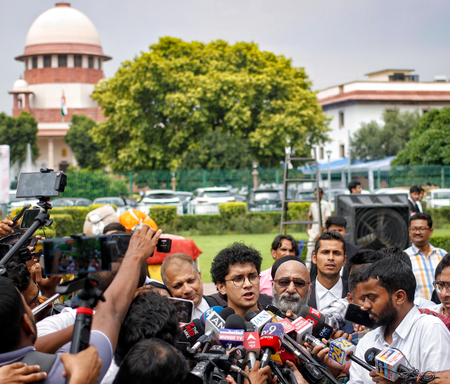
New Delhi, Aug 18 (IANS) The Supreme Court on Tuesday announced its decision to constitute a high-powered fact-finding committee to scan CCTV footage of the students’ march from Jantar Mantar towards Parliament on July 20 and investigate allegations of police excesses.
A bench headed by Chief Justice Surya Kant sought suggestions from the parties on former judges, ex-DGPs or retired CBI directors who could be included in the panel that will examine the question of whether excessive force was used against students protesting against NEET paper leak and irregularities in other tests.
The apex court was hearing a batch of petitions related to student protests in Delhi and Bihar.
During an earlier hearing, the apex court had said that the right to peaceful protest was “absolutely guaranteed”, noting that a “lathi charge” cannot be justified merely because there is an agitation.
On Tuesday, the apex court said that the fact-finding committee may be asked to present periodic reports so that the bench could pass necessary directions, especially in the backdrop of alleged sexual assault and online harassment of female protestors.
“Whosoever is responsible, there can be no excuse and no justification. It must be taken seriously and taken to its logical conclusion. That is why we are constituting a high-powered committee. The committee will look into each and every aspect of these matters,” said the bench headed by CJI Surya Kant.
The CJI, however, clarified that larger constitutional questions related to facial recognition technology, surveillance and privacy will be decided by the apex court itself and not by the committee.
The petitioners are also likely to get an opportunity to directly place issues before the high-powered committee, he said.
The matter relates to clashes between Cockroach Janta Party-led agitators and police on July 20, during which the police used lathi charge and teargas to prevent a possible storming of Parliament.
The bench indicated that it would consider using its powers under Article 142 (extraordinary power of the Supreme Court to do complete justice) to quash the FIRs involving students, but the cases involving persons with serious criminal antecedents can be dealt with separately.
The apex court also directed State governments to provide lists of FIRs in which only protesting students, without any criminal antecedents, have been named.
While hinting at quashing FIRs against students, the apex court said it was a question concerning the lives and futures of the youth.
“Their parents are spending their hard-earned money on their education. They have a future to live. They have legitimate expectations from the system,” said the bench headed by CJI Surya Kant.
–IANS
rch/uk