

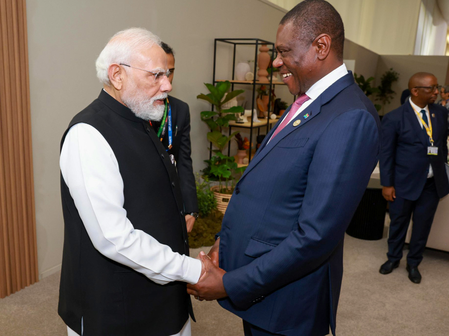
New Delhi, June 29 (IANS) The six-day working visit of South African Deputy President Paul Mashatile signalled that India is emerging as one of the key arenas where Africa will negotiate its economic future, strategic autonomy, and voice in a fragmenting world order, a report stated on Monday.
“In New Delhi, Mashatile and his counterparts explicitly framed their talks as part of a project to ‘advance the priorities of the Global South,’ from reforming multilateral lending rules to giving developing countries a greater say in global governance.
South Africa has already backed India’s efforts to secure full membership for the African Union in the G20, a symbolic but important step that was lauded by President Cyril Ramaphosa when he hosted India’s prime minister last year,” noted Abebe Bikila, Senior Research Fellow at the Global Trade and Economic Council (GTEC), while writing for the India Narrative.
Bilateral trade between India and South Africa reached 15-18 billion dollars in recent financial years, making South Africa India’s single-largest trading partner on the African continent, and India-Africa trade overall crossed the 100-billion-dollar mark in 2024-25, up from 56 billion dollars just five years earlier. India is also one of the top five investors on the continent.
“In this context, Mashatile’s meetings with Indian business associations and corporations, delivering a keynote at the Global Trade and Technology Council of India and engaging with technology and pharma firms in Hyderabad, were about more than bilateral deal-making.
They were a pitch to position South Africa as India’s ‘gateway into Africa’ under the African Continental Free Trade Area (AfCFTA), a role Pretoria has begun to highlight more assertively,” highlighted the report.
The India-South Africa Critical Minerals Symposium, held in March 2026 at the Future Africa campus of the University of Pretoria, brought together policymakers, geologists, and industry to explore cooperation on minerals such as manganese, chromium, rare earths, and platinum group metals. These metals are indispensable to electric vehicles, batteries and renewable energy technologies.
According to Bikila, South Africa and India underscored their interest in expanding collaboration in mining, including critical minerals, alongside traditional sectors like coal and gold during Mashatile’s visit.
“India, whose energy transition plans depend on secure supplies of such inputs, sees South Africa not only as a supplier but as a potential partner in processing and value-addition, and the two governments have floated ideas for joint ventures and technology exchanges in mining and beneficiation,” he highlighted.
According to Bikila, the timing of Mashatile’s trip was not accidental.
“Global economic disruptions, from wars that roil oil supply routes to tariff shifts that upend manufacturing plans, have made South-South partnerships more attractive as a hedge against dependencies on any single bloc.
As India’s junior foreign minister recently reminded a business audience, India-Africa trade now rivals its commerce with some advanced economies, and New Delhi is openly staking a claim to be one of the continent’s principal long-term partners,” noted Bikila.
–IANS
ksk/dan