

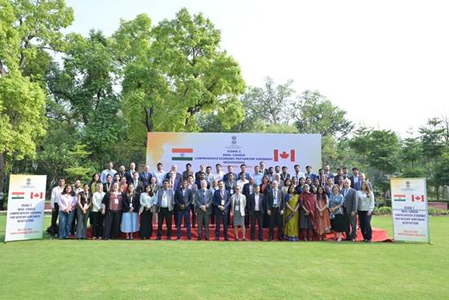
New Delhi, May 8 (IANS) India and Canada held detailed discussions across a wide range of chapters, including trade in goods, trade in services, intellectual property, rules of origin, sanitary and phytosanitary measures, and technical barriers to trade as part of the second round of negotiations for the proposed Comprehensive Economic Partnership Agreement (CEPA), according to a joint statement issued by the two countries on Friday.
The second round of talks hosted by the Commerce Ministry from May 4–8 at the Vanijya Bhawan here, concluded successfully on Friday, the statement said.
Both sides agreed to continue negotiations in a constructive and cooperative spirit and looked forward to the next round of discussions, scheduled to be held in July in Ottawa, with intersessional engagements to continue in the interim, it added.
The discussions were held in accordance with the Terms of Reference signed by the Trade Ministers of both countries on March 2. The negotiations witnessed constructive and productive engagement between the two sides. India and Canada reaffirmed their shared commitment to advancing a balanced, ambitious, and mutually beneficial agreement aimed at strengthening bilateral trade and economic ties, the statement said.
The five-day talks in New Delhi come ahead of Commerce and Industry Minister Piyush Goyal’s scheduled visit to Canada at the end of this month to accelerate the momentum of the economic engagement as the two countries target increasing bilateral trade to $50 billion by 2030.
“The attempt is to fast-track talks so that the agreement can be concluded by the year-end as decided by the Prime Ministers of the two countries earlier this year,” a senior official told IANS.
The first round of negotiations for the pact, officially called the India-Canada Comprehensive Economic Partnership Agreement (CEPA), took place in March this year following Canadian Prime Minister Mark Carney’s meeting with Prime Minister Narendra Modi here.
PM Carney’s visit to India set the tone for a marked improvement in diplomatic ties between the two countries that had hit rock bottom during his predecessor Justin Trudeau’s term. The Trudeau government was seen to be encouraging Sikh extremists to pursue an anti-India agenda in Canada.
PMs Modi and Carney set a year-end target to complete the negotiations for the CEPA between the two countries and agreed to deepen bilateral collaboration in the energy and critical mineral sectors during their meeting at New Delhi in March this year.
“The leaders expressed confidence that a comprehensive trade framework would serve as a durable economic anchor for the partnership and support the shared aspiration of expanding bilateral trade to CAD 70 billion/INR 4.65 lakh crore by 2030,” according to the joint statement issued after the summit between the two leaders.
India-Canada bilateral trade in goods stood at $8.66 billion in 2024-25, while India’s exports to the country touched $4.22 billion.
Major items of India’s exports to Canada include pharmaceutical products, machinery parts and mechanical appliances, iron & steel articles, electronic goods, organic chemicals, jewellery, gems & precious stones, garments and textiles, seafood, engineering goods and auto parts. India’s major imports from Canada include pulses, fertilisers, mineral fuels, wood pulp, gems & precious stones, aircraft parts, machinery parts, and iron & aluminium scrap.
India’s IT sector is the main contributor to services exports to Canada.
–IANS
sps/vd