

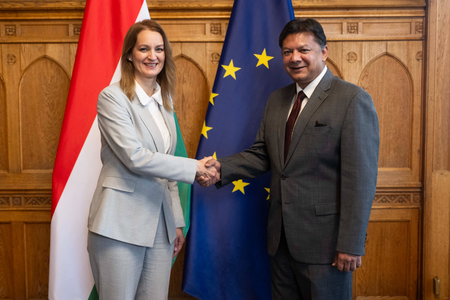
Budapest, June 23 (IANS) India’s Ambassador to Hungary on Tuesday held a meeting with the Speaker of the country’s National Assembly and discussed enhancing bilateral cooperation and parliamentary exchanges.
“Ambassador was honoured to call upon the Speaker of the National Assembly of Hungary, Agnes Forsthoffer. Discussed enhancing bilateral cooperation, parliamentary exchanges, and our deep shared faith in democracy and parliamentary functions. Pleased to share that an India-Hungary Parliamentary Friendship Group will be set up soon!” the Indian Embassy in Hungary wrote on X.
“A special connection: The Speaker’s roots in Balatonfured resonate deeply with us as we celebrate the ‘Year of Tagore,’ marking the centenary of Gurudev Rabindranath Tagore’s historic visit to the city,” the Embassy added.
In April, Prime Minister Narendra Modi congratulated Prime Minister of Hungary Peter Magyar and his Tisza Party on their decisive victory in Hungary’s parliamentary elections, marking a significant political shift in the European nation.
In a post on X, PM Modi wrote, “Heartiest congratulations to Mr. Peter Magyar and the Tisza Party on your resounding election victory. India and Hungary are bound by deep-rooted friendship, shared values and enduring mutual respect. I look forward to working closely with you to further strengthen our bilateral cooperation and to advance the vital India-EU Strategic Partnership for the shared prosperity and well-being of our peoples.”
The congratulatory message came after Hungary’s April 12 parliamentary elections delivered a landmark result, with Magyar Tisza Party securing a commanding majority in parliament. The outcome brings an end to the 16-year rule of Viktor Orban, whose Fidesz party conceded defeat after nearly all votes were counted.
Prime Minister Modi’s message underscores the longstanding ties between India and Hungary, which have remained stable despite political and economic transitions over the decades. The relationship has historically been described as “close and friendly”, built on shared values and mutual respect, even as Hungary reoriented its foreign policy in the post-Cold War era.
–IANS
ksk/as