

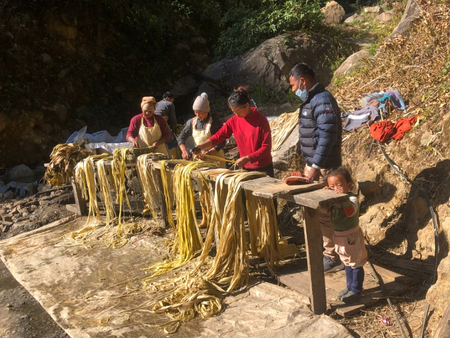
Kolkata, June 24 (IANS) Believe it or not, trees used as a raw material for Japanese banknotes are grown 5,200 km away in the slopes of Nepal.
Most of the Mitsumata (Oriental paperbush) used as a raw material for Japanese banknotes is cultivated in the mountainous regions of Nepal, it has been revealed by the Japan International Cooperation Agency (JICA).
“This has happened, thanks to efforts by Osaka-based company Kanpou Inc, which has spent many years teaching people in Nepal how to cultivate and process the plant. Approaching the 70th anniversary of diplomatic relations between Japan and Nepal, we look back at Kanpou’s efforts and JICA’s cooperation in the initiative,” the agency has said.
Mitsumata is a deciduous shrub whose name literally means “three-forked” in Japanese, referring to the way its branches split into three at the tips. Its fibres are extremely strong, so it has long been valued as a material for banknotes and traditional Japanese paper, or washi.
“Mitsumata grown in Nepal is of the highest quality in the world,” Kanpou President Matsubara Tadashi has said.
Mitsumata grown in Nepal is now an essential material for making Japan’s new banknotes. While its high quality is well recognized, the road to stable production was not easy.
Kanpou got involved in Mitsumata production in Nepal in 1990. One day, a staff member from the Ministry of Finance’s printing bureau said, “Fewer people are growing Mitsumata, and it’s becoming difficult to secure enough of it in Japan. Apparently, Mitsumata originates from the Himalayan region.”
This comment prompted Kanpou to turn its attention to cultivating Mitsumata in Nepal.
After several years of local research, the company found an area in the Jiri region where Mitsumata grew naturally across the mountain slopes, JICA has said.
Matsubara then taught the local population how to grow and process Mitsumata. He used videos instead of written materials, explaining things in a way that everyone could understand.
“Harvesting Mitsumata on mountain slopes, steaming it to soften it, carefully peeling off the outer bark, washing it with water and drying it — these processes required no special knowledge and are not physically demanding. Therefore everyone could fully take part in the work,” JICA said.
“Women living in mountain villages were able to work in their spare time between housework and childcare. By earning cash income, women who had long been in socially vulnerable positions gradually gained confidence,” it added.
The income from producing and processing Mitsumata also helped pay for children’s school fees and other such expenses, creating new educational opportunities.
In 2016, the project was selected for JICA’s “Support for Japanese Small and Medium-sized Enterprises Overseas Business Development” program.
After consulting the Japanese Embassy in Nepal, Kanpou was introduced to the JICA program.
The production areas grew significantly, and annual output increased from about 30 tons to around 100 tons, stably supporting Japan’s demand for banknote paper.
–IANS
jayanta/khz