

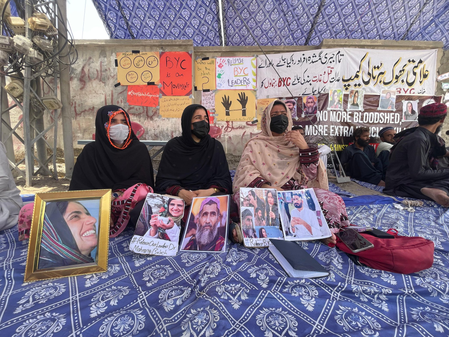
Brussels, Sep 19 (IANS) The recent case involving the enforced disappearance of Baloch student leader Jiand Baloch by Pakistani forces has once again exposed the vicious cycle of disappearances in Pakistan, where activists increasingly find themselves targeted for speaking out, organising students and demanding answers about those already missing, a report has stated.
Pakistan’s crisis of enforced disappearances goes far beyond the fate of missing persons. It strikes at the heart of accountability — testing whether security institutions are bound by law, whether courts can force transparency and whether families will ever learn the truth about their missing loved ones, according to a report in the European Times.
“The disappearance of Baloch student leader Jiand Baloch from his Quetta home in the early hours of July 24, 2026, followed a familiar script: a raid, a family left without answers and a man taken away without an explanation. Eleven days later, on August 3, he returned home. For Jiand, however, this was not an isolated episode. It was the third time he had disappeared,” the report detailed.
“His first disappearance came in November 2018, when he was taken along with his father and younger brother and remained missing for nine months. In July 2024, he disappeared again for about a month while campaigning around the Baloch Raaji Muchi, or Baloch National Gathering. His latest disappearance lasted 11 days,” it noted.
Citing Amnesty International, the report said Jiand was targeted for his peaceful activism and his prominent position as chairperson of the Baloch Students Organisation.
“The repetition is significant. A person can disappear once amid a security operation or an unresolved investigation. When the same activist disappears repeatedly, each time in the context of his public work, the episode becomes part of a wider question about the use of state power, due process and accountability in Pakistan,” European Times highlighted.
“Jiand’s case has once again placed Pakistan’s long-running enforced-disappearance crisis under scrutiny. It also illustrates why the issue remains unresolved despite the existence of a state commission, judicial interventions and years of international pressure,” it added.
The report cited a February 2025 communication by United Nations experts that flagged alleged arbitrary arrests, detention-related mistreatment, enforced disappearances and extrajudicial killings in Balochistan.
They expressed concerns over restrictions on activists, censorship and the use of counter-terrorism provisions against individuals exercising their rights to freedom of expression and peaceful assembly.
The UN experts subsequently raised alarm over amendments to Pakistan’s Anti-Terrorism Act and related provincial laws that permit preventive detention for up to 90 days on broad grounds of suspected links to terrorism, the European Times mentioned.
“They warned that such provisions could increase the risk of arbitrary detention, enforced disappearance and torture, particularly in cases involving political dissenters, human rights defenders, journalists, students and members of minority groups,” it noted.
–IANS
scor/ksk/as