

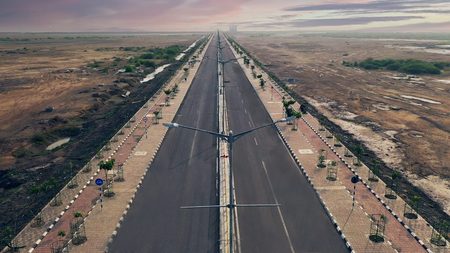
Ahmedabad, Nov 16 (IANS) A 200-bed multi-speciality hospital, an integrated school, hotels and other civic amenities are being developed in the Activation Area of Dholera Special Investment Region (DSIR) as Gujarat seeks to build a fully functional urban ecosystem alongside its emerging semiconductor manufacturing hub.
Chief Minister Bhupendra Patel reviewed the progress of industrial, social and urban infrastructure projects in Dholera on Monday, with a focus on facilities required to support businesses, investors, professionals and residents as industrial activity gathers pace.
The region is also expected to be a key focus area at the Vibrant Gujarat Global Summit (VGGS) 2027, with the state looking to attract investments in healthcare, hospitality, education, housing and commercial infrastructure.
Among the projects reviewed were a 200-bed multi-speciality hospital, an integrated school, a fire station, a hotel, a guest house, a food court, a tent city and residential and commercial developments.
The review also assessed progress since the Chief Minister’s previous visit. Several hospitality facilities are nearing completion. These include a 42-room guest house with suites and conference facilities, a food court with a capacity to serve around 600 people and a tent city comprising 50 tents.
The facilities are expected to become operational shortly and are intended to accommodate investors, business delegations and other visitors.
The projects are being developed against the backdrop of Tata Electronics’ semiconductor fabrication facility, a major investment expected to anchor Dholera’s industrial ecosystem.
The company is setting up a 12-inch (300 mm) semiconductor fabrication plant with an investment of around Rs 91,000 crore.
The facility is expected to manufacture chips for applications in automobiles, mobile devices and artificial intelligence.
The semiconductor project is also expected to attract ancillary industries, technology companies, research institutions and suppliers, creating demand for skilled workers and supporting services.
The Union government has notified a special economic zone for the project across 66.166 hectares, with an estimated employment potential of 21,000 people.
Healthcare and education are among the key components of the proposed township.
According to the Union government’s recent account of Dholera’s development, the 200-bed hospital is under construction, with completion targeted for December this year, while an International Baccalaureate (IB)-curriculum school is also being developed.
Alongside urban infrastructure, the region is also undertaking environmental initiatives. A plantation drive carried out in partnership with the Forest Department and Sadhbhavna Trust has resulted in around 1.11 lakh saplings being planted across 53 hectares in the Activation Area.
Drum plantation techniques have also been introduced to improve the survival of saplings and strengthen the area’s green cover. Connectivity is another major component of Dholera’s development.
The Ahmedabad-Dholera Expressway has improved road access to the region, while the international airport is targeted to become operational by the end of this year.
Rail connectivity plans include the 23-km Bhimnath-Dholera Logistics Hub rail link and the proposed 134-km Ahmedabad-Dholera semi-high-speed double railway line. The latter received Union Cabinet approval in May this year at an estimated cost of Rs 20,667 crore.
The projects are intended to strengthen links with Ahmedabad, the airport and the wider freight network.
With the state preparing for VGGS 2027, Dholera is expected to feature prominently in the state’s investment outreach.
Alongside advanced manufacturing and semiconductor industries, the government is looking to attract private investment in hospitals, hotels, educational institutions, residential projects, commercial spaces and other urban services.
The development strategy is aimed at making Dholera more than an industrial destination by creating facilities that can support a growing population of workers, professionals, investors and their families.
The parallel development of industrial, social, environmental and transport infrastructure is expected to play a key role in determining the region’s long-term growth as a planned industrial city.
–IANS
mys/dan