

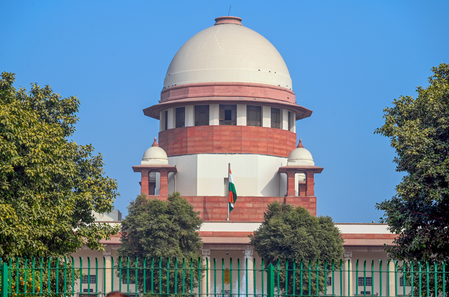
New Delhi, Oct 5 (IANS) The Supreme Court on Monday directed the Delhi Police and the Union Ministry of Home Affairs (MHA) to place their responses on record within four weeks in its suo motu proceedings concerning recent rape and sexual assault incidents in Delhi-NCR, orally observing that it was important to prevent crimes rather than taking follow-up action.
A Bench of Justices J.B. Pardiwala and K. Vinod Chandran stressed the need for effective preventive measures and continuous monitoring of vulnerable public spaces to ensure the safety of women and children.
The apex court orally remarked that merely putting measures on paper would not be sufficient and said that authorities must take concrete action to prevent crimes.
“We have to work together. We must ensure that every woman in Delhi-NCR should feel safe even at 11 p.m. whether travelling on the roads or the metro,” the Justice Pardiwala-led Bench observed.
It further said that the focus should be on preventing crime rather than merely acting after an offence has taken place.
“What is important is to prevent a crime, not what you do after a crime is committed,” the top court said, stressing that the police must create fear among “goons and anti-social elements” who are prone to committing such crimes.
The Supreme Court also questioned the Delhi Police on the effectiveness of CCTV surveillance in the absence of continuous monitoring and asked whether there was a mechanism for continuous monitoring of vulnerable areas.
It also questioned the absence of a dedicated “war room” for monitoring and responding to incidents, asking how crime could be prevented without such a mechanism.
“You have to create fear in the mind of a person who is ready to commit a crime,” the bench observed, adding that the police were required to instil the fear that committing such offences would have severe consequences.
The proceedings arise from the Supreme Court’s suo motu cognisance of a series of disturbing reports of rape and sexual assault across Delhi-NCR.
In its order passed on September 28, the apex court had expressed serious concern over the safety of public spaces, including parks, roads, buses, metro stations, subways and footbridges, observing that such places could not be allowed to become high-risk zones due to inadequate lighting, poor surveillance, or lax patrolling.
The bench had also sought a comprehensive status report on the safety arrangements in public places, the use of the National Database on Sexual Offenders (NDSO), the Investigation Tracking System for Sexual Offences (ITSSO), the Mission Shakti programme, emergency response systems, women’s helplines, CCTV coverage, women help desks and One Stop Centres.
It had directed the Delhi Police to constitute dedicated teams for each police district to identify vulnerable locations and prepare district-wise vulnerability maps. It had further ordered audits of lighting and CCTV infrastructure and intensified patrolling in identified vulnerable areas.
The proceedings came against the backdrop of several reported sexual offences, including the alleged gang rape of a 17-year-old girl at Aastha Kunj Park and the alleged sexual assault of a minor inside a moving sleeper bus travelling from Greater Noida to Delhi. The apex court had observed that the latter incident raised painful parallels with the 2012 Nirbhaya case.
The matter is now tentatively listed for further hearing on November 16.
–IANS
pds/vd