

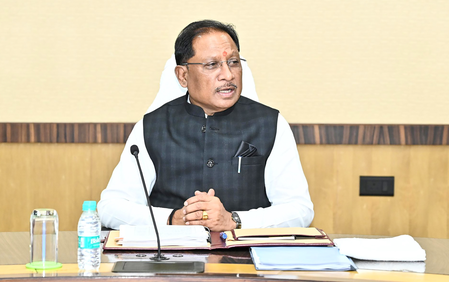
Raipur, April 23 (IANS) The Chhattisgarh government, led by Chief Minister Vishnu Deo Sai, has withdrawn its controversial order within just 24 hours of issuing it, marking a swift reversal that has stirred political debate in the state.
The directive issued late Wednesday had initially stated that no government officer or employee would be allowed to hold political posts or participate in political activities, and warned that disciplinary action would be taken against violators under the Civil Conduct Rules. However, the order quickly faced opposition, including objections raised by the Congress party, which questioned the timing and intent, reiterating rules that already exist across the country.
The Congress party pointed out that the Civil Services Conduct Rules are already in force nationwide and prohibit government employees from engaging in political activities. They argued that the issuance of a fresh circular raised new questions, particularly whether participation in events organised by the Rashtriya Swayamsevak Sangh would be considered a violation of these rules.
This demand for clarification added to the pressure on the government, which eventually decided to withdraw the order.
Under the Chhattisgarh Civil Services (Conduct) Rules, government employees are required to maintain absolute integrity and impartiality in the discharge of their duties. The rules explicitly forbid employees from becoming active members of political parties or organisations, and from engaging in activities that could compromise their neutrality.
The withdrawn circular had essentially repeated these provisions, but its sudden issuance was interpreted by critics as politically motivated. The reversal highlights the sensitivity of political directives in a state where governance and party politics often intersect.
By withdrawing the order, the Sai government has attempted to defuse tensions and avoid further controversy, though the episode has already sparked discussions about the role of government employees in political life and the boundaries of administrative neutrality.
The incident underscores how even established rules can become contentious when reissued in a politically charged environment.
While the government insists that the rules remain binding, the withdrawal of the circular reflects an effort to balance administrative discipline with political realities.
The debate is likely to continue, as opposition parties demand clarity on whether participation in certain organisations falls under the definition of political activity, a question that remains unresolved despite the government’s quick retreat.
–IANS
sktr/dpb