
GST reforms can further lower inflation, allow RBI to cut repo rate by another 25 bp this year
New Delhi, Sep 4 (IANS) The GST tax rate cuts can further lower inflation if companies pass on all benefits to the consumers, allowing the Reserve Bank of India (RBI) to cut repo rate once again by 25 bp in the fourth quarter this year, a report said on Thursday.
The GST tax rate cuts can lower headline CPI inflation by 1 percentage point.
"However, if the pass-through is only partial, the inflation fall could be closer to 0.5 ppt. We expect the RBI to cut rates once again by 25bp in 4Q25, taking the repo rate to 5.25 per cent," an HSBC report said.
On the consumption side, several essential items saw a rate cut (toothpaste, shampoo, small cars, air conditioners, and medicines).
On the production side, inputs in several sectors will face a lower tax burden (tractors in the agriculture sector, leather and marble in labour-intensive goods, cement in the construction sector, RE devices in the power sector, medical devices in the healthcare sector).
Some exemptions were added, and individual life and health insurance policies will be exempt from GST.
According to the report, the government's loss is the consumer's gain.
Over a year, led by stronger consumption, GDP growth can rise by 0.2 ppt. But for this to transpire, the government should not run a tighter fiscal policy to offset the consumption boost, it said.
"It is also important to put the GST cuts in a broader context. If we add on the benefits from the income tax cut earlier this year (0.3 per cent of GDP) and a lower debt servicing burden due to repo rate cuts (0.17 per cent of GDP), the overall boost to consumption can be 0.6 per cent of GDP," the report said.
“Of course, a part of this could be saved instead of spent, lowering the net boost," it added.
The GST rate rationalisation was not limited to lower and lesser tax rates.
"Some of the inverted duty problem was corrected for the textiles and fertiliser sectors. Plans were laid out for easier GST registration, pre-filled returns, and quicker refunds. If these improvements are indeed made, it will improve the ease-of-doing-business environment," the HSBC report noted.
--IANS
na/vd
GST reforms can further lower inflation, allow RBI to cut repo rate by another 25 bp this year
New Delhi, Sep 4 (IANS) The GST tax rate cuts can further lower inflation if companies pass on all benefits to the consumers, allowing the Reserve Bank of India (RBI) to cut repo rate once again by 25 bp in the fourth quarter this year, a report said on Thursday.
The GST tax rate cuts can lower headline CPI inflation by 1 percentage point.
"However, if the pass-through is only partial, the inflation fall could be closer to 0.5 ppt. We expect the RBI to cut rates once again by 25bp in 4Q25, taking the repo rate to 5.25 per cent," an HSBC report said.
On the consumption side, several essential items saw a rate cut (toothpaste, shampoo, small cars, air conditioners, and medicines).
On the production side, inputs in several sectors will face a lower tax burden (tractors in the agriculture sector, leather and marble in labour-intensive goods, cement in the construction sector, RE devices in the power sector, medical devices in the healthcare sector).
Some exemptions were added, and individual life and health insurance policies will be exempt from GST.
According to the report, the government's loss is the consumer's gain.
Over a year, led by stronger consumption, GDP growth can rise by 0.2 ppt. But for this to transpire, the government should not run a tighter fiscal policy to offset the consumption boost, it said.
"It is also important to put the GST cuts in a broader context. If we add on the benefits from the income tax cut earlier this year (0.3 per cent of GDP) and a lower debt servicing burden due to repo rate cuts (0.17 per cent of GDP), the overall boost to consumption can be 0.6 per cent of GDP," the report said.
“Of course, a part of this could be saved instead of spent, lowering the net boost," it added.
The GST rate rationalisation was not limited to lower and lesser tax rates.
"Some of the inverted duty problem was corrected for the textiles and fertiliser sectors. Plans were laid out for easier GST registration, pre-filled returns, and quicker refunds. If these improvements are indeed made, it will improve the ease-of-doing-business environment," the HSBC report noted.
--IANS
na/vd
Amidst global turbulence, partnership with India rooted in deep reservoir of trust: Singapore PM
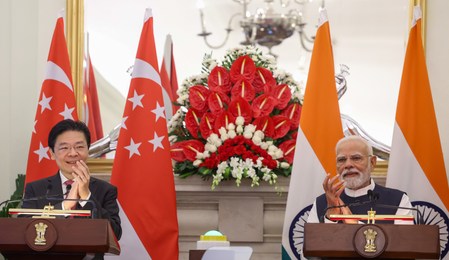
New Delhi, Sep 4 (IANS) Stressing that partnership between India and Singapore is rooted in shared values, mutual respect and deep reservoir of trust, Singapore Prime Minister Lawrence Wong on Thursday said that the partnership between two nations is more important in a world marked by great uncertainty and turbulence.
While addressing joint press meet along with Prime Minister Narendra Modi following their talks at the Hyderabad House in New Delhi, Wong stated that Singapore will continue to support India's skill development journey. The Singapore PM said that he and PM Modi have agreed to enhance people-to-people exchanges, including through closer civil service cooperation.
"Prime Minister Modi and I reaffirmed that people-to-people ties remain the bedrock of our relationship. We agreed to enhance exchanges including through closer civil service cooperation. All of these initiatives reflect the breath and depth of our CSP. And to guide our efforts, PM Modi and I have also agreed on a roadmap, an ambitious and detailed roadmap, to chart the next phase of our relationship.
"In a world marked by great uncertainty and turbulence, the partnership between India and Singapore becomes even more important because this is a partnership rooted in shared values, mutual respect and a deep reservoir of trust. We can draw strength from our shared history and the friendship and trust between our peoples and together we can strengthen resilience, seize new opportunities and contribute to stability and growth in our region and beyond. So, I look forward to working hand-in-hand with Prime Minister Modi to bring the Singapore India partnership to even greater heights in the years ahead," he added.
Stating that the bilateral relationship between India and Singapore has "grown in tandem", he mentioned as an investor, Singapore accounts for around a quarter of India's foreign direct investment inflows and cooperation now spans various sectors.
Lauding the leadership of PM Modi, Lawrence Wong stated, "Over this past decade, India has made remarkable advances under Prime Minister Modi's leadership. India is now the fourth largest economy in the world with a dynamism and influence felt far beyond its borders."
Speaking about his discussions with PM Modi, Singapore PM said, "Last year, PM Modi and I agreed to elevate relations to a Comprehensive Strategic Partnership or a CSP. This morning, we had fruitful discussions on how we can take this CSP forward. Prime Minister has highlighted quite a number of areas and I will reiterate a few of them. Singapore will continue to support India's skill development journey. We are honored to accept India's invitation to be a global partner for the national center of excellence in Chennai which will focus on advanced manufacturing. We will also collaborate with India to set up state level skill centers to meet industry needs in sectors like aviation maintenance repair and overhaul and semiconductors."
He announced that India and Singapore will expand cooperation in manufacturing and industrial development and deepen collaboration in semiconductors. He stated that two nations will strengthen connectivity across the air, sea and digital sectors. He stated that two nations will also enhance digital connectivity between financial systems.
"We will strengthen connectivity across the air, sea, and digital domains. This morning, we exchanged an MoU on cooperation in training, research, and development in civil aviation. This will support the growth of our aviation sectors, facilitate trade and tourism, and create more commercial opportunities. On the maritime side, we just launched phase two of PSA's Bharat Mumbai container terminal in Navi Mumbai, which will become India's largest standalone container terminal," said Wong.
"We will expand cooperation in frontier areas like space. To date, more than 20 Singapore made satellites have been launched by India. Through the MoU on promoting collaboration in the space sector, we will broaden this partnership and push the boundaries of what we can achieve together," the Singapore PM added.
--IANS
akl/as
Amidst global turbulence, partnership with India rooted in deep reservoir of trust: Singapore PM
New Delhi, Sep 4 (IANS) Stressing that partnership between India and Singapore is rooted in shared values, mutual respect and deep reservoir of trust, Singapore Prime Minister Lawrence Wong on Thursday said that the partnership between two nations is more important in a world marked by great uncertainty and turbulence.
While addressing joint press meet along with Prime Minister Narendra Modi following their talks at the Hyderabad House in New Delhi, Wong stated that Singapore will continue to support India's skill development journey. The Singapore PM said that he and PM Modi have agreed to enhance people-to-people exchanges, including through closer civil service cooperation.
"Prime Minister Modi and I reaffirmed that people-to-people ties remain the bedrock of our relationship. We agreed to enhance exchanges including through closer civil service cooperation. All of these initiatives reflect the breath and depth of our CSP. And to guide our efforts, PM Modi and I have also agreed on a roadmap, an ambitious and detailed roadmap, to chart the next phase of our relationship.
"In a world marked by great uncertainty and turbulence, the partnership between India and Singapore becomes even more important because this is a partnership rooted in shared values, mutual respect and a deep reservoir of trust. We can draw strength from our shared history and the friendship and trust between our peoples and together we can strengthen resilience, seize new opportunities and contribute to stability and growth in our region and beyond. So, I look forward to working hand-in-hand with Prime Minister Modi to bring the Singapore India partnership to even greater heights in the years ahead," he added.
Stating that the bilateral relationship between India and Singapore has "grown in tandem", he mentioned as an investor, Singapore accounts for around a quarter of India's foreign direct investment inflows and cooperation now spans various sectors.
Lauding the leadership of PM Modi, Lawrence Wong stated, "Over this past decade, India has made remarkable advances under Prime Minister Modi's leadership. India is now the fourth largest economy in the world with a dynamism and influence felt far beyond its borders."
Speaking about his discussions with PM Modi, Singapore PM said, "Last year, PM Modi and I agreed to elevate relations to a Comprehensive Strategic Partnership or a CSP. This morning, we had fruitful discussions on how we can take this CSP forward. Prime Minister has highlighted quite a number of areas and I will reiterate a few of them. Singapore will continue to support India's skill development journey. We are honored to accept India's invitation to be a global partner for the national center of excellence in Chennai which will focus on advanced manufacturing. We will also collaborate with India to set up state level skill centers to meet industry needs in sectors like aviation maintenance repair and overhaul and semiconductors."
He announced that India and Singapore will expand cooperation in manufacturing and industrial development and deepen collaboration in semiconductors. He stated that two nations will strengthen connectivity across the air, sea and digital sectors. He stated that two nations will also enhance digital connectivity between financial systems.
"We will strengthen connectivity across the air, sea, and digital domains. This morning, we exchanged an MoU on cooperation in training, research, and development in civil aviation. This will support the growth of our aviation sectors, facilitate trade and tourism, and create more commercial opportunities. On the maritime side, we just launched phase two of PSA's Bharat Mumbai container terminal in Navi Mumbai, which will become India's largest standalone container terminal," said Wong.
"We will expand cooperation in frontier areas like space. To date, more than 20 Singapore made satellites have been launched by India. Through the MoU on promoting collaboration in the space sector, we will broaden this partnership and push the boundaries of what we can achieve together," the Singapore PM added.
--IANS
akl/as
Amidst global turbulence, partnership with India rooted in deep reservoir of trust: Singapore PM
New Delhi, Sep 4 (IANS) Stressing that partnership between India and Singapore is rooted in shared values, mutual respect and deep reservoir of trust, Singapore Prime Minister Lawrence Wong on Thursday said that the partnership between two nations is more important in a world marked by great uncertainty and turbulence.
While addressing joint press meet along with Prime Minister Narendra Modi following their talks at the Hyderabad House in New Delhi, Wong stated that Singapore will continue to support India's skill development journey. The Singapore PM said that he and PM Modi have agreed to enhance people-to-people exchanges, including through closer civil service cooperation.
"Prime Minister Modi and I reaffirmed that people-to-people ties remain the bedrock of our relationship. We agreed to enhance exchanges including through closer civil service cooperation. All of these initiatives reflect the breath and depth of our CSP. And to guide our efforts, PM Modi and I have also agreed on a roadmap, an ambitious and detailed roadmap, to chart the next phase of our relationship.
"In a world marked by great uncertainty and turbulence, the partnership between India and Singapore becomes even more important because this is a partnership rooted in shared values, mutual respect and a deep reservoir of trust. We can draw strength from our shared history and the friendship and trust between our peoples and together we can strengthen resilience, seize new opportunities and contribute to stability and growth in our region and beyond. So, I look forward to working hand-in-hand with Prime Minister Modi to bring the Singapore India partnership to even greater heights in the years ahead," he added.
Stating that the bilateral relationship between India and Singapore has "grown in tandem", he mentioned as an investor, Singapore accounts for around a quarter of India's foreign direct investment inflows and cooperation now spans various sectors.
Lauding the leadership of PM Modi, Lawrence Wong stated, "Over this past decade, India has made remarkable advances under Prime Minister Modi's leadership. India is now the fourth largest economy in the world with a dynamism and influence felt far beyond its borders."
Speaking about his discussions with PM Modi, Singapore PM said, "Last year, PM Modi and I agreed to elevate relations to a Comprehensive Strategic Partnership or a CSP. This morning, we had fruitful discussions on how we can take this CSP forward. Prime Minister has highlighted quite a number of areas and I will reiterate a few of them. Singapore will continue to support India's skill development journey. We are honored to accept India's invitation to be a global partner for the national center of excellence in Chennai which will focus on advanced manufacturing. We will also collaborate with India to set up state level skill centers to meet industry needs in sectors like aviation maintenance repair and overhaul and semiconductors."
He announced that India and Singapore will expand cooperation in manufacturing and industrial development and deepen collaboration in semiconductors. He stated that two nations will strengthen connectivity across the air, sea and digital sectors. He stated that two nations will also enhance digital connectivity between financial systems.
"We will strengthen connectivity across the air, sea, and digital domains. This morning, we exchanged an MoU on cooperation in training, research, and development in civil aviation. This will support the growth of our aviation sectors, facilitate trade and tourism, and create more commercial opportunities. On the maritime side, we just launched phase two of PSA's Bharat Mumbai container terminal in Navi Mumbai, which will become India's largest standalone container terminal," said Wong.
"We will expand cooperation in frontier areas like space. To date, more than 20 Singapore made satellites have been launched by India. Through the MoU on promoting collaboration in the space sector, we will broaden this partnership and push the boundaries of what we can achieve together," the Singapore PM added.
--IANS
akl/as
Indian startups accelerate ‘Aatmanirbhar Chips’ roadmap under DLI Scheme
New Delhi, Sep 4 (IANS) Backed by the government's Design Linked Incentive (DLI) Scheme, domestic chip design and IPR are accelerating across critical sectors, from surveillance and energy metering to networking and motor control, the Ministry of Electronics and IT said on Thursday.
According to the ministry, to date, 23 chip design projects have been sanctioned under the DLI Scheme, with 72 companies gaining access to industry-grade Electronic Design Automation (EDA) tools.
Many of these startups showcased their roadmaps at Semicon India 2025, reflecting India's growing capability and self-reliance in semiconductor chip design.
InCore Semiconductors, founded by the creators of the SHAKTI Processors - the first open-source RISC-V processor in India - has launched an innovative System-on-Chip (SoC) Generator Platform that reduces frontend chip design time from months to just a few minutes.
This automation accelerates development timelines, lowers costs, and minimises design risks, enabling faster innovation cycles for their customers.
A test chip taped out on TSMC’s 40nm process node showcases six heterogeneous RISC-V cores from InCore’s IP portfolio, a custom Network-on-Chip (NoC) with automatic protocol bridging, multiple automatically integrated peripherals, and a fully deployed software stack including a Real Time Operating System (RTOS), underscoring the platform’s robustness, the ministry added.
Aheesa Digital Innovations will make available its SoC along with reference platforms to Original Equipment Manufacturers (OEMs) and Original Design Manufacturers (ODMs) in the first quarter of 2026, enabling them to develop custom networking and broadband solutions using a 100 per cent indigenously designed, Made-in-India SoC.
Four Indian companies, 3rdiTech, Netrasemi, BigEndian Semiconductors, and Mindgrove Technologies, are designing indigenous SoC solutions for critical applications such as surveillance and CCTV cameras, the Ministry added.
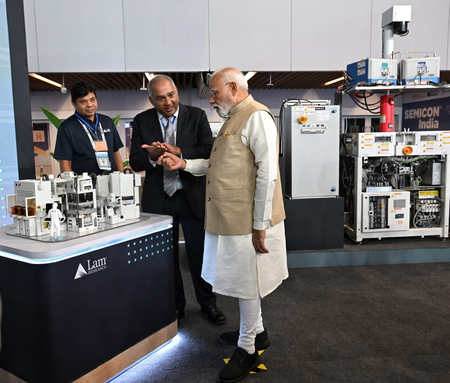
On Day 2 of Semicon India 2025, held at Yashobhoomi in New Delhi, Prime Minister Narendra Modi visited the exhibition stalls.
He was accompanied by Electronics and Information Technology Minister Ashwini Vaishnaw and Minister of State for Electronics and Information Technology Jitin Prasada.
During his visit, the Prime Minister underscored the pivotal role of startups in propelling India’s semiconductor ambitions and the importance of Indian Intellectual Property(IP) creation.
--IANS
aps/vd
Indian startups accelerate ‘Aatmanirbhar Chips’ roadmap under DLI Scheme
New Delhi, Sep 4 (IANS) Backed by the government's Design Linked Incentive (DLI) Scheme, domestic chip design and IPR are accelerating across critical sectors, from surveillance and energy metering to networking and motor control, the Ministry of Electronics and IT said on Thursday.
According to the ministry, to date, 23 chip design projects have been sanctioned under the DLI Scheme, with 72 companies gaining access to industry-grade Electronic Design Automation (EDA) tools.
Many of these startups showcased their roadmaps at Semicon India 2025, reflecting India's growing capability and self-reliance in semiconductor chip design.
InCore Semiconductors, founded by the creators of the SHAKTI Processors - the first open-source RISC-V processor in India - has launched an innovative System-on-Chip (SoC) Generator Platform that reduces frontend chip design time from months to just a few minutes.
This automation accelerates development timelines, lowers costs, and minimises design risks, enabling faster innovation cycles for their customers.
A test chip taped out on TSMC’s 40nm process node showcases six heterogeneous RISC-V cores from InCore’s IP portfolio, a custom Network-on-Chip (NoC) with automatic protocol bridging, multiple automatically integrated peripherals, and a fully deployed software stack including a Real Time Operating System (RTOS), underscoring the platform’s robustness, the ministry added.
Aheesa Digital Innovations will make available its SoC along with reference platforms to Original Equipment Manufacturers (OEMs) and Original Design Manufacturers (ODMs) in the first quarter of 2026, enabling them to develop custom networking and broadband solutions using a 100 per cent indigenously designed, Made-in-India SoC.
Four Indian companies, 3rdiTech, Netrasemi, BigEndian Semiconductors, and Mindgrove Technologies, are designing indigenous SoC solutions for critical applications such as surveillance and CCTV cameras, the Ministry added.
On Day 2 of Semicon India 2025, held at Yashobhoomi in New Delhi, Prime Minister Narendra Modi visited the exhibition stalls.
He was accompanied by Electronics and Information Technology Minister Ashwini Vaishnaw and Minister of State for Electronics and Information Technology Jitin Prasada.
During his visit, the Prime Minister underscored the pivotal role of startups in propelling India’s semiconductor ambitions and the importance of Indian Intellectual Property(IP) creation.
--IANS
aps/vd
Indian startups accelerate ‘Aatmanirbhar Chips’ roadmap under DLI Scheme
New Delhi, Sep 4 (IANS) Backed by the government's Design Linked Incentive (DLI) Scheme, domestic chip design and IPR are accelerating across critical sectors, from surveillance and energy metering to networking and motor control, the Ministry of Electronics and IT said on Thursday.
According to the ministry, to date, 23 chip design projects have been sanctioned under the DLI Scheme, with 72 companies gaining access to industry-grade Electronic Design Automation (EDA) tools.
Many of these startups showcased their roadmaps at Semicon India 2025, reflecting India's growing capability and self-reliance in semiconductor chip design.
InCore Semiconductors, founded by the creators of the SHAKTI Processors - the first open-source RISC-V processor in India - has launched an innovative System-on-Chip (SoC) Generator Platform that reduces frontend chip design time from months to just a few minutes.
This automation accelerates development timelines, lowers costs, and minimises design risks, enabling faster innovation cycles for their customers.
A test chip taped out on TSMC’s 40nm process node showcases six heterogeneous RISC-V cores from InCore’s IP portfolio, a custom Network-on-Chip (NoC) with automatic protocol bridging, multiple automatically integrated peripherals, and a fully deployed software stack including a Real Time Operating System (RTOS), underscoring the platform’s robustness, the ministry added.
Aheesa Digital Innovations will make available its SoC along with reference platforms to Original Equipment Manufacturers (OEMs) and Original Design Manufacturers (ODMs) in the first quarter of 2026, enabling them to develop custom networking and broadband solutions using a 100 per cent indigenously designed, Made-in-India SoC.
Four Indian companies, 3rdiTech, Netrasemi, BigEndian Semiconductors, and Mindgrove Technologies, are designing indigenous SoC solutions for critical applications such as surveillance and CCTV cameras, the Ministry added.
On Day 2 of Semicon India 2025, held at Yashobhoomi in New Delhi, Prime Minister Narendra Modi visited the exhibition stalls.
He was accompanied by Electronics and Information Technology Minister Ashwini Vaishnaw and Minister of State for Electronics and Information Technology Jitin Prasada.
During his visit, the Prime Minister underscored the pivotal role of startups in propelling India’s semiconductor ambitions and the importance of Indian Intellectual Property(IP) creation.
--IANS
aps/vd
Gujarat records over 92 pc rainfall; 113 dams on high alert
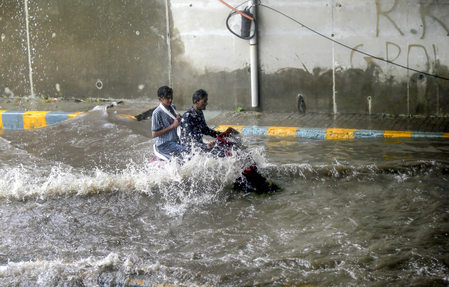
Gandhinagar, Sep 4 (IANS) Gujarat has received widespread rainfall this monsoon, with an average of 92.64 per cent recorded across the state till Thursday, according to the State Emergency Operation Centre (SEOC).
North Gujarat has reported the highest rainfall at 96.94 per cent, followed by South Gujarat (96.91 per cent), East-Central Gujarat (93.79 per cent), Kutch (85.14 per cent) and Saurashtra (84.74 per cent). The heavy and uniform rainfall has significantly filled up reservoirs.
Out of 206 dams in the state, 113 are on high alert, with 82 filled to 100 per cent capacity and 68 between 70-100 per cent.
The Sardar Sarovar Dam, considered Gujarat’s lifeline, currently holds more than 89 per cent of its total storage capacity. The abundant rainfall has also benefited agriculture. By September 1, a total of 96.29 per cent of the cultivable area had been sown under kharif crops. Groundnut tops the list with 22 lakh hectares under cultivation, followed by cotton on 20 lakh hectares and paddy on over eight lakh hectares, according to the state agriculture department. In the last 24 hours, 24 districts and 158 talukas reported more than 12 mm of rainfall.
Meanwhile, the IMD has advised fishermen not to venture into the sea between September 4 and 7 due to rough weather conditions.
The impact of this year’s rainfall on farming in Gujarat has been twofold -- largely beneficial for crop prospects but also challenging in certain pockets. With the state receiving over 92 per cent of its seasonal average rainfall, it ensures ample irrigation water for kharif crops like cotton, groundnut, paddy, pulses, and bajra.
Farmers in Saurashtra and North Gujarat, where groundnut and cotton dominate, have particularly benefited as timely and sufficient rains boosted sowing and improved crop growth. The assured water supply is also expected to support a strong rabi season, especially for wheat, cumin, and mustard.
The state’s extensive dam network -- over 200 major and medium reservoirs, with 113 placed on high alert this season -- plays a crucial role in flood control, irrigation, and water storage, ensuring both drinking water and agricultural supply for the year.
Urban centres like Ahmedabad, Surat, and Vadodara have invested in stormwater drainage projects, riverfront development, and flood-control mechanisms, which help reduce the impact of heavy downpours. Rural areas benefit from thousands of check dams, farm ponds, and watershed structures that recharge groundwater and prevent drought conditions later.
--IANS
janvi/dpb